No Online Booking on Your HVAC Website? Here's What It Costs
HVAC companies miss 27% of calls and lose $45K-$120K yearly. Online booking captures leads 24/7 — even when no one's answering the phone.
It’s 10:47 PM on a Saturday in July. A homeowner’s AC just died. She grabs her phone, Googles “AC repair near me,” and taps the first result. The site loads — eventually. She looks for a way to book service. There’s a phone number. She calls. No answer. Voicemail. She hangs up and taps the next result. That company has a “Book Now” button. She enters her address, picks a time slot, and gets an instant confirmation. By the time your office opens Monday morning, that $600 emergency call belongs to someone else.
This plays out thousands of times a day across the HVAC industry. And the companies without online booking never even know they lost the lead.
HVAC Companies Miss 27% of Incoming Calls
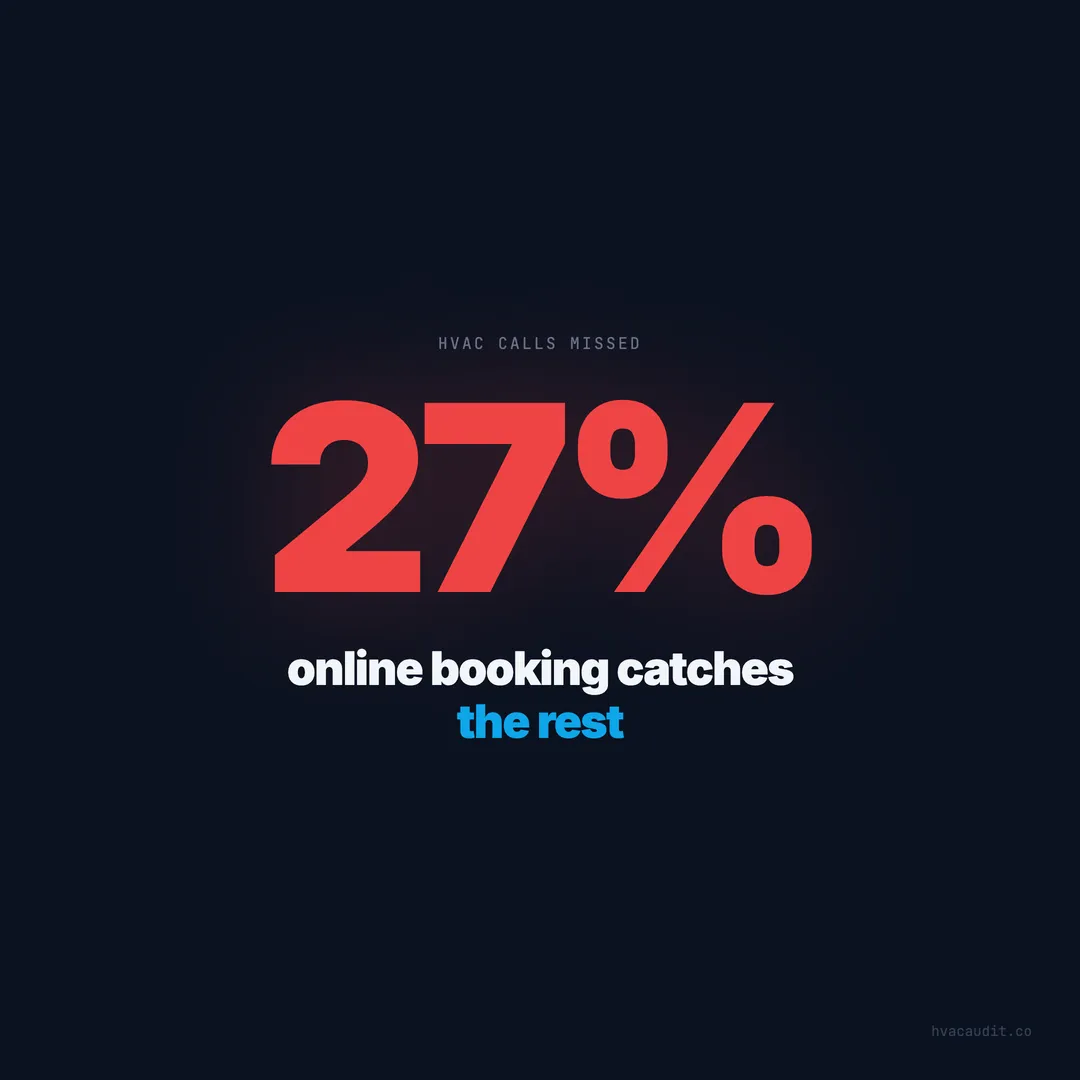
The data on this is brutal. Across 1,200+ contractor businesses — plumbing, HVAC, electrical — 27% of inbound calls go unanswered. Not declined. Not busy. Just… ringing into nothing.
For the average HVAC company, that translates to $45,000 to $120,000 in lost revenue every year. Each missed call costs roughly $180 in potential revenue. Emergency calls — the ones worth $500 to $800 — are even more painful to lose.
When we audited 147 HVAC websites, we found that most companies rely entirely on phone calls as their booking method. No form. No chat. No scheduling widget. Just a phone number and a prayer that someone picks up.
The problem isn’t that HVAC owners don’t care. The problem is that they’re on a roof, under a house, or driving between jobs when those calls come in. The phone rings, nobody answers, and 78% of those callers immediately call a competitor.
After-Hours Calls Are the Most Expensive Ones to Lose
Here’s what makes the missed-call problem worse: the highest-value calls come at the worst times.
31% of emergency HVAC calls happen after business hours. Evenings. Weekends. Holidays. The exact times when nobody’s in the office to pick up. And these aren’t $99 tune-up calls — after-hours emergency calls average $450 per job.
The callback delay is the killer. When a homeowner calls and gets voicemail, the average time to return that call is 4.2 hours. By then, 67% have already booked with a competitor. They’re not waiting around. Their house is 88 degrees. They need someone now.
Every HVAC owner we talk to says the same thing: “We call everyone back.” But calling back isn’t the same as answering when it matters. A homeowner at midnight with a dead AC doesn’t need a callback at 8 AM. They need a way to book service right now.
94% of Customers Book When Online Scheduling Is Available
This isn’t a “nice to have” anymore. A 2025 Housecall Pro survey of U.S. homeowners found that 94% of customers are more likely to book a service when online scheduling is available. Not slightly more likely. Overwhelmingly more likely.
And it makes sense. People book restaurant reservations online. They book doctor appointments online. They book haircuts, car service, and even vet visits online. But most HVAC companies still expect customers to pick up the phone during business hours and hope someone answers.
Meanwhile, 69% of consumers across all industries now prefer self-service options over calling. That preference is even stronger in younger homeowners — the exact demographic entering the home-buying market right now.
The HVAC companies that offer online booking aren’t just adding convenience. They’re capturing an entirely different pool of leads — the ones who never would have called in the first place.
Phone Calls Still Convert Better — And That’s Exactly the Point
Let’s be honest about something: phone calls are still the highest-converting channel. Phone leads convert at 37% during the call. They generate 10-15x more revenue than web form submissions. When someone calls, they’re ready to buy.
But here’s the trap HVAC owners fall into: because phone calls convert so well, they assume the phone is enough. It’s not. The phone is the best channel — for the people who actually get through. The 27% who don’t? They’re gone.
Online booking doesn’t replace the phone. It catches the overflow. The after-hours calls. The Saturday morning “I’ll just book it online real quick” crowd. The introvert who would rather click a button than make a phone call.
Think of it this way: if your phone converts at 37%, and your website converts at 2-3% through a basic contact form, an online booking widget typically converts at 8-12% because it removes friction. The customer picks a date, picks a time, enters their info, and they’re done. No waiting on hold. No playing phone tag. No “let me check our schedule and call you back.”
Online Booking Captures Revenue While You Sleep
The math is straightforward. If your company misses 27% of calls and loses $45K-$120K annually from those missed calls, an online booking option that captures even half of those lost leads pays for itself many times over.
Here’s what happens when an HVAC company adds online booking:
The after-hours problem disappears. A homeowner at 11 PM with a failing AC can book a morning slot without calling anyone. AI-powered scheduling tools show 40-70% higher appointment booking rates compared to traditional phone-only operations. That’s not a marginal improvement — that’s transformational.
Peak season overflow gets captured. During July and August, your phones are already slammed. Online booking absorbs the excess without requiring more office staff. The homeowner who couldn’t get through during your busiest hours books online instead of calling your competitor.
No-shows drop. Automated confirmations and reminders — which most booking tools include — reduce no-shows significantly. That’s revenue you’ve already scheduled but would have lost to forgotten appointments.
What Effective HVAC Online Booking Actually Looks Like
Not all online booking is created equal. A “contact us” form is not online booking. A generic Calendly link is not online booking. Effective HVAC booking has specific requirements.
Service type selection. The customer picks what they need — repair, maintenance, installation, emergency — before they see available times. This lets your team prepare and allocate the right technician.
Real-time availability. The calendar shows actual open slots, not a “request a time and we’ll call to confirm” runaround. If Tuesday at 10 AM is open, the customer books it and gets confirmation immediately.
Mobile-first design. More than half of HVAC searches happen on phones. If the booking flow requires pinching, scrolling sideways, or switching between tabs, homeowners abandon it. The button needs to be big, the form needs to be short, and the confirmation needs to be instant.
Emergency flagging. The booking form should let customers mark a request as urgent. This triggers a different workflow — faster response, priority scheduling, possibly a callback within minutes instead of waiting for the next available slot.
When we audit HVAC websites, we see companies scoring 34 out of 100 with no booking option at all. Their competitor across town scores 91 — with a prominent “Book Now” button that works at 2 AM. The gap isn’t about design taste. It’s about revenue capture.
The Companies Already Offering This Are Pulling Ahead
HVAC scheduling inefficiency — missed emergency calls, double bookings, idle technicians, delayed responses — costs the average company $80,000 to $150,000 per year. During peak season, those losses can hit $300,000.
The companies that have added online booking aren’t just capturing more leads. They’re running smoother operations. The booking widget pre-qualifies the job. The calendar auto-assigns the right technician. The confirmation email sets expectations before the truck rolls.
And here’s the competitive edge that’s hard to claw back once someone else has it: a homeowner who books online at 11 PM and gets an instant confirmation has already chosen you. By the time your competitor’s office opens at 8 AM, that homeowner isn’t shopping anymore. They’re waiting for your technician.
The speed-to-lead data backs this up. The first company to respond wins the job in the vast majority of cases. Online booking makes your response time zero — because the customer books themselves.
We’ve audited 147 HVAC websites. The top 5% share common traits: fast load times, clear CTAs, prominent reviews, and — increasingly — an online booking option that works on mobile at any hour. The other 95% are still hoping someone picks up the phone.
If your website loads in 18.4 seconds and the only way to book is calling a number that goes to voicemail after 5 PM, you’re not losing leads to better marketing. You’re losing them to better infrastructure.
The fix isn’t complicated. But every week without it is another week those leads go to the company that made it easy to book.
Online booking is one of the biggest conversion gaps on HVAC websites that look professional but aren’t converting. See the full diagnostic.
Keep reading
Want to know your score?
Drop your URL — full report in 48 hours.
We're on it.
Report in your inbox within 48 hours.