After-Hours HVAC Calls Are Worth 3x — You Send Them to VM
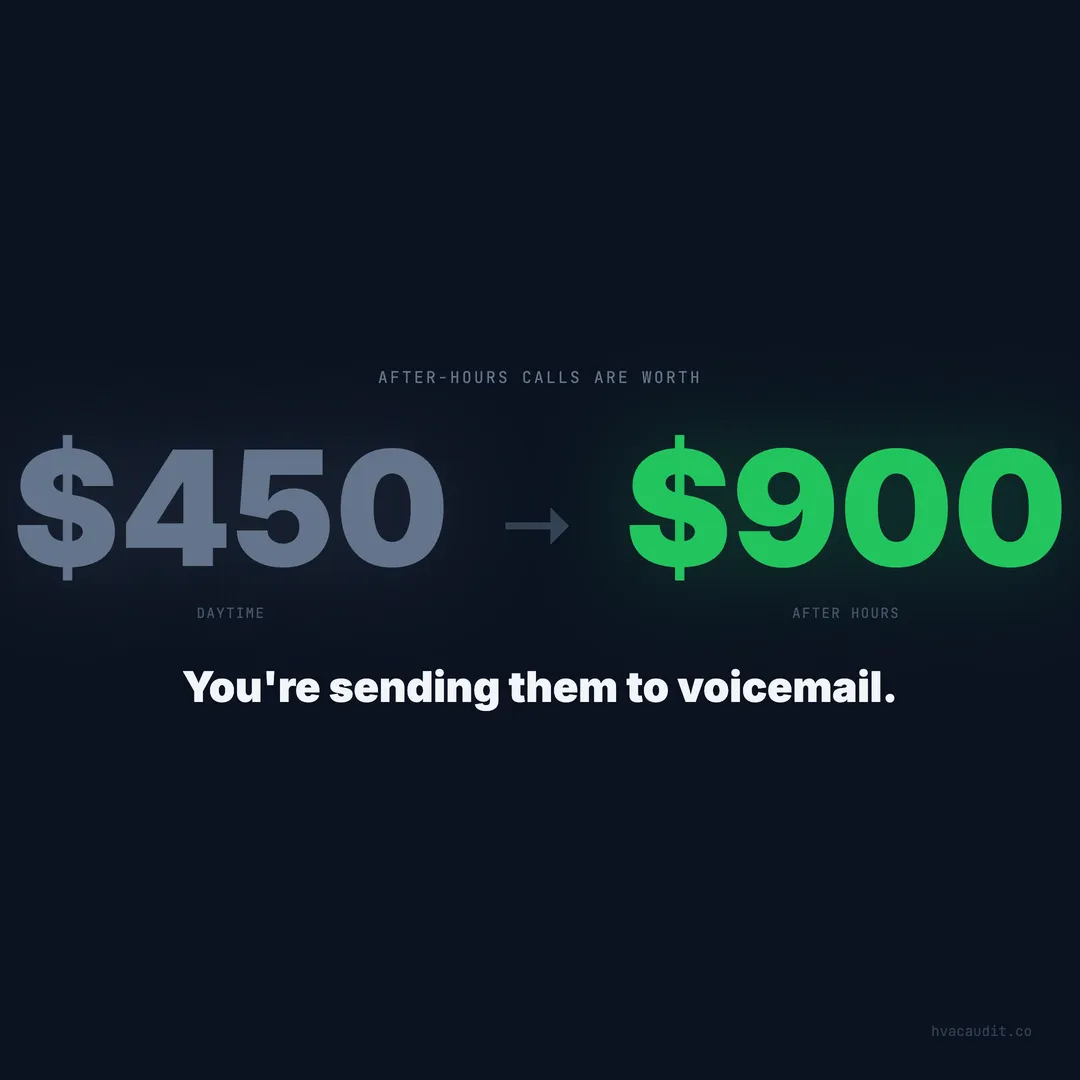
Emergency calls after 5 PM close at higher rates, command premium pricing, and convert into lifetime customers. But most HVAC companies send them straight to voicemail. Here's what that costs.
A homeowner’s furnace dies at 8 PM on a Saturday in January. The house is 52 degrees and dropping. She has two kids. She Googles “emergency heating repair” and starts calling.
First company: voicemail. “Our office hours are Monday through Friday, 8 AM to 5 PM. Please leave a message.”
Second company: voicemail. Same thing.
Third company: a live person answers. “We can have a tech there by 9:30. Emergency diagnostic is $200, waived if we do the repair tonight.”
She books immediately. She doesn’t ask what it costs. She doesn’t compare options. She doesn’t even check reviews. She just needs heat.
That third company just captured a $600–$1,200 emergency repair at premium margins — while the first two companies slept through a voicemail they’ll hear Monday morning, long after the job is done.
After-hours calls are the highest-value leads in HVAC
Not all calls are equal. The homeowner calling at 2 PM on a Wednesday about a tune-up is comparison shopping. She’ll call three contractors and pick the cheapest one. The homeowner calling at 9 PM about a dead furnace isn’t shopping — she’s buying.
Emergency calls close at significantly higher rates than daytime calls because urgency eliminates comparison behavior. The homeowner with no heat in January or no AC in July doesn’t have time to get three quotes. She needs someone now.
The economics of after-hours calls:
| Metric | Daytime call | After-hours emergency |
|---|---|---|
| Close rate | 35–45% | 70–85% |
| Average ticket | $300–$600 | $600–$1,200 |
| Price sensitivity | High (comparison shopping) | Low (urgency overrides) |
| Willingness to pay premium | Moderate | Very high |
| Lifetime value potential | Average | Above average (loyalty from rescue) |
Homeowners who receive emergency service develop stronger loyalty than routine customers. The contractor who showed up at 10 PM when nobody else would becomes “our HVAC guy” — the one they call for every future need and refer to friends. That one emergency visit often creates a lifetime customer worth $12,000+.
Most HVAC companies are closed when emergencies happen
HVAC emergencies don’t follow business hours. Systems fail on weekends, holidays, and at 2 AM. But most HVAC companies operate 8 AM–5 PM, Monday through Friday. After 5 PM, the phone goes to a generic voicemail that says “leave a message and we’ll call you back during business hours.”
When we audited 147 HVAC websites, 78% had no after-hours messaging. No “24/7 emergency service” badge. No after-hours phone number. No indication that calling outside business hours would reach anyone.
The homeowner who searches “emergency AC repair” at 11 PM and lands on a website that says nothing about after-hours availability makes an instant assumption: they’re closed. She moves to the next result.
Meanwhile, the contractor’s website might say “emergency service available” somewhere on an interior page — but if it’s not on the homepage, above the fold, in clear text, the homeowner never sees it. 42% of consumers decide to stay or leave a website within 10 seconds. If “24/7” isn’t visible in that window, the after-hours visitor is gone.
The answering service solution costs less than one missed call
An after-hours answering service costs $200–$500/month depending on call volume. The service answers calls after hours, takes the caller’s information, and dispatches an on-call tech notification via text or app.
One after-hours emergency call produces $600–$1,200 in revenue. The answering service pays for itself on the first call of the month. Every subsequent call is pure upside.
The alternatives are worse:
Personal phone forwarding burns out the owner. Answering calls at 11 PM, 3 AM, and 6 AM while also running the business during the day is unsustainable. Most contractors who try this stop within 6 months.
Voicemail with callback loses 80%+ of after-hours callers. The homeowner with no heat doesn’t leave a message and wait. They call the next number.
No after-hours option sends every emergency to your competitor. You don’t lose one call — you lose every call that happens outside 8–5.
Your website needs to sell after-hours service
Even if you offer 24/7 emergency service, most homeowners won’t know unless your website tells them — prominently, above the fold, on every page.
Here’s what the top 5% of HVAC websites do:
- “24/7 Emergency Service” badge in the header, visible on every page
- After-hours phone number (or same number with instructions) above the fold
- Emergency pricing visible: “$200 after-hours diagnostic” eliminates pricing anxiety
- Response time promise: “A tech at your door within 90 minutes”
When your site doesn’t mention after-hours availability, the homeowner searching at 11 PM assumes you’re closed. She doesn’t call. She doesn’t leave a message. She opens the next search result and calls someone who makes it obvious they’re available.
76% of home service searches lead to a same-day call. Many of those searches happen outside business hours — on evenings, early mornings, and weekends when the problem is urgent. If your website only speaks to 8–5 visitors, you’re invisible to the most valuable segment of searchers.
The math on one after-hours emergency per week
A contractor who captures just one additional after-hours emergency call per week — one that would have gone to voicemail — adds significant revenue:
- 1 emergency/week × $900 avg ticket = $3,600/month
- Annual impact: $43,200
- Minus answering service: $3,600/year
- Net gain: $39,600/year
That’s $39,600 in revenue from calls that were already coming in — calls you were sending to voicemail. No additional marketing spend. No new leads to generate. Just answering the phone.
Add in the lifetime value of those customers — maintenance agreements, future repairs, system replacements, referrals — and one emergency call per week represents $100,000+ in lifetime revenue annually.
The competitor who answers gets the customer and the review
After-hours emergencies produce the most emotionally charged reviews. “They came at 11 PM when nobody else would” is the kind of review that wins the call for every future customer who reads it.
93% of homeowners check reviews before calling. A review that describes an emergency rescue — fast response, fair pricing, problem solved at midnight — is worth more than 50 five-star “great service” reviews. It tells the next homeowner: when it matters most, this company shows up.
The contractors sending after-hours calls to voicemail aren’t just losing revenue. They’re losing the reviews that build the trust that generates the next 100 calls. They’re losing the lifetime customers who refer two friends each. They’re losing the competitive advantage that no amount of marketing can buy.
The phone is ringing at 9 PM. The only question is whether you’re going to answer it — or let your competitor earn $12,000 from the call you missed.
After-hours capture is one of the biggest hidden gaps on HVAC websites. If your site looks great but isn’t converting, see the full diagnostic for hidden conversion killers.
Keep reading
Want to know your score?
Drop your URL — full report in 48 hours.
We're on it.
Report in your inbox within 48 hours.