Your HVAC Website Converts at 2% — Top Performers Hit 15%
The average HVAC website converts 2-3% of visitors into calls. Top performers convert 15%. A 1-second delay costs 7% in conversions. Here's exactly what separates a 2% site from a 15% site.
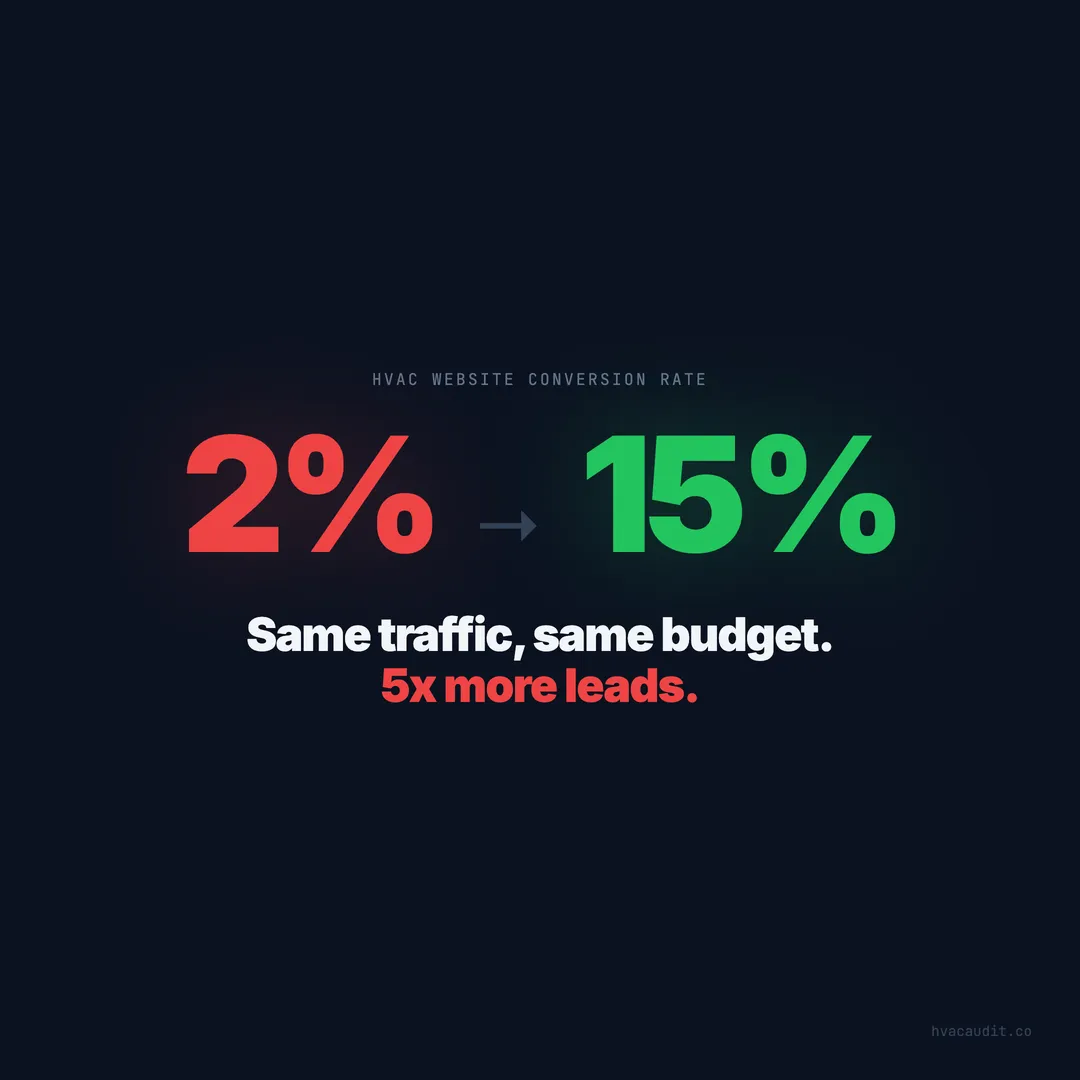
An HVAC company pays $3,000/month for Google Ads. Their site gets 600 visitors from those ads. Their conversion rate is 2.5%. That’s 15 leads per month — costing $200 each.
Their competitor pays the same $3,000. Gets the same 600 visitors. But their site converts at 12%. That’s 72 leads — costing $42 each.
Same budget. Same traffic source. Same market. The difference is the website. The average HVAC website converts 2–3% of visitors into calls or form submissions. Top performers convert 10–15%. That 5x gap isn’t about design trends or expensive development. It’s about whether your site answers questions or just looks like a business exists.
What conversion rate actually means for revenue
Conversion rate isn’t a vanity metric. It directly determines how much revenue your marketing spend produces.
| Monthly visitors | Conversion rate | Leads/month | At $500 avg ticket |
|---|---|---|---|
| 600 | 2% | 12 | $6,000 |
| 600 | 5% | 30 | $15,000 |
| 600 | 10% | 60 | $30,000 |
| 600 | 15% | 90 | $45,000 |
The difference between 2% and 10% on the same traffic is $24,000/month in potential revenue. That’s not theoretical — it’s the gap between the average HVAC site scoring 34/100 and the top 5%.
A 1-second delay in page load reduces conversions by 7%. If your site loads in 6 seconds instead of 2, you’ve already lost 28% of potential conversions before the homeowner sees your content. Speed isn’t a nice-to-have — it’s the foundation of conversion rate.
The 7 conversion killers we see on every audit
When we audit HVAC websites, the same problems appear on almost every site. These aren’t edge cases — they’re the standard.
1. No click-to-call above the fold. 90% of HVAC leads happen over the phone. If the homeowner has to scroll, navigate to a contact page, or manually dial a number they saw in text — you’ve added friction to the most important conversion action on the site. Top sites have a sticky tap-to-call button visible on every page.
2. Slow load time. The average HVAC site takes 18.4 seconds to load. 53% of visitors leave after 3 seconds. A site that loads in 2 seconds versus 8 seconds has fundamentally different conversion math — even with identical content.
3. No pricing information. 70% of homeowners skip contractors who hide pricing. The site that shows “$150 diagnostic fee, most repairs $250–$600” converts the visitor who’s ready to call. The site that says “call for a quote” sends them to the next result.
4. Generic service pages. A page titled “AC Services” with a paragraph about “comprehensive air conditioning solutions” converts at near-zero. A page titled “AC Repair — Same-Day Service, $150 Diagnostic” with bullet points explaining what’s included converts because it answers the 7 questions homeowners ask.
5. No reviews on the site. 93% of homeowners check reviews before calling. If they have to leave your site to find reviews on Google, some won’t come back. Embedding reviews directly on your homepage and service pages keeps the decision-making loop on your site.
6. No emergency messaging. 78% of HVAC websites lack after-hours messaging. The homeowner searching at 11 PM sees no indication of 24/7 service and assumes you’re closed. A simple “24/7 Emergency Service” badge in the header converts this visitor.
7. Complex forms. A form with 7 fields (name, email, phone, address, service type, preferred date, message) has a completion rate under 20%. A form with 3 fields (name, phone, “how can we help?”) completes at 40%+. Every field you add costs you submissions.
What a 15% conversion site looks like
The HVAC sites converting at 15% don’t have revolutionary designs. They have basics done right — consistently, on every page.
Homepage first screen (above the fold):
- Company name and logo
- “24/7 Emergency AC & Heating Repair”
- “$150 Diagnostic Fee — Waived With Repair”
- Tap-to-call button (48px, green, impossible to miss)
- “4.8 ★ (312 reviews)” widget
- NATE Certified + Licensed & Insured badges
Service pages:
- Specific service name as H1 (“AC Repair” not “Our Services”)
- Price range and what’s included
- Average response time
- 3–5 embedded reviews specific to that service
- Click-to-call CTA every 300 words
Mobile experience:
- Loads in under 2.5 seconds
- Sticky call button at bottom of every page
- Forms limited to 3 fields
- Emergency badge visible without scrolling
This isn’t a $50,000 custom build. It’s a $2,000–$5,000 website with the right elements in the right places. The audit breakdown comparing a 28-score site to a 91-score site shows exactly this — the difference is content placement, not design sophistication.
Conversion rate improvement is the fastest ROI in marketing
Every other marketing investment — Google Ads, SEO, content marketing — generates more traffic. Conversion rate optimization makes the traffic you already have more valuable.
Doubling your conversion rate doubles your leads at zero additional cost. A site getting 600 visitors/month that goes from 2% to 4% just added 12 leads/month without spending an extra dollar on marketing. At a $500 average ticket, that’s $6,000/month in new revenue — $72,000/year — from a one-time investment in website optimization.
The average HVAC site costs its owner $4,200/month in missed leads. Most of that cost comes from poor conversion — traffic is arriving, but the site doesn’t convert it. Fix the conversion killers, and a significant portion of that $4,200 becomes revenue instead of waste.
The conversion rate test you can run right now
Open your website on your phone. Time yourself answering these questions:
- Can I call with one tap? If you have to navigate to a contact page, the answer is no.
- Do I see pricing within 5 seconds? Not on an interior page. On the homepage.
- Can I tell this company is available right now? Emergency badge, response time, or hours of operation.
- Do I see social proof? Reviews, star rating, or trust badges above the fold.
- Does the page load in under 3 seconds? Use Google PageSpeed Insights to check.
If your answer is “no” to three or more of these, your conversion rate is likely under 3%. Each “yes” you add moves the needle. Five fixes, nine hours of work — and the economics of your entire marketing budget change.
Your traffic isn’t the problem. Your site is. Fix the site, and the same traffic that produces 12 leads starts producing 60.
Keep reading
Want to know your score?
Drop your URL — full report in 48 hours.
We're on it.
Report in your inbox within 48 hours.