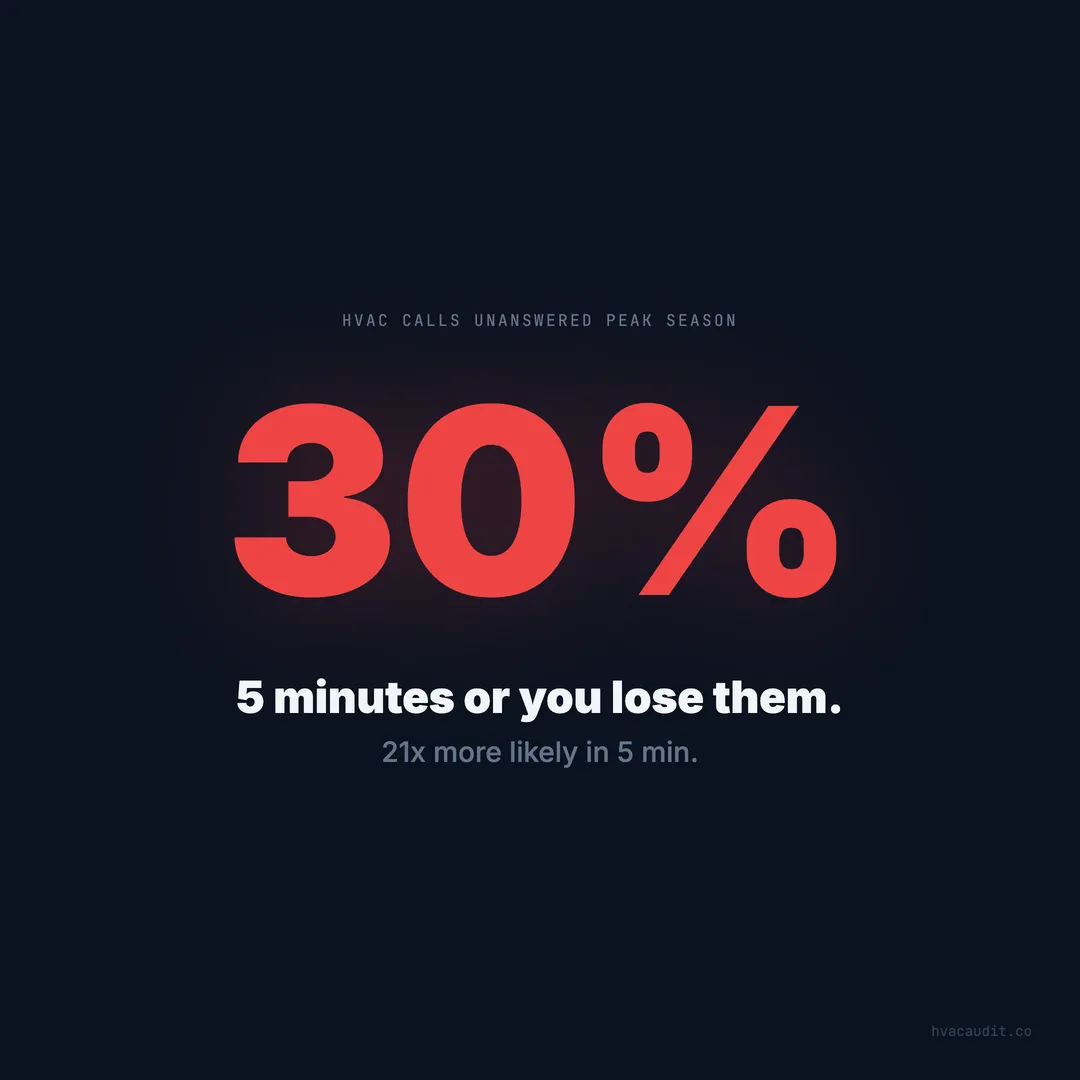
30% of HVAC Calls Go Unanswered During Peak Season
The average HVAC booking rate is 42%. Responding in 5 minutes makes you 21x more likely to qualify a lead. But 30% of calls go straight to voicemail during peak season. Here's what that costs you.
It’s 2 PM on a Tuesday in July. A homeowner’s AC stopped working an hour ago. She searches “AC repair near me,” finds your company, and calls. The phone rings six times and goes to voicemail. She hangs up and calls the next result.
Your tech was on a roof. Your office manager was on the other line. Nobody picked up. You just lost a $400–$800 emergency repair — and possibly a $12,000 lifetime customer — because of a 20-second window.
30% of HVAC calls go unanswered during peak season. Not to voicemail. Not to a callback list. Unanswered. The homeowner hears ringing, gives up, and calls your competitor. You never know they called unless you check your missed call log — and by then, they’ve already booked with someone else.
The 5-minute window decides everything
Responding to a lead within 5 minutes makes you 21x more likely to qualify that lead compared to responding in 30 minutes. Not 2x. Not 5x. Twenty-one times more likely.
The data is consistent across every study of lead response time. The first contractor to make meaningful contact with a homeowner wins the job 78% of the time. After 5 minutes, the odds drop dramatically. After 30 minutes, you’re competing against 2–3 contractors who already made contact.
| Response time | Likelihood of qualifying the lead |
|---|---|
| Under 5 minutes | 21x baseline |
| 5–10 minutes | 4x baseline |
| 10–30 minutes | Baseline |
| 30+ minutes | Below baseline — homeowner likely booked elsewhere |
This matters more in HVAC than in most industries because 90% of HVAC leads happen over the phone. Not through forms. Not through chat. Phone calls. And phone calls have a shelf life of about 20 seconds — if nobody answers, the lead is gone.
The booking rate problem is worse than the answer rate
Even when contractors do answer the phone, the average booking rate is only 42%. That means for every 100 calls that get answered, only 42 result in a booked appointment. The other 58 calls — from real homeowners with real problems — end without a booking.
The gap between a 42% booking rate and a 70%+ booking rate comes down to what happens during the call:
Price objection handling. When a homeowner asks “how much?” and the CSR says “we can’t give prices over the phone,” the call ends. 70% of homeowners skip contractors who won’t discuss pricing. The CSR who says “$150 diagnostic fee, waived with repair — most AC repairs run $250–$600” books the call.
Urgency matching. A homeowner calling about a dead AC at 2 PM wants to hear “we can have someone there by 4 PM.” If the first available slot is Thursday, she’s calling someone else. Urgency matching isn’t about lying — it’s about prioritizing emergency calls over routine maintenance in your scheduling.
Trust signals during the call. “We’re licensed and insured, we’ve been in business 12 years, and all our techs are background-checked” takes 5 seconds to say and eliminates half the anxiety homeowners feel before booking.
What unanswered calls actually cost
Let’s put real numbers on this. A 3-truck HVAC company gets 50 inbound calls per week during peak season. At a 30% unanswered rate, 15 of those calls go to voicemail. Of those 15 missed calls, assume 10 were real leads (the rest were spam, vendors, or existing customers who’ll call back).
At a 42% booking rate and a $500 average ticket, those 10 missed leads represent:
- Potential bookings lost: 4.2 per week
- Revenue lost: $2,100 per week
- Monthly revenue lost: $8,400
- Peak season loss (4 months): $33,600
That’s $33,600 in missed revenue during the four months when margin is highest — the same four months that are supposed to fund the entire off-season. And this doesn’t account for lifetime value — each of those missed customers was potentially worth $12,000 over the next decade.
After-hours calls are the most valuable — and most ignored
The calls that come in after 5 PM and on weekends represent the highest-value leads in HVAC. A homeowner calling at 9 PM has an emergency. They’re willing to pay premium rates. They’re not comparison shopping — they need someone now.
Most HVAC companies send after-hours calls to voicemail. The homeowner hears a recording, hangs up, and calls the next result until someone answers live. The contractor who answers after-hours calls — or at minimum, has a professional answering service — captures the highest-margin work in the industry.
We see this pattern repeatedly when we audit HVAC websites. 78% lack any after-hours messaging on their website. No “24/7 emergency service” badge. No “call our after-hours line.” No indication that anyone will respond outside business hours. The homeowner with a dead AC at 11 PM has no reason to believe calling will produce a response.
Google now shows response time publicly
Google Business Profile now displays response time data: “Usually responds in minutes” or “Usually responds in hours.” This badge appears directly in search results, influencing which contractor the homeowner clicks before they even visit your website.
The contractor who responds in minutes appears in search results as more reliable than the one who responds in hours — regardless of star rating, review count, or search position. This is another layer of the trust signal stack that determines who gets the call.
If you’re not answering calls within 5 minutes — or at minimum, returning missed calls within 15 minutes — Google’s response time badge is actively working against you in search results.
Three fixes that cost less than one missed call
1. Overflow answering service: $200–$400/month. A professional answering service picks up when your team can’t. They take the caller’s name, number, and problem description, and dispatch it to your on-call tech. The cost of the service is less than one missed emergency call.
2. Missed call text-back: $50–$100/month. Automated systems send a text within 30 seconds of a missed call: “Hi, this is [Company]. Sorry we missed your call — we’re helping another customer. Can we call you back in 10 minutes?” This buys you time and signals responsiveness.
3. Website after-hours messaging: $0. Add a badge to your homepage: “24/7 Emergency Service — Call [Number].” Add after-hours instructions to your voicemail: “For emergencies, press 1 to reach our on-call technician.” The top 5% of HVAC websites all have visible after-hours messaging.
The 30% of calls going to voicemail represent the easiest revenue opportunity in your business. Every other growth strategy — ads, SEO, website redesign — tries to generate more calls. This one just answers the calls you’re already getting.
Keep reading
Want to know your score?
Drop your URL — full report in 48 hours.
We're on it.
Report in your inbox within 48 hours.