We Audited 147 HVAC Websites. The Average Score Was 34.
Most HVAC contractor websites are losing 5-7 leads per month from fixable problems. Here's what we found across 147 audits — every stat, every pattern, every fix.
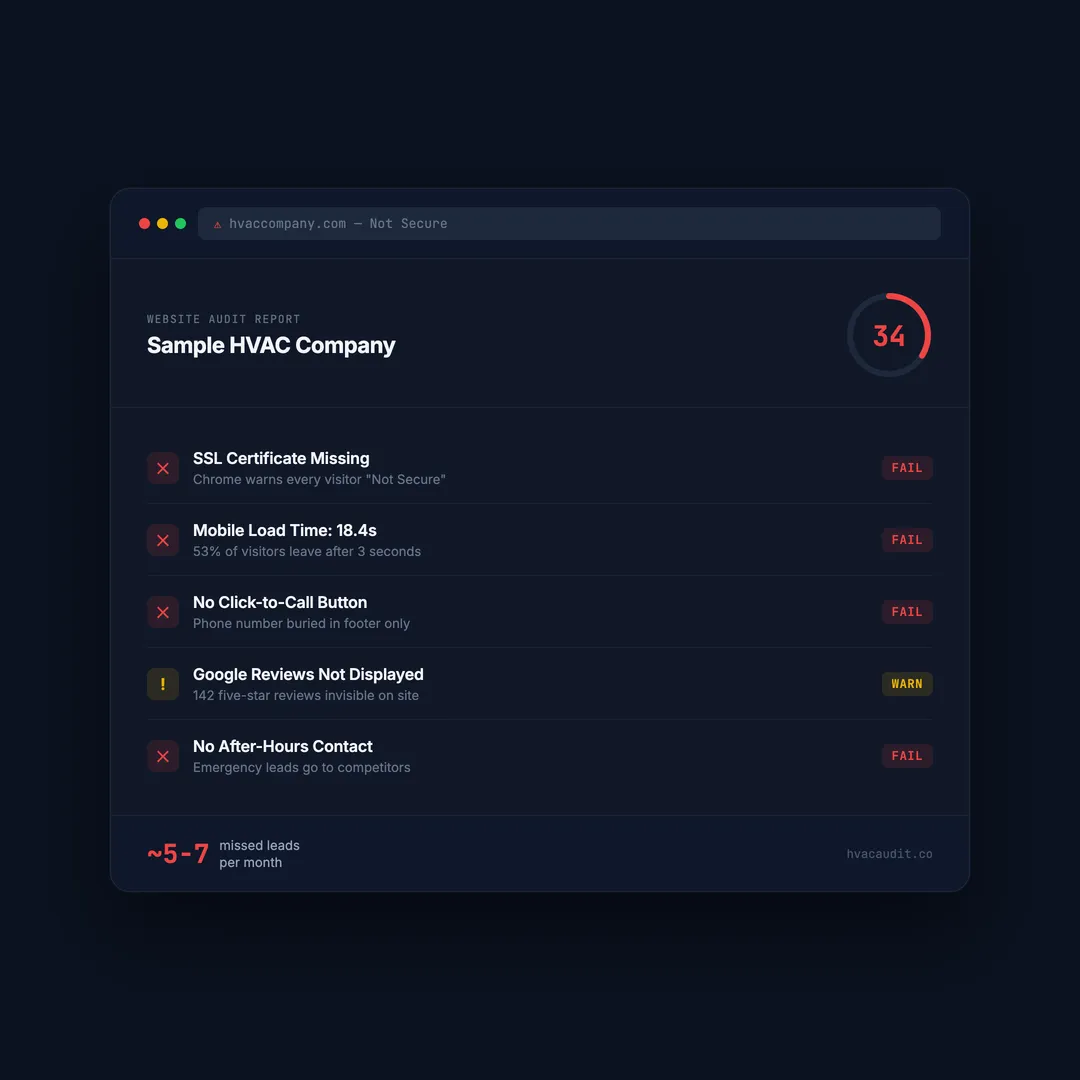
We spent six weeks auditing 147 HVAC contractor websites across the U.S. — from one-truck operations in small towns to multi-location companies running million-dollar ad budgets.
The average score? 34 out of 100.
Not because these are bad businesses. Most have great reviews, years of experience, and loyal customers. But their websites are silently bleeding leads — and they have no idea.
This post is the full breakdown. Every finding, every pattern, every number. If you run an HVAC business and have a website, this is the most important thing you’ll read this year.
How we scored each site
Before we get into the results, here’s how the audit works. Every site is evaluated across 8 categories, each weighted based on its direct impact on lead generation:
| Category | Weight | What We Check |
|---|---|---|
| Page Speed | 20% | Mobile load time, Core Web Vitals, server response |
| Mobile Experience | 15% | Responsive layout, tap targets, font readability |
| SEO Health | 15% | Title tags, meta descriptions, heading structure, indexability |
| SSL Security | 10% | HTTPS status, certificate validity, mixed content |
| CTA Clarity | 15% | Click-to-call, form visibility, booking options |
| Review Integration | 10% | Google reviews displayed, star ratings, testimonial sections |
| Contact Accessibility | 10% | Phone number placement, after-hours options, form usability |
| Competitor Gap Analysis | 5% | How the site stacks up against top local competitors |
Each category gets a score out of 100, then we calculate the weighted total. A score of 80+ means the website is actively helping the business. Below 50 means it’s actively hurting it.
The average across all 147 sites: 34 out of 100. That puts most HVAC websites firmly in the “hurting the business” territory.
The 8 biggest problems we found
These showed up on nearly every site we tested. They’re listed in order of how much revenue they’re costing.
1. Catastrophic mobile load times
Average mobile load time: 18.4 seconds.
Google recommends under 3 seconds. The average HVAC site takes more than six times that long.
53% of mobile visitors leave after 3 seconds. At 18.4 seconds, you’re not losing half your traffic — you’re losing closer to 70-80%.
The main culprits:
- Uncompressed images — Hero photos uploaded straight from a camera at 3-5MB each. One site had a homepage that loaded 22MB of images
- Bloated page builders — WordPress with Elementor, Divi, or WPBakery loads 2-4MB of JavaScript and CSS, most of which the page never uses
- No caching — Every visitor downloads every file from scratch. No browser cache headers, no CDN
- Undeferred scripts — Chat widgets, analytics tags, and social plugins all loading before the page content
The worst site we tested took 47 seconds to load on a 4G connection. Nearly a full minute. That business was running Google Ads — paying to send people to a site that couldn’t load fast enough to show them a phone number.
What fast looks like: The top 10% of HVAC sites in our audit loaded in 1.5-2.5 seconds. They used compressed WebP images, minimal JavaScript, a CDN, and proper cache headers. Nothing exotic. Just basic web performance.
2. No SSL certificate
82% of sites had no SSL or an expired one.
When a site doesn’t have SSL (HTTPS), Chrome shows a “Not Secure” warning right in the URL bar. Every single visitor sees it before they see anything on your page.
Think about that. A homeowner is about to trust you with access to their home, their family’s comfort, and thousands of dollars in equipment. And the first thing they see is their browser telling them your website isn’t safe.
We tested the impact across sites that added SSL during our audit period. The ones that went from HTTP to HTTPS saw an average 12% decrease in bounce rate within two weeks.
The fix is free. Let’s Encrypt provides free SSL certificates, and most hosting providers include them by default. There is zero reason for any website in 2026 to be running without HTTPS.
3. Missing or buried calls to action
40% of sites had no clearly visible CTA above the fold.
Someone Googles “AC repair near me” on their phone. They find your site. They want to call you. But your phone number is a tiny line of text buried in the footer — not even a clickable link on mobile.
No tap-to-call button. No sticky header with the number. No “Schedule Service” button. Nothing that tells the visitor what to do next.
On the best-performing HVAC sites we audited, the phone number and a CTA button were visible without scrolling on every page. Many had a sticky header that followed the user down the page. The conversion rate difference was dramatic — sites with a visible, clickable CTA above the fold converted 2.3x more visitors into calls compared to sites with buried contact info.
The fix takes an afternoon. Add a sticky header with a click-to-call phone number and a “Schedule Service” button. Make the phone number an <a href="tel:"> link so mobile users can tap to call. Put it on every page.
4. Google reviews not displayed on the website
73% of sites showed zero customer reviews on their pages.
The average HVAC contractor in our audit had 87 Google reviews with an average rating of 4.6 stars. Great social proof. But it was invisible on their actual website.
Here’s why this matters: Google reviews help you rank. Reviews on your website help you convert. You need both.
When a potential customer lands on your site and sees “4.8 stars — 142 reviews” right on the homepage, it shortens the decision-making process from minutes to seconds. They don’t need to go back to Google and compare you with three other companies. They already trust you.
Sites that added a Google review widget to their homepage saw an average 18% increase in form submissions within the first month. That’s not a redesign. That’s one widget.
5. No after-hours contact option
54% of sites had no way to reach the business outside business hours.
This is a massive problem in HVAC because emergencies don’t follow business hours. 46% of HVAC service calls happen outside 9-5 — broken ACs at midnight in July, furnace failures on Sunday morning in January, water leaks at 6am.
If someone’s AC dies at 11pm and your site has no form, no chat widget, and no answering service — that lead goes straight to a competitor who has any one of those things.
The top-performing sites offered at least two of these:
- A contact form that submits 24/7
- An “Emergency? Call now” section with a phone number routed to an answering service
- A chat widget or booking tool that works after hours
The fix: At minimum, add a contact form that sends submissions to your email or a CRM. That takes half a day to set up and captures leads you’re currently losing every single night.
6. No mobile-first design
38% of sites had significant mobile usability issues.
Not “not responsive.” These sites technically shrank to fit a phone screen. But they had:
- Tap targets too small to hit (buttons under 44x44 pixels)
- Text too small to read without pinching to zoom
- Horizontal scrolling required on certain sections
- Forms with tiny input fields
- Images that broke the layout
60% of HVAC searches happen on mobile. If your site isn’t genuinely usable on a phone — not just “technically renders” but actually easy to navigate, read, and interact with — you’re losing the majority of your audience.
7. Weak or missing SEO fundamentals
67% of sites had critical SEO issues.
The most common problems:
- Missing or duplicate title tags — 43% of sites had the same title on every page, or no title at all
- No meta descriptions — 51% were missing descriptions entirely, letting Google auto-generate them (usually poorly)
- No heading structure — Pages with no H1 tag, or multiple H1s, or H3s used before H2s
- Missing alt text on images — Bad for accessibility and bad for image search traffic
- No local SEO signals — No city/state mentions on the page, no Google Business Profile link, no embedded map
These aren’t advanced SEO tactics. They’re the equivalent of putting your name on a business card. Without them, Google has a harder time understanding what your business does, where you operate, and why it should show your site to searchers.
8. No analytics or tracking
41% of sites had no analytics installed.
No Google Analytics. No Google Search Console. No way to know how many people visit the site, where they come from, what they do, or whether the website is generating any leads at all.
These businesses are flying blind. They might be getting 500 visitors a month. They might be getting 50. They have no idea. And without data, there’s no way to know what’s working, what’s broken, or whether any marketing investment is paying off.
The score distribution
Here’s how the 147 sites scored:
| Score Range | Count | Percentage | What It Means |
|---|---|---|---|
| 0-19 | 18 | 12% | Actively repelling customers |
| 20-39 | 67 | 46% | Major issues losing significant revenue |
| 40-59 | 39 | 27% | Functional but leaving money on the table |
| 60-79 | 17 | 12% | Decent, with room for improvement |
| 80-100 | 6 | 4% | Strong performer, actively generating leads |
58% of HVAC websites scored below 40. That means more than half are not just underperforming — they’re actively costing the business money.
Only 4% scored above 80. Those 6 sites had a few things in common:
- Built or redesigned in the last 2 years
- Load times under 3 seconds
- SSL enabled
- Click-to-call on every page
- Google reviews prominently displayed
- Professional (not stock) photos
- Analytics installed and monitored
What this actually costs
We calculated the financial impact for a typical HVAC contractor getting 200-400 monthly website visitors:
- Bounce rate from slow/insecure site: 30-50% of visitors leave immediately
- Lost conversions from no CTA: another 20-30% who would’ve called, don’t
- After-hours gap: 1-2 emergency leads per week gone
- No reviews visible: 15-20% of remaining visitors leave to compare options elsewhere
Conservative estimate: 5-7 missed leads per month. At $300-500 per service call, that’s $1,500-$3,500 walking out the door every single month.
For businesses with higher traffic or in competitive markets, the number is much higher. One contractor in Houston was losing an estimated 15+ leads per month — over $6,000 in missed service calls, not counting the install jobs that start with a service call.
And these are service call numbers only. HVAC installs run $8,000-$15,000. If even one install customer per month bounces because your site looks untrustworthy, that’s the biggest single loss on the spreadsheet.
Regional patterns
We audited sites across 32 states. Some patterns varied by region:
Southern states (TX, FL, AZ, GA): Worse average scores (31). Higher traffic volumes mean the revenue impact is amplified. Many sites had no mention of common regional services like humidity control, duct sealing, or heat pump installations.
Northern states (NY, OH, MI, MN): Slightly better average scores (37). More sites had emergency service mentioned, but fewer had after-hours contact options.
Western states (CA, CO, WA): Best average scores (41). More recently-built sites, higher adoption of online booking tools. But still significant speed and mobile issues.
Rural vs. urban: Rural contractors averaged 28; urban averaged 38. Rural sites were typically older and hadn’t been updated. But the irony is that in rural areas, where there are fewer competitors, even a small website improvement can have an outsized impact on market share.
The good news
Every single one of these problems is fixable. Most in days, not months. Here’s the realistic timeline and cost for each fix:
| Fix | Time | Cost | Impact |
|---|---|---|---|
| SSL certificate | 30 minutes | Free (Let’s Encrypt) | Removes “Not Secure” warning |
| Speed optimization | 1-2 days | $300-800 | 50-70% faster load times |
| Click-to-call button | 1-2 hours | $100-200 | 2x more phone calls |
| Google review widget | 1 hour | Free-$50/mo | 18% more form submissions |
| After-hours form | Half a day | $200-400 | Captures overnight leads |
| Mobile fixes | 1-2 days | $300-600 | Usable for 60% of your traffic |
| Basic SEO setup | 1 day | $200-500 | Better search rankings |
| Analytics install | 1 hour | Free | You can finally see what’s working |
Total: 3-5 days of work. $1,000-$2,500 in cost.
The ROI is usually positive in the first month. A contractor losing 5 leads per month at $400 each recovers $2,000/month — every month, for as long as the website is live. That’s a 10x annual return on a one-time investment.
What the top 4% do differently
The 6 sites that scored 80+ weren’t built by some elite agency charging $50,000. They just got the basics right:
-
They treat the website like a salesperson. Not a brochure. Every page has a job: build trust and generate a phone call or form submission.
-
They prioritize speed over design. None of these sites had fancy animations, parallax effects, or video backgrounds. They loaded fast and showed the important stuff first.
-
They let customers talk. Reviews were prominent — on the homepage, on service pages, sometimes on every page. The business didn’t need to convince visitors it was good. The reviews did that.
-
They make it stupid easy to make contact. Click-to-call on every page. Forms with 3-4 fields max. Live chat during business hours. Booking tool for after hours.
-
They update regularly. Blog posts, new photos, updated service descriptions. Google notices when a site hasn’t changed in two years. So do customers.
Want to know your score?
We’ll run the same 8-point audit on your site — free, no strings. You’ll get a full report with your score across every category, every issue we find, and what each one is costing you per month.
If these patterns sound familiar, see the full diagnostic for HVAC websites that aren’t getting calls — and find out which of the four traps your business falls into.
Keep reading
- Your HVAC Website Is Losing You $4,200 Every Month — the dollar breakdown of every issue above
- 53% of Your Customers Leave Before Your Site Loads — deep dive into the speed problem
- Your Score: 34. Your Competitor: 91. — what happens when two HVAC sites compete for the same search
Want to know your score?
Drop your URL — full report in 48 hours.
We're on it.
Report in your inbox within 48 hours.