Your Score: 34. Your Competitor: 91. Guess Who Gets the Call.
When two HVAC sites show up for the same search, the one that loads faster and looks more trustworthy gets the call. Here's what separates a 34 from a 91.
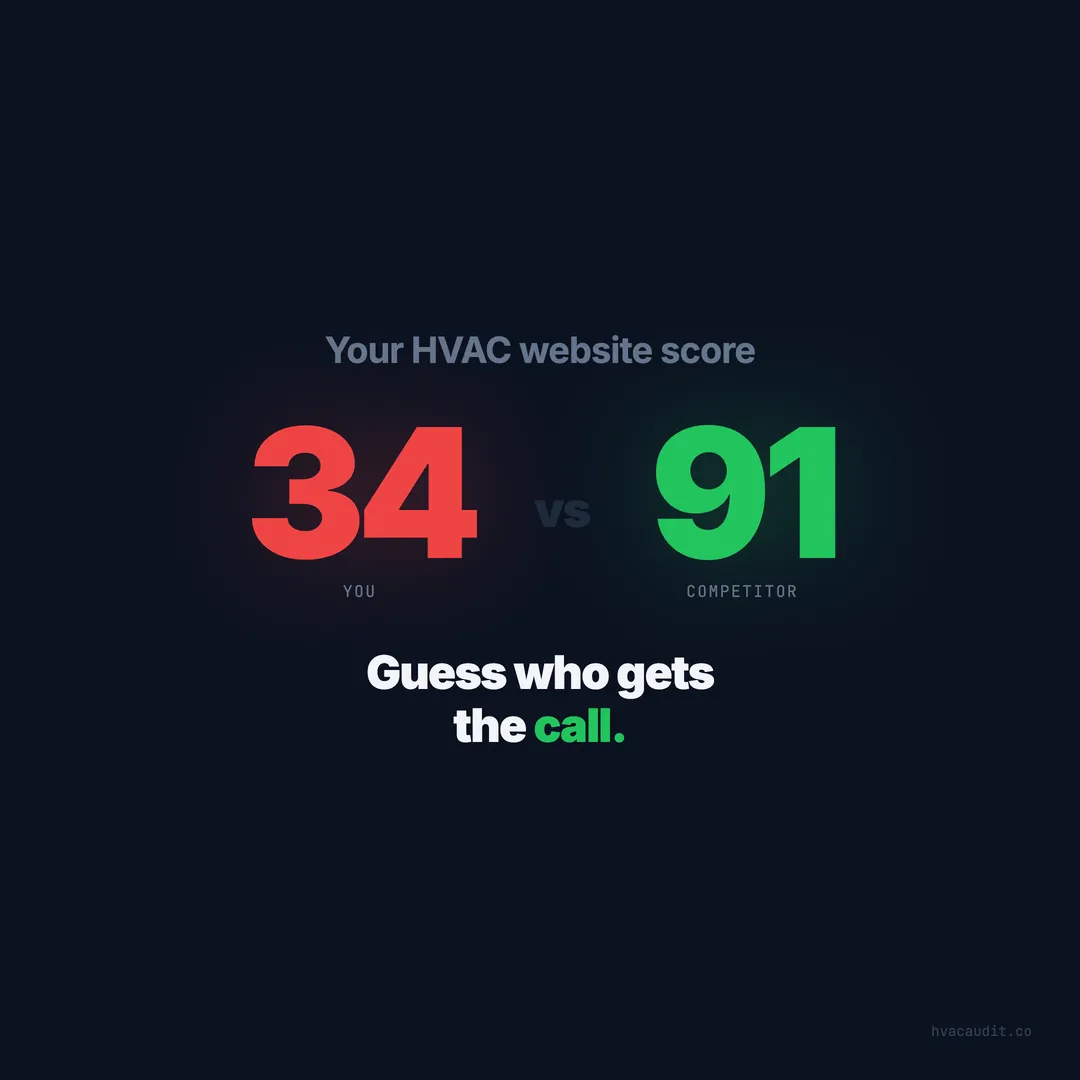
We scored two HVAC websites in the same city. Same zip code. Same services. Same price range.
One scored 34 out of 100. The other scored 91.
Guess who gets the call.
It’s not about who’s better at HVAC
Both companies had licensed technicians, good reviews, and years of experience. On paper, they’re equal. Both show up on page one of Google for “AC repair” in their city. Both have Google Business profiles with 4.5+ stars.
But when a homeowner Googles “AC repair near me” and clicks both links, the decision is made in about 5 seconds. Not 5 minutes. Not after reading the About page. Not after comparing prices. Five seconds.
And in those 5 seconds, the two sites tell very different stories.
What the homeowner sees
The 34-scoring site
The browser shows a “Not Secure” warning in the URL bar. The page starts loading — slowly. After 3 seconds, there’s still a white screen with a spinner. After 5 seconds, a giant hero image starts appearing from the top, pushing content around as it loads.
After 8 seconds, the page is mostly loaded. The homeowner sees:
- A blurry hero photo that’s still loading
- A paragraph of text about the company’s history since 1987
- No phone number visible without scrolling
- No reviews anywhere on the page
- A “Contact Us” link in the navigation that leads to a form with 9 fields
- Stock photos that look like they came from 2012
The homeowner hits the back button. They didn’t even scroll.
The 91-scoring site
The page loads in 1.8 seconds. No browser warning. The homeowner sees:
- A clean headline: “AC Repair in [City] — Same Day Service”
- A big, tappable “Call Now” button at the top
- “4.8 stars — 142 reviews” with actual Google reviews visible below the hero
- A photo of a real technician standing next to a branded truck
- “Licensed, Insured, Background-Checked” badges
- A “Book Online” button on every page
The homeowner taps “Call Now.” The entire interaction took 12 seconds.
Both companies do the same work. Both are good at what they do. But one gets the call because their website communicates trust in 5 seconds.
The 5-second trust test
Web users don’t read websites. They scan them. And they’ve been trained by Amazon, Google, and every major site to look for specific trust signals.
When those signals are present, they stay and convert. When they’re absent, something feels “off” and they leave — usually without being able to articulate why.
Here are the five signals that a visitor evaluates in the first 5 seconds:
1. HTTPS lock icon = safe to interact with
When a site shows “Not Secure,” visitors don’t think “the SSL certificate is missing.” They think “I don’t trust this.” It’s reflexive. In our 147-site audit, 82% of HVAC sites lacked SSL.
The 91-scoring site has SSL. Green lock. No warning. The visitor never even notices — and that’s the point. Security signals should be invisible when they’re working correctly.
2. Fast load = professional operation
A site that loads in under 2 seconds feels like a company that has their act together. A site that takes 18.4 seconds to load feels like a company that can’t answer the phone.
This association isn’t rational. Load speed has nothing to do with HVAC skill. But it’s real, and it costs the 34-scoring site visitors on every single visit.
3. Visible reviews = social proof
Humans are herd animals. When we see that 142 other people had a good experience, we feel safe making the same choice. When there are no reviews visible, we feel uncertain — even if we saw the reviews on Google 30 seconds ago.
The 91-scoring site doesn’t just have good reviews. It shows them. On the homepage, on service pages, embedded with star ratings. The visitor doesn’t need to go back to Google and compare. The social proof is right there.
4. Easy contact = they want my business
When a site has a big, tappable phone number and a “Book Now” button visible without scrolling, it communicates: “We want your call. We made it easy.” When the phone number is buried in the footer as non-clickable text, it communicates: “We’re here, but we’re not going to make it easy for you.”
The 34-scoring site’s “Contact Us” page had a form with 9 fields — name, email, phone, address, service type, preferred date, preferred time, how did you hear about us, and a CAPTCHA. That’s not a contact form. That’s a job application.
The 91-scoring site had a 3-field form: name, phone, brief description. Plus a clickable phone number on every page.
5. Real photos = real company
Stock photos of smiling models in hard hats don’t build trust. They erode it. Visitors recognize stock photography instantly. It signals “this company couldn’t even take their own photos.”
Real photos — the actual team, actual trucks, actual job sites — build authenticity. They say “we’re real people who do real work.” The 91-scoring site had a team photo on the About page and truck photos on the homepage. The 34-scoring site had generic stock images that also appeared on 500 other contractor websites.
The compounding effect
Here’s the part that makes the gap between 34 and 91 even more devastating: these issues don’t add up linearly. They compound.
A slow site with no SSL, no reviews, and a buried phone number doesn’t lose 4x the visitors. It loses visitors at each stage of the funnel:
- 80% bounce from slow speed — out of 100 visitors, 80 leave
- 15% of remaining bounce from “Not Secure” — 3 more gone, 17 left
- 30% of remaining leave because no reviews — 5 more gone, 12 left
- 50% of remaining can’t find the phone number — 6 more gone, 6 left
- 15% conversion rate on the survivors — less than 1 lead
Out of 100 visitors, the 34-scoring site generates 0-1 leads.
Now run the same 100 visitors through the 91-scoring site:
- 30% normal bounce — 70 stay
- SSL present — no additional loss
- Reviews visible — trust established, no additional loss
- CTA prominent — no friction, no additional loss
- 15% conversion rate — 10-11 leads
Same 100 visitors. One site gets 0-1 leads. The other gets 10-11. That’s not a small difference. That’s the difference between a website that costs you money and a website that generates money.
Same traffic, different results
Here’s the part that really hurts: both sites might get the same amount of traffic from Google. Same rankings. Same ad spend. Same effort.
But the 91-scoring site converts 10x more visitors into calls because people trust it enough to pick up the phone.
That means the 34-scoring site is spending the same money on marketing and getting a fraction of the results. Every dollar of ad spend, every SEO effort, every Google Business listing optimization — all underperforming because the website fumbles the handoff.
It’s like having a great salesperson who answers the phone in a language the customer doesn’t speak. The opportunity was there. The lead was warm. But the conversion tool — the website — failed.
The math over a year
For a contractor getting 250 monthly visitors:
| Metric | Score: 34 | Score: 91 |
|---|---|---|
| Monthly visitors | 250 | 250 |
| Effective conversion rate | 0.4% | 4.4% |
| Monthly leads | 1 | 11 |
| Monthly revenue (at $400/job) | $400 | $4,400 |
| Annual revenue from website | $4,800 | $52,800 |
Annual revenue gap: $48,000. From the exact same traffic.
And that’s just service calls. If even one of those 11 monthly leads converts into a system install ($8,000-$15,000), the annual gap becomes six figures.
Closing the gap
Going from 34 to 91 isn’t a full redesign. It’s not a $20,000 project. It’s a checklist of specific, fixable issues — most of which take hours, not weeks.
The priority list
-
Add SSL — Free (Let’s Encrypt), takes 30 minutes. Removes the “Not Secure” warning immediately.
-
Fix speed — Compress images to WebP, remove unused plugins, add Cloudflare CDN and cache headers. 1-2 days, $300-800. Load time drops from 18 seconds to 2-3 seconds.
-
Add click-to-call — Sticky header with a clickable phone number + “Call Now” button visible without scrolling. 2-3 hours, $100-200. Calls increase by 2x or more.
-
Embed Google reviews — Widget on the homepage showing your Google rating and recent reviews. 1 hour, free to $50/month. Form submissions increase by 18%.
-
Add after-hours contact — Simple form or chat widget that works 24/7. Half a day, $200-400. Captures emergency leads you’re currently losing every night.
-
Replace stock photos — Take photos of your real team, your trucks, your job sites. Ask a customer if you can photograph a completed install. 1 day, cost of a photographer ($200-500) or your phone camera (free).
Total investment
| Item | Time | Cost |
|---|---|---|
| SSL | 30 min | Free |
| Speed optimization | 1-2 days | $300-800 |
| Click-to-call | 2-3 hours | $100-200 |
| Review widget | 1 hour | Free-$50/mo |
| After-hours form | Half day | $200-400 |
| Real photos | 1 day | $0-500 |
| Total | 3-5 days | $600-$1,900 |
Payback period: less than 1 month. If the gap between the two sites is $4,000/month in missed revenue, a $1,000 investment pays for itself in the first week.
The gap isn’t talent. It isn’t money. It’s attention.
The contractor with the 91-scoring site isn’t smarter. They don’t have more money. They’re not a bigger company. They just paid attention to their website.
They (or someone they hired) made sure it loaded fast, looked professional, showed reviews, and made it easy to call. That’s it. There’s no secret. There’s no expensive trick.
The contractor with the 34-scoring site paid someone $5,000 for a website, approved it on a desktop, and never looked at it again. That website has been silently losing them money every day since it launched.
Right now, your competitor is getting the calls because they paid attention first. The good news: it’s not too late. The checklist above works. The timeline is days, not months. The cost is a fraction of what you’re already losing.
The gap between a 34 and a 91 isn’t traffic — it’s how well the site converts visitors into calls. If your site looks professional but leads are flat, the problems are hidden.
See your score → Get your free audit
Keep reading
- We Audited 147 HVAC Websites. The Average Score Was 34. — the full study behind the 34 average
- Your HVAC Website Is Losing You $4,200 Every Month — what that 34 score actually costs in dollars
- 18 Seconds. Your Customer Left After 3. — the speed problem explained
Want to know your score?
Drop your URL — full report in 48 hours.
We're on it.
Report in your inbox within 48 hours.