53% of Your Customers Leave Before Your Site Loads
More than half of HVAC website visitors bounce before the page finishes loading. Here's the research, the math, and exactly what to do about it.
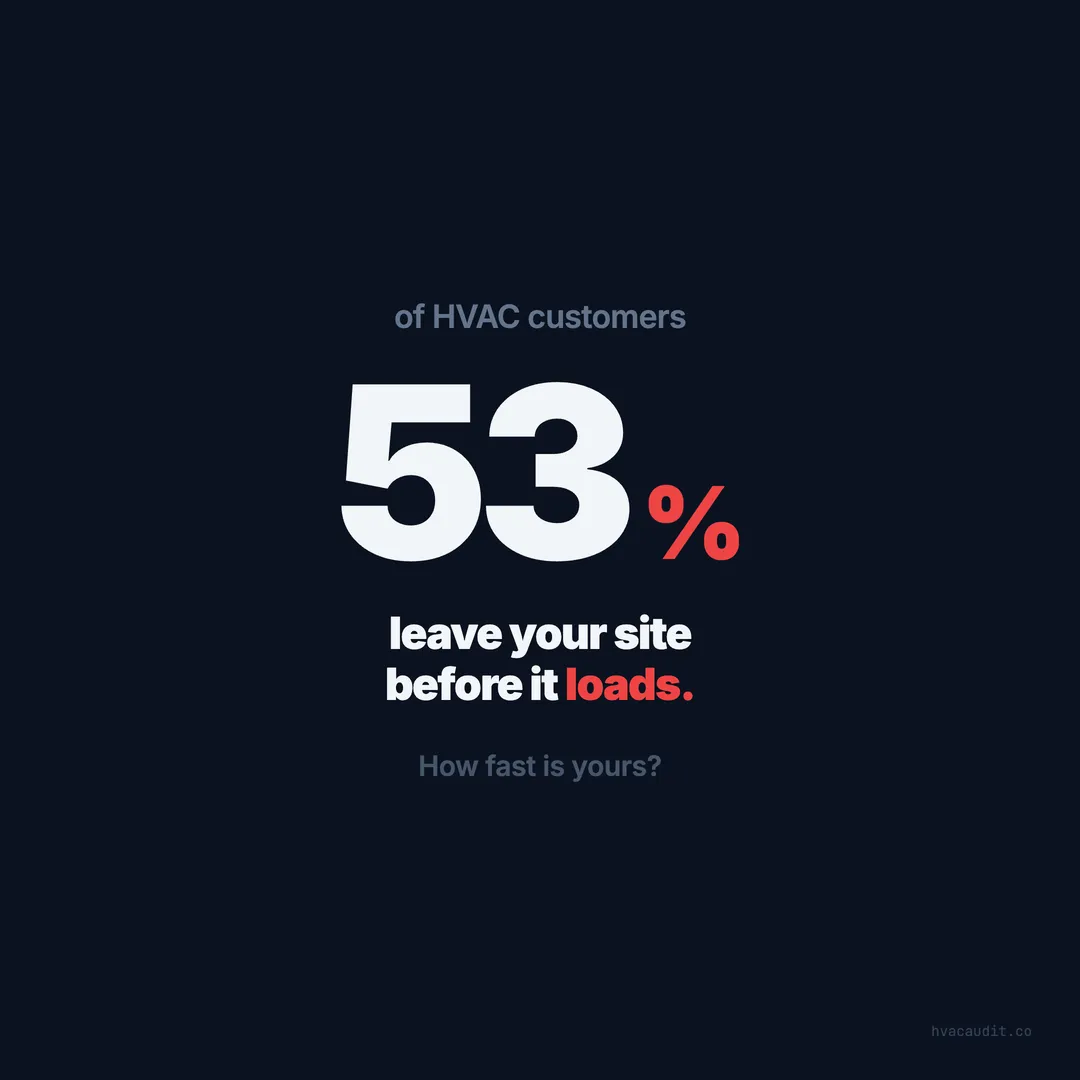
53%.
More than half of the people who click on your HVAC website leave before it finishes loading.
They needed AC repair. They found you on Google. They tapped the link. And they bounced — not because they didn’t need you, but because your site was too slow to show up.
This one stat explains more about why HVAC websites fail than anything else. If you fix nothing else after reading this, fix your load time.
Where the 53% number comes from
Google’s Mobile Speed Study analyzed millions of mobile page visits across industries. The headline finding: 53% of mobile site visits are abandoned if the page takes more than 3 seconds to load.
Three seconds. That’s it.
The study also found the relationship gets worse as load time increases. It’s not linear — it’s exponential. The longer the wait, the faster visitors give up:
| Load Time | Probability of Bounce |
|---|---|
| 1 second → 3 seconds | 32% increase |
| 1 second → 5 seconds | 90% increase |
| 1 second → 6 seconds | 106% increase |
| 1 second → 10 seconds | 123% increase |
The average HVAC website we audited loads in 18.4 seconds on mobile. At that speed, bounce probability isn’t 53% — it’s closer to 80%.
These numbers have been confirmed by multiple independent studies. Amazon found that every 100ms of additional load time cost them 1% in sales. Walmart saw a 2% increase in conversions for every 1-second improvement. The relationship between speed and money is settled science.
What 53% actually looks like for your HVAC business
Let’s run the math for a typical HVAC contractor. Not a huge operation — just a regular company getting a reasonable amount of web traffic.
Scenario: 300 monthly visitors
That’s a realistic number for a local HVAC company with a Google Business Profile, some basic SEO, and maybe a few Google Ads.
With a slow site (18+ seconds):
- 300 visitors arrive
- ~80% bounce before loading = 240 leave
- 60 visitors actually see your site
- At 15% conversion rate = 9 leads
With a fast site (under 3 seconds):
- 300 visitors arrive
- ~30% bounce (normal bounce rate) = 90 leave
- 210 visitors actually see your site
- At 15% conversion rate = 31 leads
Difference: 22 additional leads per month. At $400 per average service call, that’s $8,800/month in recovered revenue.
And this is being conservative. We used 300 visitors, not 500 or 1,000. We used a 15% conversion rate, not the 20-25% that top HVAC sites achieve. The actual number for a well-optimized site is likely higher.
Scenario: 150 monthly visitors
Even for a smaller operation or a rural contractor with less traffic:
Slow site: 150 → 30 stay → 4-5 leads Fast site: 150 → 105 stay → 15-16 leads
Difference: 10-11 extra leads per month. At $400 each = $4,000-$4,400/month.
The point is the same at any traffic level: when more than half your visitors never see your site, you’re operating your business at a fraction of its potential.
It’s not just impatience — it’s context
People aren’t being unreasonable by leaving after 3 seconds. Consider the context of an HVAC search:
Their AC just broke. It’s 95 degrees in the house. The kids are cranky. The dog is panting. They grabbed their phone and Googled “AC repair near me.” They’re not browsing. They’re in a crisis.
They’re comparing multiple options. Google shows 3-4 results with Google Ads, another 3 in the local pack, and 10 organic results. That’s 16+ options. If your site doesn’t load, they don’t wait — they tap the next one. There’s always a next one.
They’re on a phone, probably on cellular data. Not sitting at a desk with fiber internet. They’re standing in a hot house, on a phone, on 4G. Your 4MB hero image that loads in 2 seconds on Wi-Fi takes 12 seconds on their connection.
They associate slow sites with bad businesses. It’s not rational, but it’s real. A site that can’t load feels like a company that can’t answer the phone. It signals “this business doesn’t have their act together.” They don’t think it consciously — they just feel it and move on.
The hidden cost: paid traffic
Here’s where the math gets painful. Many HVAC contractors run Google Ads. They pay $15-$50 per click for keywords like “AC repair near me” or “furnace installation.”
If 53-80% of those clicks bounce because of load time, here’s what that looks like:
| Monthly Ad Spend | Cost Per Click | Clicks | Bounced (70%) | Wasted Spend |
|---|---|---|---|---|
| $1,000 | $25 | 40 | 28 | $700 |
| $2,000 | $30 | 67 | 47 | $1,410 |
| $3,000 | $25 | 120 | 84 | $2,100 |
A contractor spending $2,000/month on Google Ads with a slow website is effectively throwing away $1,400/month. They’re paying to send people to a site that can’t load.
Fix the speed first. Then run ads. In that order. Every dollar of ad spend becomes 3x more effective when the landing page actually loads.
What makes a site fast
The target is under 3 seconds on mobile. Here’s what that requires:
Images: the biggest lever
- Total image payload under 500KB — most HVAC sites load 4-8MB of images
- WebP format — 60-80% smaller than JPEG with no visible quality loss
- Responsive sizes — serve 400px-wide images to phones, 1200px to desktops
- Lazy loading — only load images the visitor can see. Load the rest as they scroll
- No background videos — that “drone shot of the neighborhood” video on the homepage weighs 15-30MB
JavaScript: less is more
- Remove unused plugins — if you’re on WordPress, audit every plugin. Do you need all 22 of them?
- Defer non-critical scripts — analytics, chat, social widgets should load after the page is visible
- Avoid heavy frameworks — a page builder that loads 3MB of JS is not “convenient.” It’s expensive
- Inline critical CSS — load the styling needed for what’s visible first, load the rest later
Server: the foundation
- CDN delivery — serves files from the closest server. Cloudflare’s free plan works great
- Browser caching — returning visitors load nearly instantly
- Gzip/Brotli compression — reduces file sizes 60-80% in transit
- Fast hosting — server response time (TTFB) should be under 200ms. If it’s over 1 second, the host is the bottleneck
Testing
None of this is cutting edge. It’s standard web performance. But most HVAC websites were built by someone who tested on desktop Wi-Fi and called it done. They never opened it on a phone, never ran a speed test, and never checked what happens on a 4G connection.
The test takes 60 seconds
Three ways to check your speed right now:
1. Google PageSpeed Insights
Enter your URL. Click “Analyze.” Look at the mobile score.
- 90-100: You’re in the top 4% of HVAC sites. Congrats.
- 50-89: Room for improvement. You’re losing some visitors.
- 0-49: Critical. More than half your mobile visitors never see your site.
2. The stopwatch test
Open your phone. Clear your browser cache (Settings → Clear Browsing Data). Navigate to your website. Time it with a stopwatch. If it takes more than 3 seconds to see content you can interact with, you have a speed problem.
3. WebPageTest.org
Enter your URL, select “Mobile — 4G” for connection speed, and run the test. This gives you the most realistic picture of what your customers experience.
What to do next
If your site loads in more than 3 seconds on mobile, here’s the priority order:
- Optimize images — biggest single improvement. Convert to WebP, resize, lazy-load. This alone can cut load time 50-70%.
- Add Cloudflare — free CDN and caching. Takes an hour to set up.
- Remove unused scripts and plugins — audit everything. If you don’t know what a plugin does, you probably don’t need it.
- Defer remaining scripts — analytics, chat, tracking should load after the page content.
- Upgrade hosting — if the server is slow, everything else is a band-aid.
Typical timeline: 1-2 days of work. Typical cost: $300-800 if you hire someone.
The payback is immediate. The visitors are already there. They’re already finding you. They already need HVAC service. You just need to let the page load fast enough for them to call.
If speed is killing your leads, it’s rarely the only problem. See the full diagnostic for HVAC websites not getting calls — speed is usually the first of several issues.
Keep reading
- 18 Seconds. Your Customer Left After 3. — the technical deep dive into why HVAC sites are so slow and how to fix each cause
- Your HVAC Website Is Losing You $4,200 Every Month — speed is the biggest piece, but not the only one
- We Audited 147 HVAC Websites. The Average Score Was 34. — the full study across 147 sites
Want to know your score?
Drop your URL — full report in 48 hours.
We're on it.
Report in your inbox within 48 hours.