What Separates a 50/100 HVAC Website From a 90/100
Most HVAC sites cluster at 30-40 out of 100. The jump from 50 to 90 comes from 5 specific fixes — not a redesign. Here's exactly what the top-scoring sites do differently.
When we audited 147 HVAC websites, we expected a bell curve — a few terrible sites, a few great ones, and most in the middle. That’s not what we found.
The scores clustered at the bottom. The average score was 34 out of 100. The median was even lower. Most HVAC websites aren’t average — they’re failing basic trust and conversion tests. The sites that score 50+ are already in the top third. The sites that score 90+ are rare outliers.
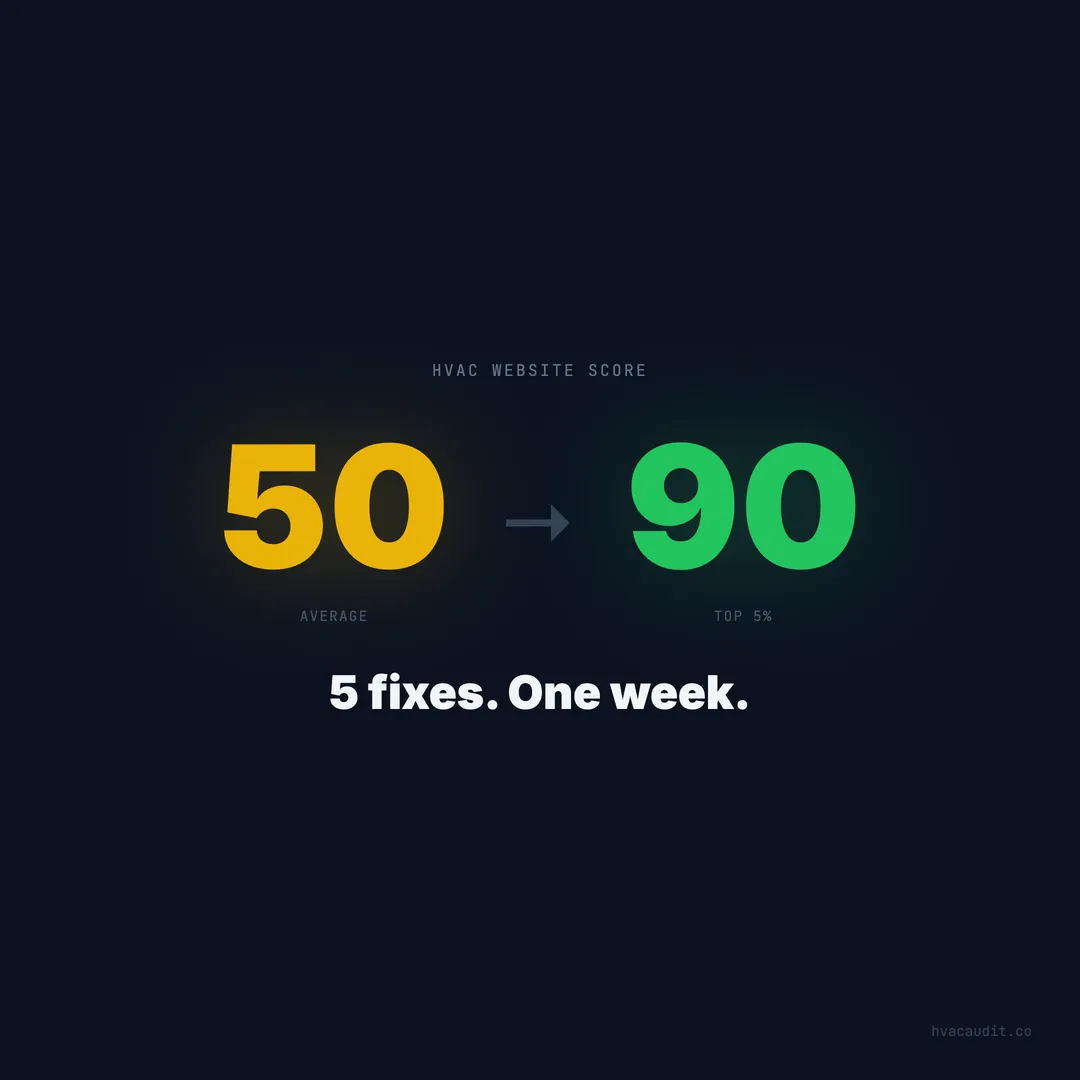
But the distance between a 50 and a 90 isn’t a $50,000 redesign. It’s five specific fixes that most contractors can implement in a week. Here’s exactly what separates them.
The scoring distribution tells the story
The 147 sites we audited didn’t spread evenly across the 0–100 scale. They bunched into three clusters:
| Score range | % of sites | What you typically find |
|---|---|---|
| 0–30 | 38% | No pricing, stock photos, 10+ second load, no reviews, broken mobile |
| 31–50 | 35% | Basic functionality, some real photos, a phone number, minimal content |
| 51–70 | 18% | Decent speed, some trust signals, partial pricing, inconsistent UX |
| 71–90 | 7% | Fast, mobile-optimized, pricing visible, reviews on site, strong CTAs |
| 91–100 | 2% | Everything right — speed, trust, pricing, reviews, schema, accessibility |
73% of HVAC websites score below 50. These aren’t sites from fly-by-night operations — many belong to established companies with multiple trucks, decades of experience, and strong word-of-mouth reputations. Their businesses work despite their websites, not because of them.
The jump from 30 to 50 usually happens with basic maintenance — fixing broken links, adding a phone number to the header, uploading a real photo. The jump from 50 to 90 requires intentional optimization of five specific areas.
Fix 1: Speed — from 8 seconds to under 3
The single biggest scoring difference between a 50 and a 90 is load time. Sites scoring 50 typically load in 5–8 seconds. Sites scoring 90+ load in under 2.5 seconds.
The average HVAC site takes 18.4 seconds to load. That number is dragged up by the worst performers, but even the “decent” sites are slow. 53% of mobile visitors leave if a page takes more than 3 seconds. A site loading in 6 seconds has already lost more than half its visitors before they see the content.
What makes HVAC sites slow:
- Uncompressed images — a single hero image can be 4MB when it should be 200KB
- Third-party scripts — chat widgets, analytics, social embeds loading synchronously
- Cheap hosting — shared servers that bottleneck under any traffic spike
- No caching — every page load re-fetches every asset
The fix is mechanical, not creative. Compress images to WebP. Defer non-critical scripts. Use a CDN or upgrade hosting. Enable browser caching. These changes can take a site from 8 seconds to under 3 seconds in a single afternoon.
Fix 2: Above-the-fold trust signals
A 50-scoring site has some trust signals scattered throughout the page. A 90-scoring site puts them above the fold — visible in the first screen without scrolling.
75% of consumers judge credibility by website design. And “design” in this context means: can I find what I need in 5 seconds? The 90-scoring sites answer three questions before the first scroll:
- “Can they help me now?” → “24/7 Emergency Service” badge in the header
- “How much?” → “$150 diagnostic fee” visible on the homepage
- “Are they legit?” → Star rating, review count, license number — all visible
The 50-scoring sites answer maybe one of these. The pricing is on an interior page. The reviews are at the bottom. The emergency messaging doesn’t exist. The homeowner has to work to find the answers — and most won’t.
CTAs placed above the fold outperform those below by 304%. A click-to-call button, a review widget, and a pricing range — all above the fold — separate a 50 from a 90 without changing a single line of body copy.
Fix 3: Pricing transparency on service pages
The gap between 50-score and 90-score sites is stark on pricing. 50-score sites either show no pricing or have a single “starting at” price. 90-score sites have pricing ranges on every service page with context.
70% of homeowners skip contractors who hide pricing. But the 90-score sites go further than just listing numbers — they provide:
- Range pricing with context: “AC repair: $150–$600 depending on the component”
- Diagnostic fee with waiver incentive: “$150 diagnostic, waived with repair”
- Monthly payment options: “$89/month for a new system — 0% for 18 months”
- What’s included: bullet list of what the service covers
The pricing doesn’t need to be exact. Ranges work. The goal is to answer the homeowner’s first question — “how much?” — before they have to call. This single change can increase conversion rates by 70% based on transparent vs. non-transparent pricing page data.
Fix 4: Review depth — not just stars, but stories
50-score sites might display a Google review widget showing a star rating. 90-score sites display detailed, recent reviews with context — and they have a system to generate new ones.
91% of homeowners check reviews before calling. But what they’re looking for has evolved. A star rating alone isn’t enough. Homeowners want to read reviews that describe:
- What the problem was
- How fast the contractor responded
- What the tech did and how they explained it
- Whether the price matched the quote
- The overall experience
90-score sites display 10+ recent reviews prominently on the homepage and service pages. They respond to every review — positive and negative. And they have a review generation system that produces 15+ new reviews per month, keeping the reviews fresh and recent.
44% of homeowners say a professional response to a negative review builds more trust than a perfect rating. The 90-score sites don’t hide from criticism — they address it publicly, which signals confidence.
Fix 5: Mobile UX — tap-to-call in one touch
70% of home service inquiries come from mobile. On a phone, every tap is a conversion barrier. The 50-score sites have a phone number somewhere on the page — usually small, often not clickable. The 90-score sites have a tap-to-call button that’s the most prominent element on the mobile screen.
The mobile differences between 50 and 90:
| Element | 50-score site | 90-score site |
|---|---|---|
| Phone number | Text-only, 14px, in header | Tap-to-call button, 48px, sticky |
| Navigation | Desktop nav shrunk to mobile | Mobile-first hamburger with priority CTAs |
| Forms | 7+ fields, desktop-sized inputs | 3 fields max, full-width inputs |
| Speed | 5–8 seconds | Under 2.5 seconds |
| Emergency CTA | Not present or below fold | Sticky bar or floating button |
A tap-to-call button in the first 400 pixels of the mobile screen is the single highest-converting element on any HVAC website. The homeowner with a dead AC at 11 PM is holding her phone, scanning search results, and looking for the fastest path to a voice. One tap. That’s the standard.
The 50-to-90 path takes a week, not a quarter
This is the part that surprises most contractors. The jump from 50 to 90 doesn’t require a new website. It requires five targeted fixes on the website you already have:
- Compress images and defer scripts — 2 hours, takes load time from 6s to under 3s
- Add trust signals above the fold — 1 hour, adds phone number, reviews widget, emergency badge to header
- Add pricing to service pages — 3 hours, adds ranges and diagnostic fees to each service
- Embed reviews with depth — 2 hours, adds 10+ recent reviews to homepage and key pages
- Fix mobile tap-to-call — 1 hour, adds sticky call button and simplifies mobile forms
Total time: approximately 9 hours of focused work. No designer required. No developer required. Any contractor with a WordPress or Wix site can make these changes — or hire someone for $500–$1,000 to do it in a day.
The average HVAC site costs its owner $4,200/month in missed leads. A 9-hour fix that moves the score from 50 to 90 could cut that loss in half. The ROI on this work is measured in days, not months.
The distance between 50 and 90 isn’t skill or budget. It’s awareness. Now you know the five things. The only question is how fast you fix them.
Keep reading
Want to know your score?
Drop your URL — full report in 48 hours.
We're on it.
Report in your inbox within 48 hours.