We Browsed 3 HVAC Sites Like a Homeowner — One Scored 28
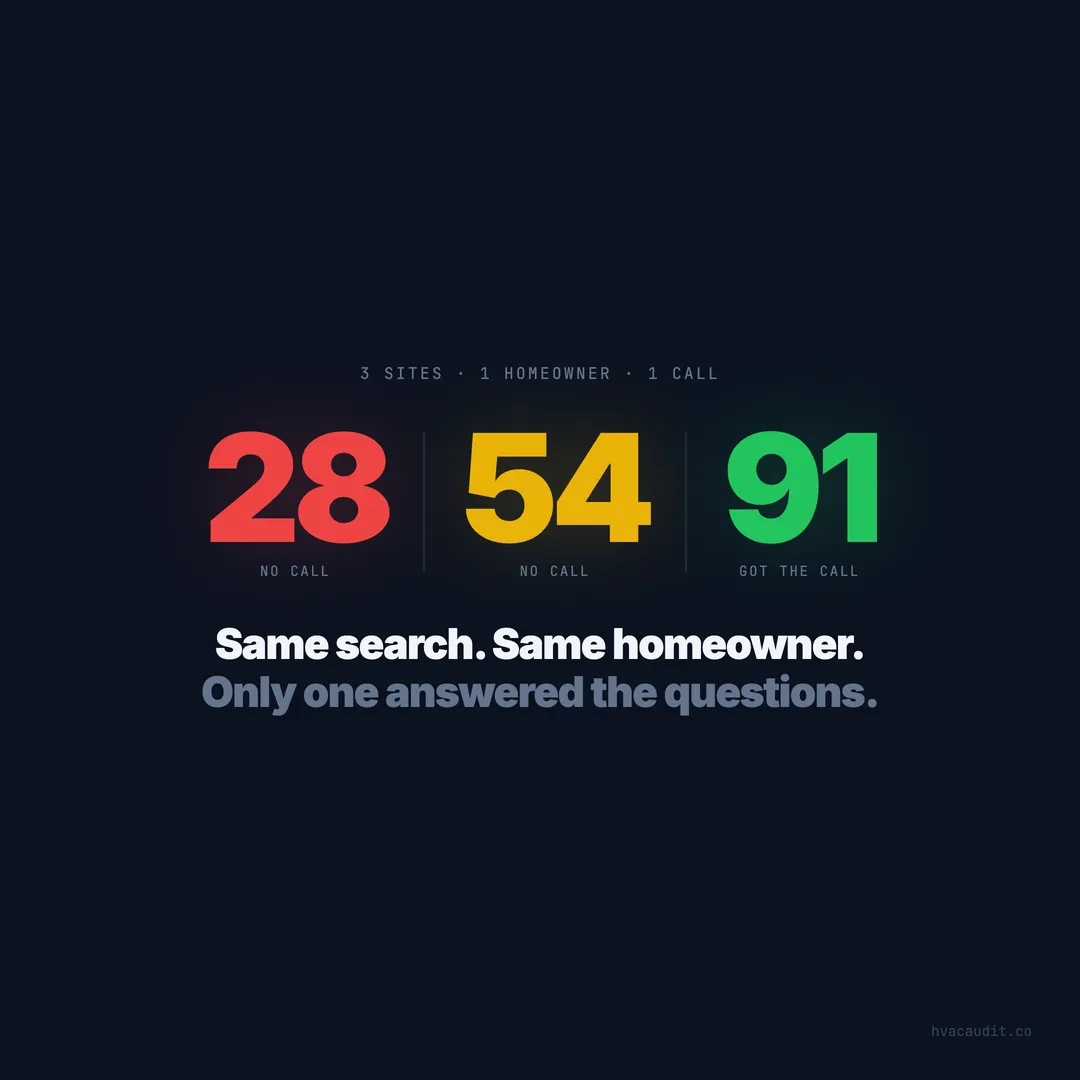
We opened 3 HVAC websites as if we needed AC repair at 11 PM. One scored 28, one scored 54, one scored 91. Here's exactly what a homeowner sees — and why most sites fail the 5-second trust test.
It’s 11 PM on a Friday in July. Your AC just stopped. The house is 84 degrees and climbing. You pick up your phone and search “AC repair near me.” Three results show up. You’re going to make a decision in the next 60 seconds — and you’re going to base it almost entirely on what you see in the first 5 seconds of each website.
Users form an opinion about a website in 0.05 seconds. That’s 50 milliseconds — faster than you can blink. And 94% of that first impression is design-related, not content-related. You’re not reading. You’re scanning. You’re looking for signals that say “this is a real business that will actually show up.”
We pulled three real HVAC websites from our 147-site audit and walked through each one the way a homeowner would — at 11 PM, on a phone, with a dead AC unit. One scored 28 out of 100. One scored 54. One scored 91. Here’s what the homeowner actually experiences.
Site A: Score 28 — “I’m already gone”
The homeowner taps the first result. The page starts loading. And loading. And loading.
The site takes 14 seconds to load on mobile. By 3 seconds, 53% of mobile visitors have already left. By 5 seconds, the bounce probability has jumped 90%. This homeowner is patient — she waits. What she gets isn’t worth the wait.
The homepage opens to a full-screen stock photo of a house with a generic “Welcome to [Company Name]” headline. No phone number visible. No mention of emergency service. No pricing. The navigation menu has six items: Home, About, Services, Gallery, Blog, Contact.
She taps “Services.” Another stock photo. A paragraph about “comprehensive HVAC solutions for residential and commercial clients.” No specific services listed. No pricing. No mention of AC repair.
She taps “Contact.” A form with seven fields — name, email, phone, address, service needed, preferred date, message. No phone number on the page. No “call now” button. At 11 PM with a dead AC, a seven-field form isn’t an answer. It’s a wall.
Total time on site: 22 seconds. Action taken: none.
Here’s what failed the trust test:
| Trust signal | What the homeowner needed | What the site provided |
|---|---|---|
| Speed | Under 3 seconds | 14 seconds |
| Phone number | Visible without scrolling | Buried on contact page |
| Emergency messaging | ”24/7” or “same-day” | Nothing |
| Pricing | Any range or diagnostic fee | Nothing |
| Real photos | Team, van, work examples | Stock photos only |
| Reviews | Star rating, recent reviews | None on site |
| Credentials | License number, certifications | None visible |
This site scored 28 out of 100. It’s not unusual. The average HVAC site scores 34 — which means most sites look almost exactly like this one.
Site B: Score 54 — “Maybe, but I’m not sure”
The homeowner opens the second result. It loads in 4.2 seconds — not great, but she sees content before she gives up. The homepage has the company name, a real photo of a service van, and a phone number in the header.
Better. But not enough.
The headline says “Quality HVAC Services Since 1998.” That tells the homeowner the company exists — but it doesn’t tell her whether they can fix her AC tonight. There’s no mention of emergency service on the homepage. No pricing. No “available 24/7.”
She scrolls. There’s a list of services — AC repair, heating, installation, maintenance. Each links to a separate page. She taps “AC Repair.” The page has a paragraph about the importance of regular AC maintenance and a list of “signs your AC needs repair.” Helpful content, wrong moment. She needs repair now, not a diagnostic checklist.
There are three Google reviews embedded on the homepage — 5 stars, but the reviews are from 2024. The average homeowner reads 5–10 reviews before deciding. Three outdated reviews don’t clear that bar.
The phone number is visible. She could call. But she’s comparing. She opens the third result first.
Total time on site: 35 seconds. Action taken: none yet — moved to next tab.
| Trust signal | What the homeowner needed | What the site provided |
|---|---|---|
| Speed | Under 3 seconds | 4.2 seconds |
| Phone number | Visible without scrolling | Yes, in header |
| Emergency messaging | ”24/7” or “same-day” | Not on homepage |
| Pricing | Any range or diagnostic fee | Nothing |
| Real photos | Team, van, work examples | Van photo only |
| Reviews | Star rating, recent reviews | 3 reviews from 2024 |
| Credentials | License number, certifications | ”Licensed and insured” text only |
This site scored 54 out of 100. It has the basics — a real photo, a visible phone number, some reviews. But it doesn’t answer the questions every homeowner asks before calling. No pricing, no emergency response time, no warranty info, no team photos. The homeowner isn’t scared away, but she isn’t convinced either.
Site C: Score 91 — “This is the one”
The third site loads in 1.8 seconds. The homeowner sees the full homepage before she’s finished her first scroll.
The headline: “24/7 Emergency AC Repair — $150 Diagnostic, Waived With Repair.” Below that, a green “Call Now” button and the phone number in 24px text. Below that, a Google review widget showing 4.8 stars from 312 reviews.
She hasn’t scrolled yet. In under 3 seconds, this site has answered three questions: Are they available now? How much will it cost? Are they any good? The top 5% of HVAC websites all do this — they front-load the answers.
She scrolls anyway. Below the fold: a row of four trust badges — NATE Certified, BBB A+, state license number, “Background-Checked Technicians.” Below that, a section titled “What’s Included in Your Diagnostic” — a bullet list of exactly what the $150 covers.
Further down: a team photo of six technicians in branded uniforms standing in front of two service vans. Real people. Real business.
The financing section shows monthly payment options: “$89/month for a new system — 0% for 18 months.” The warranty section says “1-year labor warranty on all repairs. 10-year manufacturer warranty on installations.”
Total time on site: 18 seconds. Action taken: tapped “Call Now.”
| Trust signal | What the homeowner needed | What the site provided |
|---|---|---|
| Speed | Under 3 seconds | 1.8 seconds |
| Phone number | Visible without scrolling | Above the fold, 24px |
| Emergency messaging | ”24/7” or “same-day” | In the headline |
| Pricing | Any range or diagnostic fee | $150 diagnostic + repair ranges |
| Real photos | Team, van, work examples | Team photo + vans |
| Reviews | Star rating, recent reviews | 4.8 ★ from 312 reviews |
| Credentials | License number, certifications | 4 trust badges above fold |
What the 91-score site does that the others don’t
The difference between a 28 and a 91 isn’t a $50,000 redesign. It’s answering questions. Site C answers every question a homeowner has before they have to ask. Site A answers none. Site B answers some — but not the ones that matter at 11 PM.
75% of consumers judge a company’s credibility based on website design alone. But “design” doesn’t mean expensive graphics or animations. It means: Can I find what I need in under 5 seconds? Does this look like a real business? Do I feel safe calling them?
Here’s what separates the scores:
Speed kills — or converts. Site A at 14 seconds lost 90%+ of visitors before they saw anything. Site C at 1.8 seconds loaded faster than the homeowner could change her mind. Every second matters, but the first three seconds matter most.
Above-the-fold answers. Site C put pricing, availability, and reviews above the fold. Site B put “Quality HVAC Services Since 1998.” One answers questions. The other talks about itself.
Review depth, not just presence. Site B had 3 reviews from 2024. Site C had 312 with a 4.8 average. 91% of homeowners check reviews before calling. Volume and recency both matter — and your review strategy should generate at least 15 new reviews per month.
CTAs placed above the fold outperform those below by 304%. Site C’s “Call Now” button was the second thing the homeowner saw. Site A’s phone number required navigating to the contact page. That navigation is a conversion killer — 44% of visitors leave a website if there’s no visible contact information.
The 5-second trust test your website is probably failing
Every homeowner who visits your website runs this test unconsciously. In 5 seconds, they need to answer three questions:
- Can they help me right now? (Emergency messaging, response time)
- How much will this cost? (Pricing range, diagnostic fee)
- Can I trust them? (Reviews, photos, credentials)
If your site answers all three in 5 seconds, you get the call. If it answers none, you get the back button. If it answers one or two, the homeowner opens the next tab and compares.
70% of home service inquiries come from mobile. On a phone screen, you have even less space to answer these questions. That means the three answers need to live in the first 400 pixels of your homepage — above the fold, before any scroll.
Your site is either Site A, B, or C — and you probably think it’s C
Most HVAC contractors think their website is decent. The average score is 34 out of 100. When we show owners their audit results, the most common reaction is surprise — not because they thought their site was perfect, but because they never looked at it the way a homeowner does.
Open your own website on your phone right now. Set a timer for 5 seconds. Can you see: a phone number, pricing or a diagnostic fee, emergency availability, and at least one trust signal (reviews, credentials, or a real photo)? If the answer is no to any of those, your site is closer to Site A than Site C.
The gap is costing you $4,200 a month in missed calls. Not because your marketing isn’t working — because your website is answering zero of the questions that decide whether the homeowner picks up the phone.
The homeowner at 11 PM didn’t compare prices across three sites. She compared experiences. One site made her feel confident. The other two made her feel nothing. The one that answered her questions got the only thing that matters — the call.
Keep reading
Want to know your score?
Drop your URL — full report in 48 hours.
We're on it.
Report in your inbox within 48 hours.