The First 3 Seconds of Your HVAC Website Decide Everything
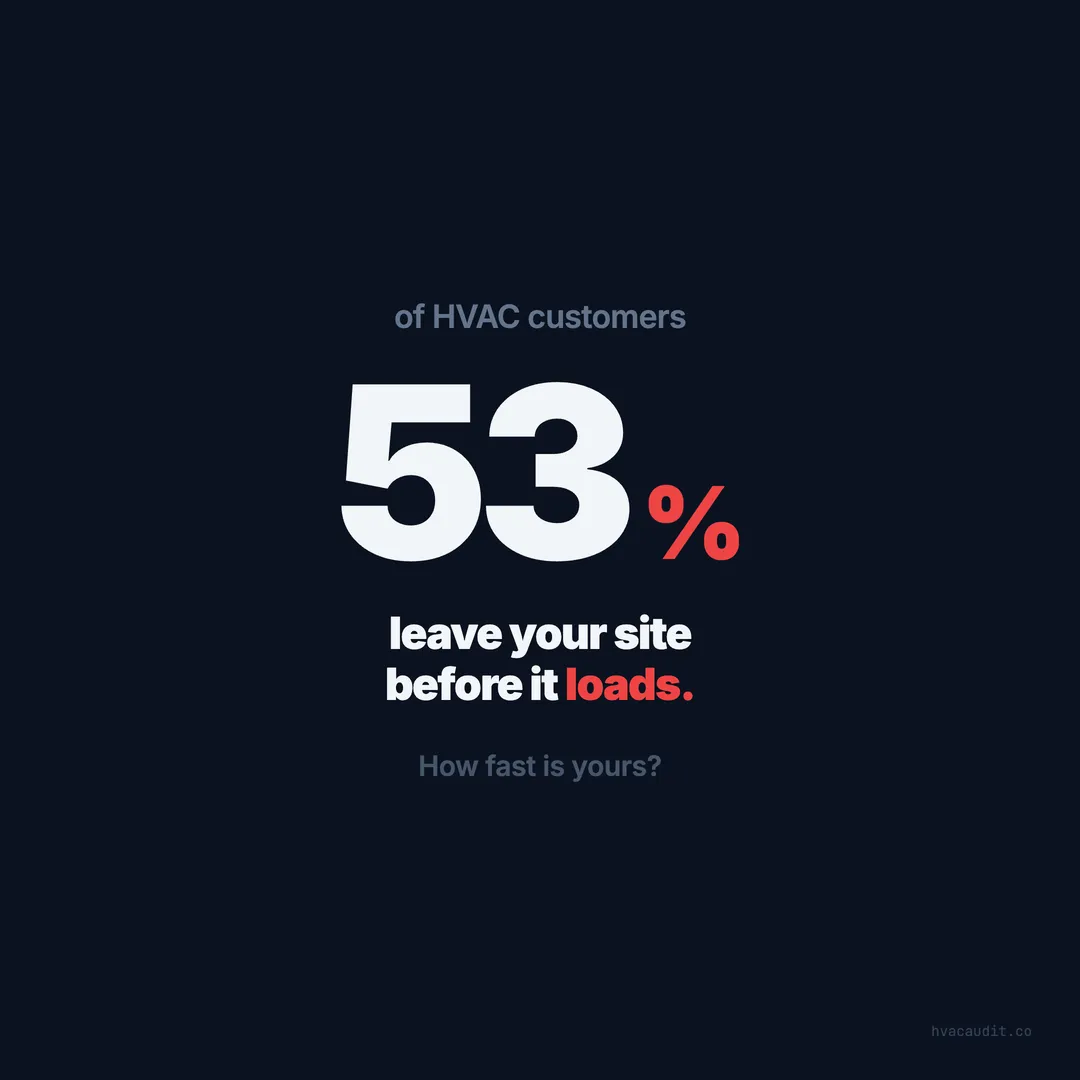
53% of visitors leave after 3 seconds. What your site shows above the fold — before any scrolling — determines whether the phone rings or the visitor bounces.
A homeowner’s AC dies at 9 PM. She grabs her phone, searches “AC repair near me,” and taps the first result. Your website starts loading.
Three seconds. That’s how long she’ll wait. 53% of mobile visitors leave if a page takes longer than 3 seconds to load. But even if your site loads in time, the next 2 seconds are just as critical. What she sees above the fold — the part of the page visible without scrolling — decides whether she calls or hits the back button.
The average HVAC website wastes those 3 seconds on logos, stock photos, and company slogans. The top performers use them to answer one question: “Can this company solve my problem right now?”
What homeowners need to see in 3 seconds
When someone searches for HVAC service, they have an immediate need. The AC is broken. The furnace won’t start. They need a tune-up before summer. They’re not browsing — they’re buying.
In those first 3 seconds, they need to see three things:
1. What you do. “Emergency AC Repair” or “Same-Day Heating Service.” Not “Welcome to [Company Name]” or “Your Comfort Is Our Priority.” The visitor needs to confirm in one glance that you offer the service they need.
2. How to contact you. A tap-to-call phone number or a “Book Now” button. Visible. Clickable. No scrolling required. 90% of HVAC leads happen over the phone — if the phone number isn’t visible immediately, you’ve lost the majority of your conversion opportunity.
3. Why you, not the next result. “Here in 60 minutes,” “$89 diagnostic,” “4.9 stars, 200+ reviews,” “Licensed & Insured.” One trust signal that separates you from the 3 other results the homeowner has open in other tabs.
That’s it. Service + contact + trust. Everything else — your history, your team photos, your full service list — comes after the fold.
What most HVAC websites show instead
We’ve audited 147+ HVAC websites. Here’s what the average site shows above the fold:
A full-width hero image. Usually a stock photo of a technician or an HVAC unit. It adds nothing to the visitor’s decision. It takes 2–4 seconds to load on mobile. It pushes the actual content below the fold.
The company name and a tagline. “Johnson HVAC — Your Comfort Experts Since 1987.” This tells the visitor nothing about whether you can help them tonight. The company name is already in the tab title and the Google listing that brought them here.
A navigation menu with 8+ items. Services, About, Blog, Careers, Gallery, Reviews, Contact, FAQ. Each link is an exit point. The visitor came for one thing — every link to something else is a distraction.
No phone number above the fold. The number is in the header, but it’s 10px font and not clickable on mobile. Or it’s below the hero image, requiring a scroll. Or it’s only on the contact page.
No CTA. No “Call Now” button, no “Book Online” link, no “Get a Quote.” The visitor sees a pretty page and no instruction on what to do next. So they do nothing — and leave.
The above-the-fold formula that converts
The HVAC sites in the top 5% of our audit scores follow the same above-the-fold structure:
Line 1: The problem + your solution
“AC Not Working? Same-Day Repair — We’re On Our Way.”
This immediately confirms: yes, you do what they need. And you do it fast.
Line 2: The trust signal
“4.9 stars from 200+ homeowners. Licensed & Insured. $89 diagnostic.”
Price, social proof, and credentials in one line. This answers “why you” before the visitor scrolls.
Line 3: The CTA
A large, high-contrast button: “Call Now: (555) 123-4567” or “Book Online — Available Tonight.”
The button should be the most visually prominent element above the fold. Not the logo. Not the hero image. The button.
Background: Simple, fast-loading
A solid color or a small, compressed photo. Not a full-width 4MB hero image. The background’s job is to not slow down the page — nothing more.
This formula works because it matches the visitor’s mental state. They have a problem. They want to know you can fix it. They want to know they can trust you. They want to take action. In that order, in 3 seconds.
The mobile problem you don’t see
When you check your website, you’re sitting at your desk on a 27-inch monitor with a wired internet connection. The site loads instantly. You can see the phone number, the navigation, and two sections of content all at once.
Your customer is on a 6-inch phone screen. 65% of HVAC website traffic is mobile. On that screen, your hero image takes up 100% of the viewport. The phone number in the header is microscopic. The navigation menu covers half the screen when opened. The “Welcome to [Company Name]” headline fills the remaining space.
Nothing actionable is visible. The visitor would need to scroll past the hero, past the company intro, past the service grid, to find a phone number or contact form. On mobile, that’s 4–6 thumb swipes. Each swipe is a chance for them to give up and try the next Google result.
Test your site on a phone, on cellular data, in a context where you’d be a customer. Not at your desk. Not on Wi-Fi. Go outside, use 4G, and pretend your AC just died. Would your own site convince you to call?
Speed is the prerequisite
None of the above-the-fold optimization matters if the page doesn’t load in 3 seconds. The average HVAC site takes 18.4 seconds to load. At that speed, the visitor never sees your above-the-fold content at all — they see a white screen and leave.
Page speed is the prerequisite. You can have the perfect headline, the perfect CTA, the perfect trust signals — and if the page loads in 8 seconds, 53% of visitors will never see any of it.
The biggest speed killers above the fold:
- Uncompressed hero images. A 4MB JPEG hero takes 6+ seconds on 4G. Compress to WebP, reduce dimensions, and target under 200KB.
- Render-blocking scripts. JavaScript and CSS files that load before the page can render. Defer everything that isn’t critical to the first paint.
- Third-party embeds. Live chat widgets, review widgets, and social media feeds that load above the fold. Move them below the fold or lazy-load them.
- Custom fonts. Loading 4 font weights from Google Fonts adds 1–2 seconds. Self-host your fonts and preload the one weight used above the fold.
Fix your first 3 seconds
If your HVAC website isn’t generating calls, start here. But the fastest single improvement you can make is fixing what visitors see in those first 3 seconds:
- Replace your hero section with a clear headline, trust signal, and CTA. Remove the full-width stock photo.
- Add a sticky tap-to-call button on mobile that’s visible on every page, at every scroll position.
- Compress your above-the-fold images to WebP, under 200KB. Target a Largest Contentful Paint under 2.5 seconds.
- Remove navigation distractions. On mobile, collapse the menu. The CTA button should be more prominent than the hamburger menu.
These changes take half a day. The impact is immediate — because you’re fixing the exact moment where most HVAC websites lose their visitors.
What the competition’s first 3 seconds look like
The HVAC companies getting calls in your market have already figured this out. Open a new tab and search “AC repair [your city].” Click the top 3 results. Compare their above-the-fold content to yours.
You’ll likely notice: the top-ranking sites have a clear headline with the service and city name, a visible phone number or booking button, and some form of trust signal (reviews, years in business, certification badge). They don’t waste the first screen on welcome messages or stock photography.
These aren’t bigger companies or better-funded companies. They’re companies that understood the 3-second rule and structured their homepage accordingly. The fix is structural, not financial — and the gap between 2% and 10% conversion is entirely about what happens in those first 3 seconds.
If your HVAC website isn’t generating the leads it should, start with the diagnostic — and pay attention to what your site shows in those first critical seconds.
Keep reading
Want to know your score?
Drop your URL — full report in 48 hours.
We're on it.
Report in your inbox within 48 hours.