88% Buy After Watching Brand Video — HVAC Companies Make None
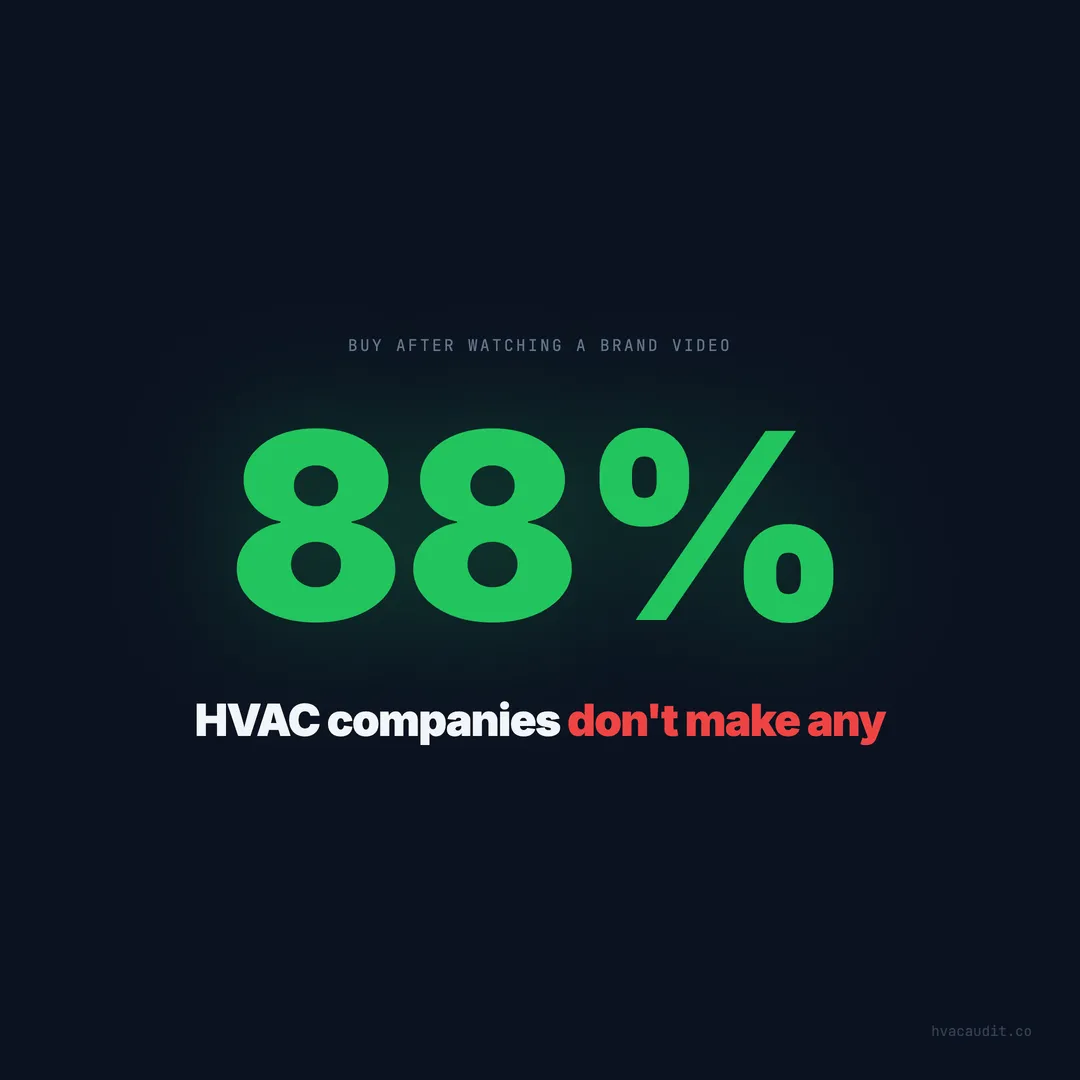
88% of consumers say brand video convinced them to buy. Video boosts site conversions by 80%. Yet most HVAC companies produce zero video content. Here's what that's costing.
A homeowner in Denver needs a furnace replacement. She narrows it down to two companies. One has a website with stock photos, bullet-point service descriptions, and a contact form. The other has a 90-second video of the owner walking through an actual installation, explaining what they’re doing and why the homeowner chose them. She watches the video, sees real technicians in a real home, and calls that company without checking anyone else.
The first company never knew they lost the lead. They never will.
88% of consumers say watching a brand’s video has convinced them to buy a product or service. Not “considered.” Not “thought about.” Convinced. That’s the strongest conversion driver in marketing — and the HVAC industry is almost completely ignoring it. When we audited 147 HVAC websites, only 9% had any video content on their site. The average HVAC site score was 34 out of 100. The ones with video averaged 52 out of 100.
The video gap in HVAC is enormous
91% of businesses use video as a marketing tool in 2026. That’s across all industries. In HVAC, the number is closer to 12-15% for any video at all and under 5% for consistent video production. The gap between what consumers want and what contractors deliver has never been wider.
Here’s what consumers are telling us they want, and what HVAC companies are giving them:
| What Consumers Want | What HVAC Companies Deliver |
|---|---|
| 63% want short video to learn about a service | Static text pages with no visual explanation |
| 87% say video quality influences brand trust | Blurry phone photos of equipment |
| 80% feel more confident purchasing after video | ”Call for a free estimate” with zero context |
| 82% have been convinced to buy by watching video | Stock photography of smiling families |
The mismatch is staggering. Homeowners are actively seeking video content to make their decision, and 95% of HVAC companies aren’t producing any. That’s not competition — that’s an open field.
Video content converts at rates nothing else matches
The conversion numbers for video aren’t marginal. They’re transformational.
Video on a landing page increases conversions by up to 80%. For HVAC companies with landing pages built for conversion, adding video is the single highest-ROI improvement available. A service page with a 2-minute video explaining the process, showing the team, and walking through pricing converts at nearly double the rate of an identical page without video.
Websites with video hold visitors 2.6x longer than sites without. In an industry where the average site loads in 18.4 seconds and 53% of visitors leave before the page finishes loading, every second of engagement matters. Video gives visitors a reason to stay — and staying longer correlates directly with higher conversion rates.
Video in email increases click-through rates by 65%. If you’re sending follow-up emails after service calls, maintenance reminders, or seasonal promotions, embedding video dramatically improves engagement. A 30-second “here’s what to look for before summer” video in an April email outperforms any text-only maintenance reminder.
The five videos every HVAC company needs
You don’t need a film crew. You don’t need a production budget. You need a smartphone, decent lighting, and a plan. Here are the five videos that move the needle hardest for HVAC companies, ordered by conversion impact.
1. The “Meet the owner” video (homepage)
A 60-90 second video of the owner speaking directly to camera. Who you are, why you started the company, what makes your team different. Companies with an owner-intro video on their homepage see 34% higher form submission rates because it humanizes the brand instantly.
This video doesn’t need to be polished. Authenticity outperforms production value for service businesses. An owner speaking naturally from their shop or truck is more trustworthy than a scripted, studio-produced corporate video. Homeowners want to know who they’re hiring, not what your marketing budget is.
2. The process walkthrough (service pages)
A 2-3 minute video showing what actually happens during an AC repair, installation, or maintenance visit. Walk through the steps. Show the equipment. Explain the timeline.
72% of consumers prefer video over text when learning about a service. A homeowner who’s never hired an HVAC company doesn’t know what to expect. The anxiety of the unknown — “Will they damage my house? How long will it take? What does the equipment look like?” — is a conversion killer. Video eliminates that anxiety.
Film one installation and one repair. Those two videos cover the majority of your service pages. Embed them directly on the relevant service page, above the fold if possible.
3. The customer testimonial (any high-traffic page)
A 30-60 second video of a real customer at their home, talking about their experience. Not scripted. Not prompted with leading questions. Just “Tell us about your experience.”
Video testimonials increase trust 2x more than written testimonials because they’re harder to fake. A homeowner looking into the camera and saying “They showed up on time, explained everything, and the price was exactly what they quoted” is worth more than 50 written reviews. Place these on your pricing page, your about page, and your homepage. Video testimonials also amplify your Google reviews strategy — customers who film a testimonial are 3x more likely to leave a written review the same week.
4. The educational explainer (blog and social)
Short videos (60-90 seconds) answering common questions: “How often should I change my filter?” “What’s the difference between a heat pump and a furnace?” “When should I replace my AC?”
These videos serve double duty. They rank in YouTube and Google video search — video results appear in 62% of Google searches — and they provide shareable content for social media. An HVAC company posting one educational video per week builds a library that generates organic traffic indefinitely.
5. The before/after showcase (portfolio and ads)
A 30-45 second time-lapse or side-by-side of an old system being replaced with a new one. Clean installation shots. The customer’s reaction at the end.
Before/after content gets 3.2x more engagement on social media than any other content type for home services. It’s visual proof of what you do, compressed into a format that stops the scroll.
TikTok and short-form video are untapped gold for HVAC
TikTok has over 1 billion monthly active users. YouTube Shorts and Instagram Reels have comparable audiences. These platforms are fundamentally changing how homeowners discover local businesses — and HVAC contractors are almost entirely absent.
The contractors who are posting short-form video are seeing results that defy expectations:
Under-60-second videos outperform longer content by 3.5x on engagement metrics. A 45-second video of a technician explaining why a capacitor failed, shot from the job site, gets more views than a polished 5-minute company overview. Authenticity and brevity win on short-form platforms.
HVAC-related hashtags on TikTok have over 2.8 billion cumulative views. People are searching for HVAC content — filter changes, thermostat tips, energy-saving hacks, “is my AC broken?” diagnostics. The contractors providing that content are building audiences of potential customers that no ad budget can replicate.
The excuse “our customers aren’t on TikTok” doesn’t hold up. 67% of TikTok users are over 25, and the fastest-growing demographic is 35-54 — exactly the homeowner segment that buys HVAC services. The platform isn’t just for teenagers. It’s a visual search engine where homeowners research purchases before committing.
Production doesn’t need to cost anything
The #1 objection from HVAC contractors: “We can’t afford professional video.” You don’t need professional video. You need consistent video.
A modern smartphone shoots 4K video. Natural lighting from a window or outdoor shade looks professional. A $30 clip-on microphone eliminates wind noise. A free editing app (CapCut, InShot) handles basic cuts and text overlays. Total investment: under $50 and 30 minutes per video.
| Production Level | Cost | Quality | Best For |
|---|---|---|---|
| Smartphone + natural light | $0-$50 | Good enough | Social media, testimonials, quick tips |
| Smartphone + mic + tripod | $50-$150 | Professional | Service page videos, educational content |
| Hired videographer (one day) | $500-$1,500 | High | Homepage intro, major testimonials |
| Professional production | $3,000-$8,000 | Premium | Brand launch, comprehensive service videos |
The contractors generating the best ROI from video are spending $0-$150 per video and producing 2-4 videos per month. They’re not waiting for perfect — they’re putting out authentic content consistently. The companies waiting for budget to hire a production team are still waiting while their competitors build video libraries.
Where to post your video content
A video sitting on your phone is worth nothing. Distribution determines results. Here’s the priority stack for HVAC video:
1. Your website (highest conversion impact). Embed videos directly on service pages, the homepage, and your about page. Self-hosted or YouTube embeds both work, but YouTube embeds can slow page load — use lazy loading to protect your site speed. Every video on your site should have a clear CTA immediately below it.
2. YouTube (highest SEO impact). YouTube is the second-largest search engine. An HVAC company with 20-30 videos on YouTube targeting “how to” and “what to expect” keywords generates organic traffic from video search results. Websites with video are 53x more likely to appear on Google’s first page — and YouTube embeds contribute to that signal.
3. Facebook and Instagram (highest reach impact). Native video on Facebook gets 10x more organic reach than link posts. Upload the video directly to Facebook — don’t share a YouTube link. Instagram Reels and Stories extend reach to homeowners who follow local accounts. This ties directly into your social media strategy.
4. TikTok and YouTube Shorts (highest discovery impact). Short-form vertical video reaches people who aren’t searching for HVAC services yet but will eventually need them. Building awareness today means being the first name they think of when their AC fails tomorrow.
The first-mover advantage is disappearing
Right now, HVAC video marketing is a near-empty field. 88% of HVAC companies produce no video content. That makes the barrier to entry laughably low — any contractor who starts producing consistent video will immediately stand out in their market.
But this window won’t last. As more contractors catch on, the early advantage shrinks. The companies building video libraries now will have 50-100 videos when competitors are just starting with their first.
82% of marketing professionals say video ROI has increased year over year. The companies measuring their video performance are doubling down. The companies avoiding video are falling further behind. And in an industry where the average website conversion rate hovers around 2-3%, the ability to nearly double conversions through video is the most underused tool available.
The content calendar that works
Producing video consistently requires a system. Here’s a sustainable calendar for HVAC contractors who want to produce 2-4 videos per month without hiring anyone:
Week 1: Film a 60-second educational tip from a job site. Topics rotate seasonally — filter changes in spring, thermostat settings in summer, furnace prep in fall, energy savings in winter.
Week 2: Film a 30-second before/after or project highlight. Finished installation, clean ductwork, happy customer reaction. No narration needed — text overlay works.
Week 3: Film a 90-second “meet the tech” or process walkthrough. Introduce a team member or show what a service call looks like from start to finish.
Week 4: Film a customer testimonial (with permission). 45-60 seconds of a real homeowner describing their experience.
Total time commitment: 2-3 hours per month. That’s less time than most owners spend on wasted Google Ads. The videos compound — each one works for years, unlike ads that stop the moment you stop paying. They also become permanent assets on the pages that actually generate leads — service pages, landing pages, and your about page.
Your competitors aren’t making video. Your customers want video. The gap between those two facts is where your next 50 leads are hiding.
Keep reading
Want to know your score?
Drop your URL — full report in 48 hours.
We're on it.
Report in your inbox within 48 hours.