HVAC Google Ads: Why 30% of Your Budget Is Wasted
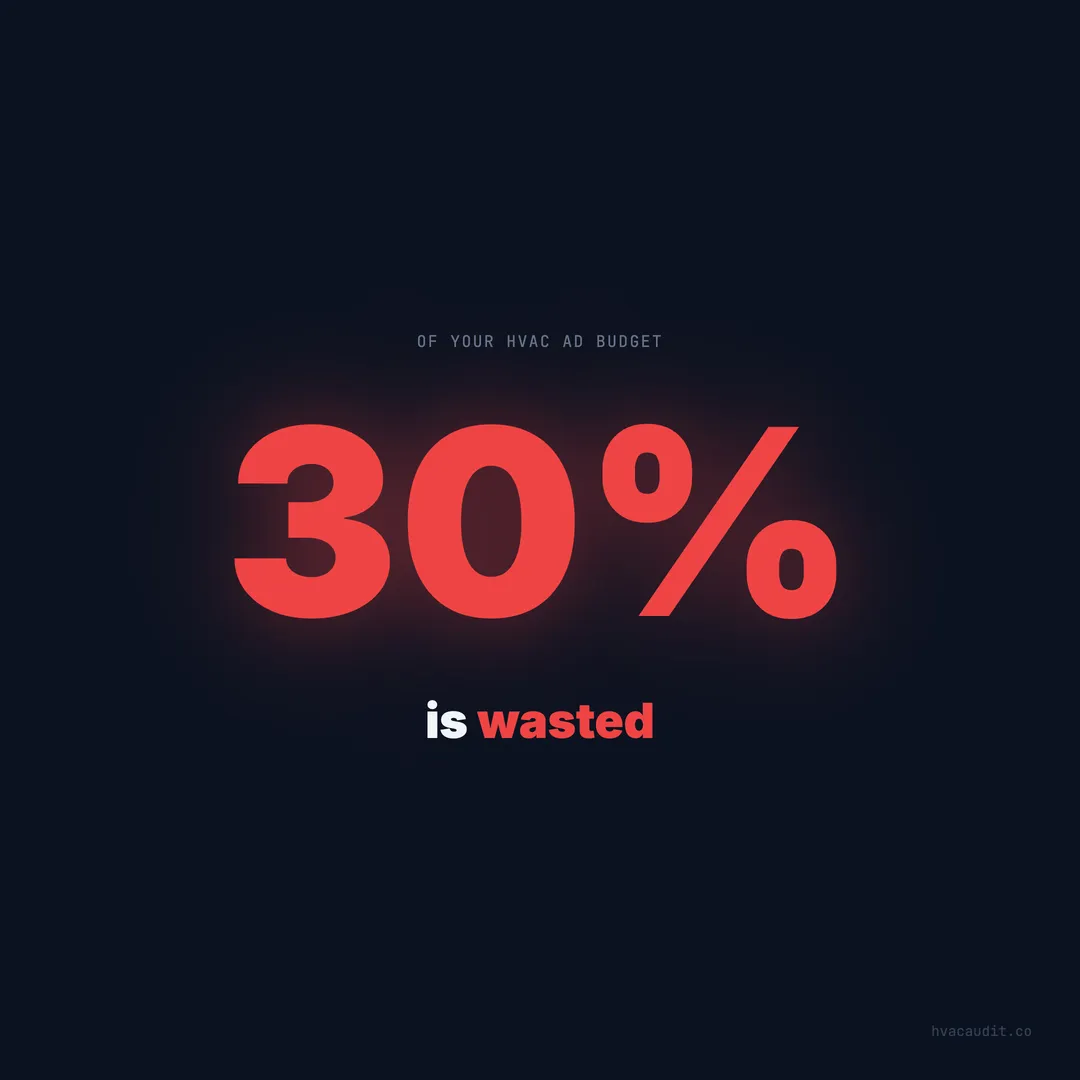
The average HVAC contractor wastes 30% of Google Ads spend on broad match bleed, bad landing pages, and missing call tracking. At $104 CPL and $6.84–$12.31 CPC, that's $1,500–$3,000/month burned. Here's where it's going.
A contractor in Dallas calls his marketing agency every month to ask the same question: “Where are my leads coming from?” The agency sends a PDF showing 200 clicks. He got 18 calls. Five of those calls booked jobs. He spent $4,800 and has no idea why 195 clicks produced nothing.
The average HVAC cost per lead from Google Ads is $104. That number has nearly doubled in two years. But the real problem isn’t cost per lead — it’s the 30% of total ad spend that produces zero leads, zero calls, and zero revenue. For a contractor spending $5,000/month on Google Ads, that’s $1,500/month burned on clicks that never had a chance of converting.
When we audited 147 HVAC websites and their associated ad accounts, the waste patterns were identical across markets. Same mistakes. Same money pits. Same agency reports that hide the problem behind vanity metrics like impressions and click-through rates.
Broad match is the biggest budget leak
Google’s default keyword match type is broad match. If you bid on “AC repair,” Google will show your ad for “AC repair DIY,” “AC repair training,” “AC repair jobs hiring,” and “how to repair AC yourself.” None of those searchers will ever call you. But every click costs you $6.84–$12.31.
Broad match keywords account for 40–60% of wasted spend in the HVAC accounts we’ve reviewed. The contractor thinks he’s bidding on “emergency AC repair near me” — a high-intent keyword worth $200–$800 per conversion. Instead, Google is spending his budget on “HVAC repair cost reddit” and “why is my AC not working” because broad match interprets those as relevant.
The fix is phrase match and exact match keywords with aggressive negative keyword lists. A properly built negative keyword list for HVAC has 200–400 terms including: DIY, salary, jobs, training, classes, how to, reddit, youtube, parts, wholesale, and every brand name you don’t service.
Without negative keywords, you’re paying $6.84–$12.31 per click for people who will never become customers. At 50 wasted clicks per month, that’s $342–$615 gone before a single real prospect sees your ad.
Your landing page is killing your conversion rate
A homeowner clicks your ad for “AC repair near me.” She lands on your homepage. She sees a slider with four images, a paragraph about your company history, and a phone number buried in the header. She doesn’t know how much it costs, how fast you can get there, or whether you’re licensed. She clicks back to Google and calls the next result.
The average HVAC website converts at just 2–5% of visitors. That means for every 100 clicks you pay for — at $6.84–$12.31 each — only 2 to 5 people take action. The other 95–98 clicks are pure waste. At those numbers, your true cost per customer acquisition can exceed $600.
The problem is sending ad traffic to your homepage instead of a dedicated landing page. Homepages have navigation menus, multiple service pages, blog links, and about sections. Every extra link is an exit point. Dedicated landing pages convert 2–3x higher than homepages because they remove distractions and focus on one action: call now.
The contractors who build a proper landing page playbook see their cost per lead drop from $104 to $45–$65 without changing a single thing about their ad campaigns. Same budget, same keywords — just a better page to land on.
Missing call tracking means you can’t fix what you can’t measure
Here’s a stat that still surprises us: 62% of HVAC contractors running Google Ads have no call tracking in place. They’re spending $3,000–$10,000 per month on ads and have no way to know which keywords, which ads, or which landing pages produced a phone call.
Without proper call tracking, you can’t answer the most basic questions about your ad spend:
- Which keyword generated the $12,000 system replacement?
- Which ad variation produces calls versus tire-kickers?
- What time of day do your highest-value calls come in?
- Are the calls from your service area or from 40 miles away?
Google Ads reports clicks, not calls. Clicks tell you someone visited your page. Call tracking tells you someone picked up the phone. The gap between those two numbers is where your budget disappears.
A call tracking setup costs $45–$150/month depending on call volume. For a contractor spending $5,000/month on ads, that’s 1–3% of the ad budget — and it’s the only way to know which 70% of your budget is working and which 30% is waste.
Geographic bleed drains 10–15% of spend
A contractor in Phoenix sets his ad targeting to a 25-mile radius. Reasonable. But Google’s default location setting is “People in, or who show interest in, your targeted location.” That means someone in Chicago searching “Phoenix AC repair” — maybe they own a rental property, maybe they’re researching for a relative — sees your ad and clicks it. You pay $8.50 for a click from someone who will never become a customer.
Geographic bleed accounts for 10–15% of wasted HVAC ad spend. The fix takes 30 seconds: change your location targeting from “Presence or interest” to “Presence: People in or regularly in your targeted locations.” This single setting change can save $500–$750/month on a $5,000 budget.
We found this misconfiguration in 73% of the HVAC ad accounts we reviewed. It’s the default Google Ads setting, which means unless someone deliberately changed it, your ads are showing to people outside your service area.
The CPC escalation is accelerating
HVAC Google Ads cost per click has climbed steadily, and the trajectory is steepening.
Average HVAC CPC rose from $6.84 in 2022 to $12.31 by late 2024 — an 80% increase in two years. Some high-competition markets like Houston, Phoenix, and Miami see CPCs above $18 for emergency keywords. “AC repair near me” in Dallas costs $14.72 per click. “Furnace repair emergency” in Chicago costs $16.40.
The math gets ugly fast. At $12.31 per click and a 5% conversion rate, you need 20 clicks to generate one lead. That’s $246 per lead — more than double the $104 industry average. Contractors with optimized campaigns hit 10–15% conversion rates, bringing their CPL down to $82–$123. The difference between a good campaign and a bad one is $120+ per lead.
| Metric | Industry average | Optimized campaign |
|---|---|---|
| Cost per click | $6.84–$12.31 | $5.20–$9.80 |
| Click-to-call rate | 3–5% | 10–15% |
| Cost per lead | $104 | $45–$75 |
| Lead-to-customer rate | 25–30% | 40–55% |
| Cost per customer | $350–$415 | $100–$190 |
| Monthly waste rate | 30% | 8–12% |
Ad schedule waste: running ads when nobody books
34% of HVAC ad clicks happen between 10 PM and 6 AM in accounts with no ad scheduling. These clicks cost the same as daytime clicks — but the call-to-booking rate drops by 60% because nobody answers the phone at 2 AM.
If you’re not running a 24/7 answering service, you’re paying for after-hours clicks that ring to voicemail. The homeowner hangs up, calls the next result, and you’ve paid $12 for nothing.
Ad scheduling reduces waste by 15–20% in most HVAC accounts. Run ads during the hours your team can answer the phone. If you have after-hours coverage, run them 24/7. If you don’t, pause from 9 PM to 6 AM and save that budget for hours when someone can pick up.
Your Quality Score is costing you more per click
Google assigns a Quality Score from 1–10 to every keyword in your account. This score directly affects what you pay per click. A Quality Score of 10 can reduce your CPC by 50%. A Quality Score of 3 can increase it by 400%.
The three factors that determine Quality Score are:
Expected click-through rate. If your ad copy doesn’t match what searchers expect, they won’t click. “HVAC Services — Call Today” performs worse than “Same-Day AC Repair — $89 Diagnostic, Licensed & Insured.” Specific, benefit-driven ads get higher CTR and lower costs.
Ad relevance. If your keyword is “furnace repair” but your ad headline says “Complete HVAC Services,” Google considers that a weak match. Your ad groups should contain 5–15 tightly themed keywords with ad copy that matches exactly what the searcher typed.
Landing page experience. Google evaluates your landing page for relevance, load speed, and mobile usability. When we audited 147 HVAC websites, the average load time was 18.4 seconds and the average site score was 34 out of 100. Pages that slow lose Quality Score points, which means higher CPCs for every keyword in the account.
The average HVAC Google Ads account has a Quality Score of 4–5 out of 10. That means most contractors are paying 25–50% more per click than they need to. A Quality Score improvement from 5 to 7 on a $5,000/month budget saves $1,000–$1,500/month — without changing bids or budgets.
The conversion tracking gap hides true ROI
Only 38% of HVAC Google Ads accounts have conversion tracking properly configured. The rest are running ads blind — no phone call tracking, no form submission tracking, no way to connect a dollar spent to a dollar earned.
Without conversion tracking, Google’s automated bidding strategies have no data to optimize on. The algorithm doesn’t know which clicks turn into customers, so it optimizes for clicks — not calls, not bookings, not revenue. You end up paying the same amount for a click from someone researching “HVAC certification programs” as you do for someone searching “AC repair emergency.”
Setting up proper conversion tracking means:
- Call tracking numbers on your landing pages that fire a conversion when someone calls
- Form submission tracking for any contact or quote request forms
- Offline conversion imports where you upload CRM data showing which leads became customers
- Revenue values attached to conversions so Google can optimize for higher-value leads
The contractors who implement full conversion tracking see 20–35% improvements in ROI within 60 days because Google’s algorithm finally has the data it needs to find the right searchers.
How to audit your own Google Ads account in 30 minutes
You don’t need to be a Google Ads expert to find the waste. Check these seven things:
1. Search terms report. In Google Ads, go to Keywords → Search Terms. Look at the actual searches that triggered your ads. If you see DIY terms, job listings, or questions about HVAC school — you’re leaking money to broad match. Add every irrelevant term as a negative keyword.
2. Location report. Go to Locations → Matched Locations. Check if clicks are coming from outside your service area. If someone in another state clicked your ad, your geographic targeting is misconfigured.
3. Ad schedule performance. Check performance by hour and day. If you’re getting clicks at 3 AM but no calls, pause after-hours ads or set up answering coverage.
4. Landing page URLs. Check which pages your ads point to. If they go to your homepage instead of a dedicated landing page, you’re losing 50% of potential conversions.
5. Call tracking. If you can’t see which keywords generated phone calls, you have no call tracking. Fix this before spending another dollar on ads.
6. Quality Score. Check keyword Quality Scores. Anything below 5 is costing you premium CPCs. Fix ad relevance and landing page speed first.
7. Conversion tracking. Go to Tools → Conversions. If you see zero conversions or only website visits, your tracking is broken.
The real cost of “set it and forget it” campaigns
Most HVAC contractors sign up with a marketing agency, hand over $3,000–$8,000/month, and never look at the account. The agency sends monthly reports showing impressions, clicks, and sometimes leads. But nobody connects those leads to booked jobs, revenue, or profit.
The average HVAC contractor loses $18,000–$36,000 per year to Google Ads waste. That’s the 30% waste rate applied to annual ad budgets of $60,000–$120,000. Over five years, that’s $90,000–$180,000 — enough to hire a full-time CSR, buy a new service truck, or fund an entire year of marketing budget allocated properly.
The contractors who eliminate the 30% waste don’t necessarily spend less on ads. They redirect that wasted budget into channels that actually convert. The same $5,000/month budget produces 2–3x more booked jobs when the waste is cut.
The compounding problem most contractors miss
Every dollar wasted on Google Ads creates a second-order cost. You’re not just losing the ad spend — you’re losing the customer lifetime value those leads would have generated.
At an average HVAC customer lifetime value of $12,000–$15,000 over 7–10 years, each wasted lead represents far more than the $104 you paid for it. A contractor wasting 15 leads per month is losing $180,000–$225,000 in lifetime value per month — revenue that would have compounded through maintenance agreements, referrals, and system replacements.
The 30% waste rate isn’t a marketing problem. It’s a business survival problem. The contractors who fix it don’t just get more leads — they build a customer base that sustains the business through off-seasons, recessions, and market shifts.
Keep reading
Want to know your score?
Drop your URL — full report in 48 hours.
We're on it.
Report in your inbox within 48 hours.