The $50 Click: How HVAC Companies End Up Paying 5x for the Same Ad
Some HVAC businesses pay $6 per click. Others pay $50 for the same keyword. The difference isn't the bid — it's the website. Here's how the cost spiral works.
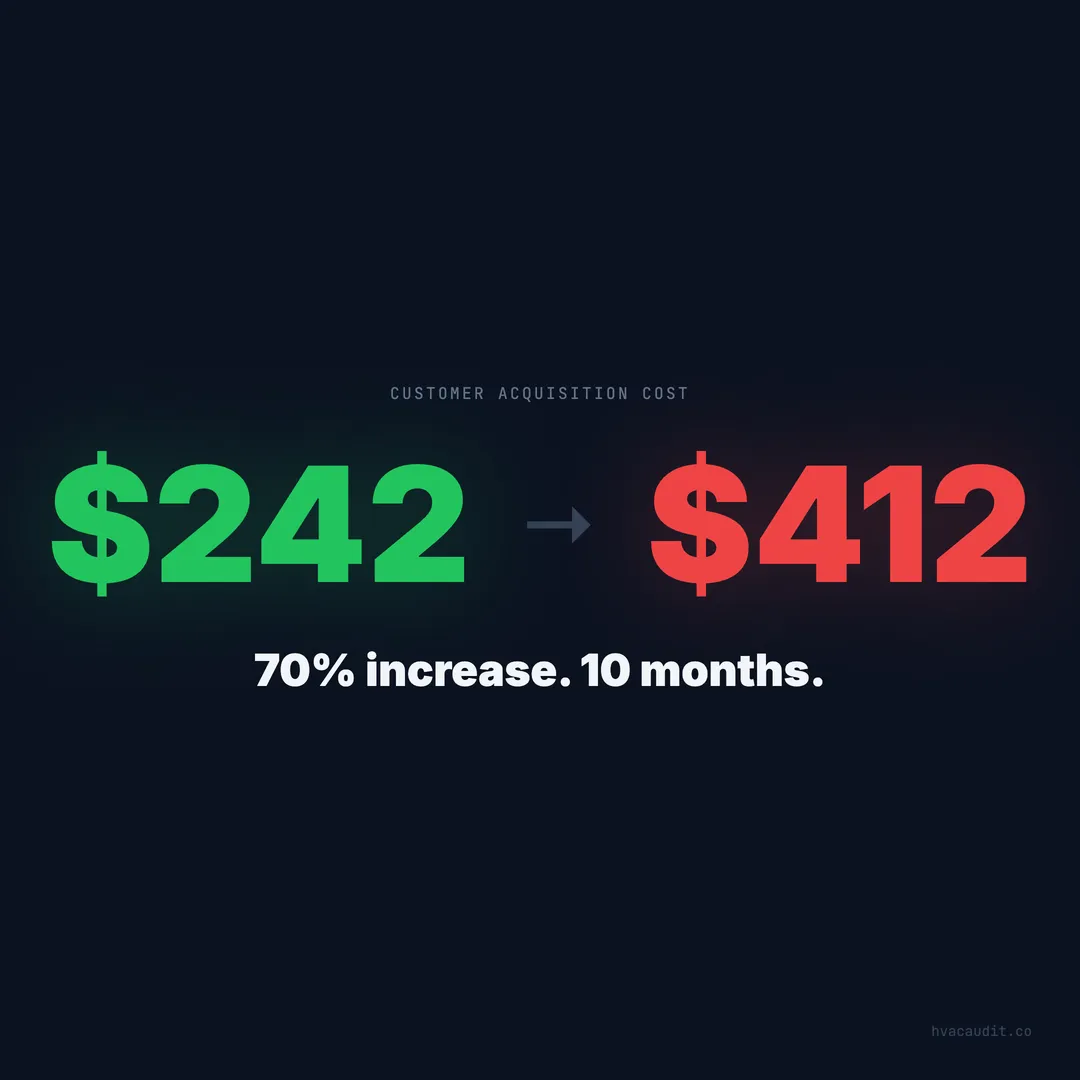
Two HVAC companies in the same city bid on the same keyword: “AC repair near me.” One pays $6.40 per click. The other pays $50. Same keyword. Same city. Same time of day.
This isn’t a bidding war — the $50 company isn’t bidding $50. They’re bidding $12. Google is charging them $50 because their website is so bad that Google has to penalize them to compensate for poor user experience. And this is happening to HVAC businesses across the country without them knowing it.
Here’s how a $12 bid turns into a $50 click, and why your website quality directly controls your ad costs.
The cost spiral explained
Google Ads doesn’t work like a simple auction. Your actual cost per click depends on three things: your bid, your Quality Score, and the competition. When your Quality Score drops, Google compensates by charging you more.
Stage 1: The website is slow. Your landing page loads in 12 seconds. Google detects this and flags your landing page experience as “Below average.” Your Quality Score drops from 7 to 4.
Stage 2: CPC increases. At Quality Score 4, Google charges a 1.5–2x penalty on your bids. Your $12 bid now costs $18–$24 per actual click. You don’t notice because you’re looking at average CPC across all keywords.
Stage 3: Fewer clicks, same budget. At $18–$24 per click instead of $12, your $5,000 monthly budget buys 208–278 clicks instead of 417. You’ve lost 33–50% of your traffic volume without changing anything about your ads.
Stage 4: Visitors bounce. Of those 278 clicks, 53% bounce because the site is too slow. That’s 147 clicks gone — $2,646 wasted. 131 visitors actually see your site.
Stage 5: Survivors don’t convert. Your site has no booking widget, the phone number isn’t clickable on mobile, and there’s no clear CTA. Conversion rate: 2%. Of 131 visitors, 2.6 call. Round up to 3.
Stage 6: True cost per lead. $5,000 budget ÷ 3 leads = $1,667 per lead. The competitor with the fast website, good Quality Score, and dedicated landing pages? They got 60+ leads from the same budget. Their cost per lead: $83.
This is the $50 click in action. Your stated CPC might be $18. But when you factor in bounces and low conversion rates caused by the website, your effective cost per converting click is $50+.
Where the money actually goes
On a $5,000/month Google Ads budget with a poor website:
| Stage | Clicks | Cost | Status |
|---|---|---|---|
| Total clicks purchased | 278 | $5,000 | Paid for |
| Bounced (53%, slow site) | 147 | $2,646 | Wasted |
| Saw site, no CTA visible | 79 | $1,422 | Wasted |
| Found CTA, didn’t trust (no reviews, no SSL) | 39 | $702 | Wasted |
| Called or filled out form | 3 | $54 | Converted |
| Didn’t answer phone | 1 | $18 | Wasted |
| Actual lead acquired | 2 | $5,000 | $2,500 CPL |
The $5,000 didn’t disappear. Google took it. But only $54 worth of clicks produced actual leads. The other $4,946 went to clicks that your website killed.
Why your ad agency doesn’t flag this
Your ad agency reports CPC, click-through rate, impression share, and sometimes conversions. These metrics measure the ad’s performance, not the website’s.
A CPC of $18 looks normal for HVAC. A click-through rate of 4% looks solid. Impression share of 60% looks competitive. Everything on the ad side looks fine. The problem is invisible in their reports because the problem is the landing page — which is outside their scope.
Most HVAC ad agencies don’t audit landing pages. They don’t check page speed, SSL, mobile responsiveness, or conversion elements. They optimize what they control: bids, keywords, and ad copy. They’re doing their job. But the money is leaking through the website, not the ads.
To see the real picture, you need:
- Call tracking — How many clicks produce phone calls?
- Form tracking — How many clicks produce form submissions?
- Quality Score by keyword — Where is Google penalizing you?
- Landing page analytics — What’s the bounce rate on your ad landing pages?
If your agency can’t provide these, they’re managing your ads blind. And you’re paying the $50 click premium without knowing it.
The real benchmark: cost per lead, not cost per click
Stop looking at cost per click. It’s a vanity metric for HVAC businesses. The only number that matters is cost per lead — how much you pay for each phone call or form submission from a real potential customer.
Industry benchmarks for HVAC cost per lead:
- Excellent: $45–$65 per lead (good website + dedicated landing pages)
- Average: $104 per lead (industry average across all sites)
- Poor: $200–$500 per lead (bad website, no landing pages)
- Terrible: $500+ per lead (bad website + broad match + no call tracking)
If your cost per lead is above $150 and you’re spending $3,000+/month on ads, your website is almost certainly the bottleneck. Improving the website — not the ads — is what moves you from $200 CPL to $65 CPL.
The competitors paying $6 per click
HVAC businesses with Quality Scores of 8–10 get Google’s discount pricing. Here’s what they have that you don’t:
Fast landing pages. Under 3 seconds on mobile. Compressed images, deferred scripts, minimal third-party code. Google rewards speed with lower CPCs.
SSL everywhere. HTTPS on every page. No Chrome warnings. Google considers this baseline security — without it, you’re penalized.
Dedicated landing pages. Each ad group points to a page that matches the keyword. “Emergency AC Repair in [City]” ad → “Emergency AC Repair in [City]” page. Perfect relevance match.
Low bounce rate. Because the page loads fast, has clear CTAs, and matches the ad, visitors stay. Google sees low bounce rate as a positive quality signal.
Mobile optimization. Large buttons, readable text, sticky call button, booking widget. The page works perfectly on a phone — which is how 65% of visitors access it.
None of these require more ad spend. They require a better website. The $6 company isn’t outspending you — they’re out-converting you. And Google rewards them with lower costs as a result.
How to stop paying $50 per click
The fix isn’t in Google Ads. It’s in your website.
Week 1: Install SSL. Compress all images. Defer non-critical scripts. Target under 3 seconds on mobile. This alone can move Quality Score up 1–2 points and reduce CPC 15–25%.
Week 2: Build dedicated landing pages for your top 3 ad groups. Each page matches the ad’s service and location. Phone number, booking button, 3 reviews, no navigation menu.
Week 3: Install call tracking. Start measuring actual cost per lead instead of cost per click. Cut keywords and campaigns that produce clicks but zero calls.
Week 4: Measure Quality Score improvement. Check CPC changes. Calculate your new cost per lead.
Within 30 days, your effective cost per click should drop from $50 to under $15. Your cost per lead should drop from $500+ to under $100. Same budget, same keywords — just a website that doesn’t kill the traffic your ads bring in.
Every dollar you spend on ads before fixing your website is a dollar wasted at 2x the necessary price. Fix the website first.
Keep reading
Want to know your score?
Drop your URL — full report in 48 hours.
We're on it.
Report in your inbox within 48 hours.