Your HVAC Customer Acquisition Cost Doubled — and You Didn't Notice
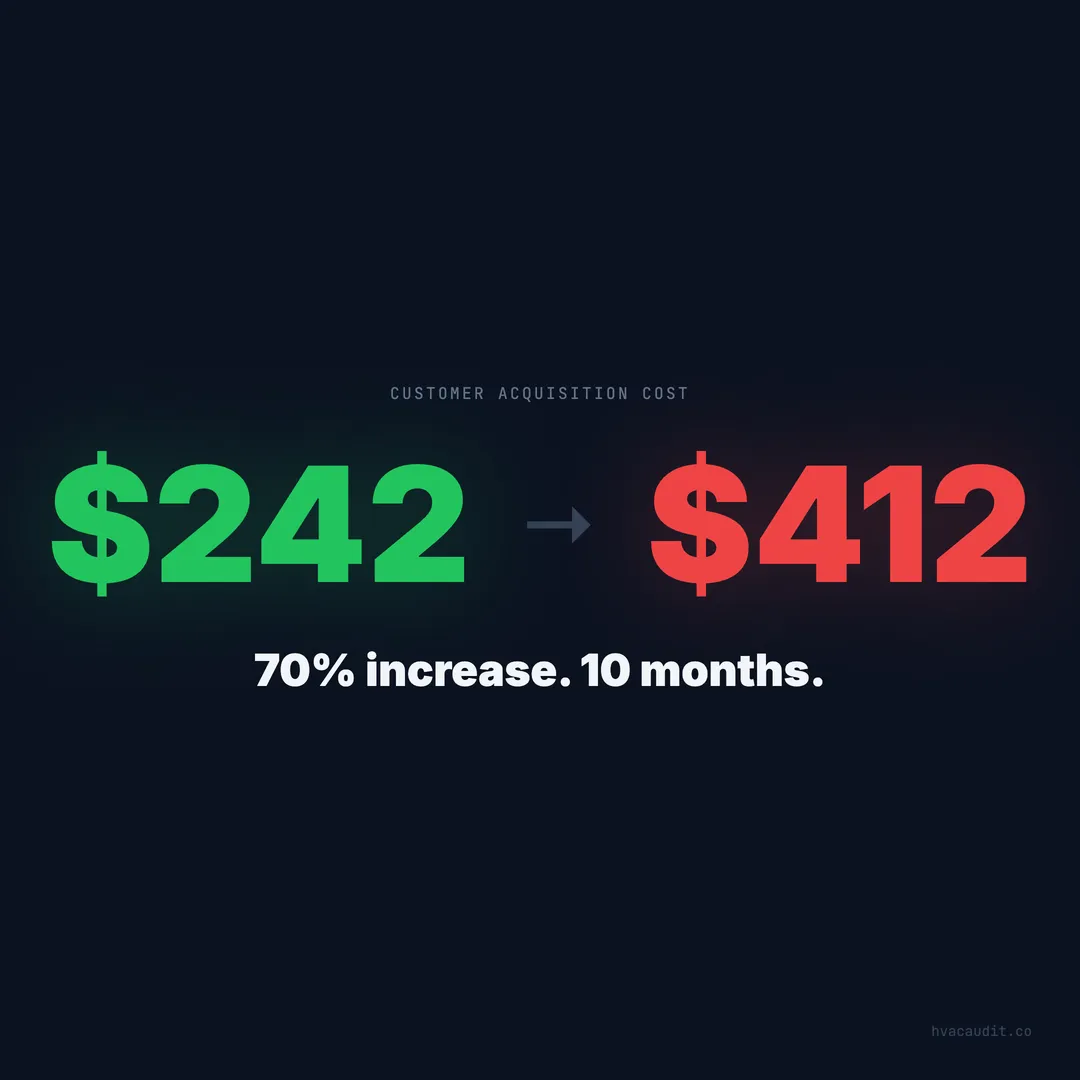
HVAC customer acquisition cost went from $242 to $412 in under a year. Most contractors don't track it. Here's why that matters — and what the LTV:CAC ratio tells you about which marketing channels to kill.
An HVAC contractor spends $5,000 a month on Google Ads. He gets 40 leads. 12 of those leads book a job. He thinks his cost per lead is $125 — which sounds reasonable. What he doesn’t realize is that only 8 of those 12 jobs were new customers. The other 4 were existing customers who would have called anyway.
His actual cost to acquire a new customer isn’t $125. It’s $625. And he’s been running those ads for two years thinking they were profitable.
The average HVAC customer acquisition cost rose from $242 in June 2022 to $412 by April 2023 — a 70% increase in under a year. Most contractors didn’t notice because they weren’t tracking it. They watched their ad spend and their total call volume, but never connected the dots to actual new customer acquisition.
What customer acquisition cost actually means
Customer acquisition cost (CAC) is the total amount you spend to acquire one new customer. Not a lead. Not a call. A paying customer who didn’t already exist in your system.
CAC = Total marketing spend ÷ Number of new customers acquired
If you spend $8,000/month across all marketing channels and acquire 16 new customers, your CAC is $500. That means every new customer costs you $500 before you earn a dollar of profit from them.
Most HVAC contractors track cost per lead but not cost per customer. The difference matters because conversion rates vary wildly by channel:
| Channel | Avg cost per lead | Lead-to-customer rate | True CAC |
|---|---|---|---|
| Google Ads | $104 | 25–30% | $350–$415 |
| Google Business Profile | $0–$50 | 40–60% | $0–$125 |
| HomeAdvisor/Angi | $150–$300 | 10–15% | $1,000–$3,000 |
| SEO (organic) | $80–$150/month amortized | 30–40% | $200–$500 |
| Referrals | $0–$50 (incentive) | 60–80% | $0–$85 |
The contractor on HomeAdvisor paying $1,400 per booked job has a CAC that’s 10x higher than the one getting organic leads from a properly optimized Google Business Profile. Both might be “getting leads,” but one is profitable and the other is buying revenue at a loss.
Why CAC doubled in one year
Three forces drove HVAC customer acquisition costs up 70% in under a year.
Google Ads competition intensified. More HVAC companies entered paid search, which drove average CPC from $6.84 to $12.31. The average HVAC cost per lead from Google Ads hit $104 — double what it was two years earlier. More companies bidding on the same keywords means every click costs more.
Lead gen platforms raised prices. HomeAdvisor (now Angi Leads) and Thumbtack both increased per-lead costs while maintaining the same low close rates. The FTC fined HomeAdvisor $7.2 million for selling fake leads — but contractors on the platform still pay for leads that never answer the phone.
Website conversion rates stayed flat. Even as traffic costs rose, most HVAC websites still convert at 2–5%. If your site converts 3% of visitors and your traffic cost doubles, your CAC doubles. The contractors who held CAC steady were the ones who improved their website conversion rate to offset the traffic cost increase.
The LTV:CAC ratio tells you which channels to kill
CAC alone doesn’t tell you if your marketing is working. A $500 CAC is terrible if the customer spends $300 and never comes back. It’s excellent if the customer spends $12,000 over five years. That’s what the LTV:CAC ratio measures.
LTV (Customer Lifetime Value) = Average revenue per customer × Average retention in years
For HVAC, a single service call customer is worth $300–$800. But a customer who buys a maintenance agreement, returns for annual tune-ups, and eventually replaces their system is worth $12,000–$15,000 over 7–10 years. That’s the real value of one HVAC service call.
The target LTV:CAC ratio is 3:1. For every dollar you spend acquiring a customer, you should earn at least three dollars back over their lifetime.
| LTV:CAC ratio | What it means | Action |
|---|---|---|
| Below 1:1 | You’re losing money on every customer | Kill or fix immediately |
| 1:1 to 2:1 | Breaking even or marginal | Optimize conversion rates |
| 3:1 | Healthy and sustainable | Maintain and scale |
| 5:1+ | Under-investing in growth | Spend more on marketing |
Most contractors don’t know their LTV:CAC by channel. When you calculate it, you often discover that referrals and organic search produce LTV:CAC ratios of 10:1 or higher, while paid lead gen platforms produce ratios below 1:1.
Your website is the CAC multiplier
Here’s the connection most contractors miss: your website’s conversion rate directly determines your CAC. If you pay $10 per click from Google Ads and your site converts 2% of visitors, your cost per lead is $500. If your site converts 5%, your cost per lead drops to $200 — same traffic, same ad spend, dramatically different economics.
The average HVAC website scores 34/100 and converts at 2–3%. The top 5% convert at 10–15%. That difference in conversion rate is the difference between a $400 CAC and a $150 CAC — on identical traffic.
Every dollar you invest in improving your website’s conversion rate pays back across every marketing channel simultaneously. Fixing your speed, adding pricing transparency, and answering the 7 questions homeowners ask costs nothing compared to the ongoing cost of a website that wastes your traffic.
How to calculate your actual CAC
Most HVAC owners have never calculated their customer acquisition cost. Here’s how to do it in 10 minutes:
- Add up all marketing spend for the last 90 days (ads, SEO, lead gen, print, everything)
- Count the total new customers acquired in those 90 days (not leads — customers who paid)
- Divide spend by customers
If the number is above $500, something is broken — either your channels are too expensive, your conversion rate is too low, or your close rate needs work. If it’s below $200, you’re either very efficient or not spending enough on growth.
Track it monthly. Track it by channel. The contractor who knows his Google Ads CAC is $380 and his organic search CAC is $120 makes very different marketing decisions than the one who just knows he “spends about $7,000 a month on marketing.”
The acquisition cost doubled. The contractors who noticed adjusted their spend. The ones who didn’t are paying 2022 attention to 2023 economics — and wondering why their margins keep shrinking.
Keep reading
Want to know your score?
Drop your URL — full report in 48 hours.
We're on it.
Report in your inbox within 48 hours.