HVAC Financing Doubles Your Close Rate — But Only If You Lead With It
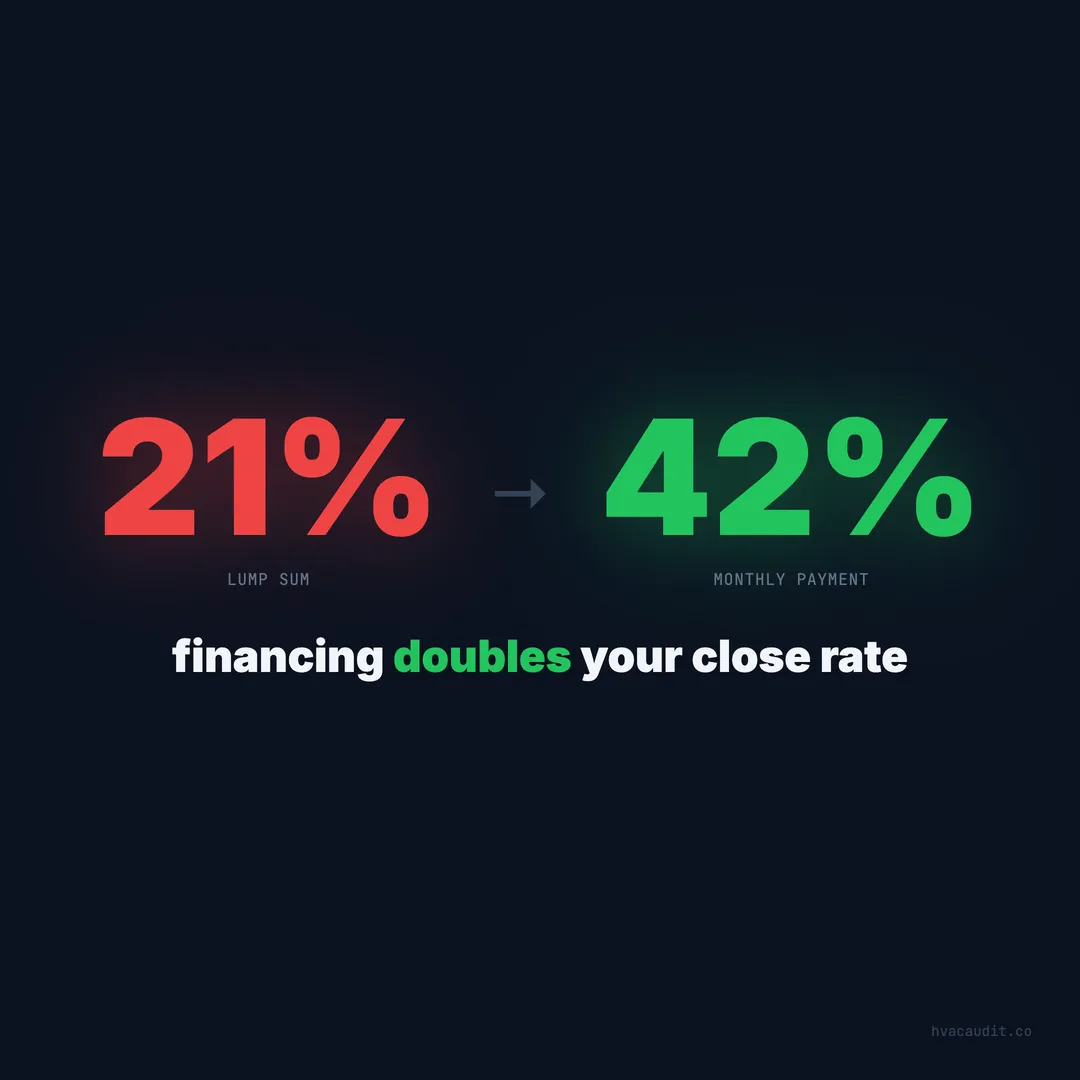
Contractors who lead with monthly payments see financing uptake jump from 21% to 42%. Close rates climb 11%. But 68% of HVAC websites don't mention financing at all.
A homeowner just got quoted $13,800 for a new heat pump system. She needs it — the old unit died two days ago in August. But $13,800 isn’t in her budget. She says “let me think about it” and starts calling other companies looking for a cheaper option.
What she doesn’t know is that the same contractor offers 0% financing for 60 months. That’s $230/month — less than her electric bill would drop. But the tech never mentioned it. The financing brochure sat in the truck’s glove box, untouched.
Contractors who lead with monthly payment framing see financing uptake jump from 21% to 42%. Close rates climb 11 percentage points when financing is proactively offered on every job. The ACCA documented this across 1,000+ contractors — and the gap between companies that lead with financing and those that mention it as an afterthought is enormous.
The sticker shock problem is getting worse
Equipment prices have nearly doubled since 2019. The average residential system replacement now runs $12,000-$15,000 depending on region and equipment tier. In premium markets, variable-speed systems with air purification regularly hit $18,000-$22,000.
34% of homeowners are currently delaying home service purchases due to economic anxiety. That number was 19% in 2021. The gap between what homeowners need and what they feel they can afford is widening every quarter.
This creates a brutal dynamic. The homeowner’s system is failing. They know they need a replacement. But a five-figure number triggers a fight-or-flight response — and “flight” means calling three more contractors hoping someone will be cheaper, or worse, choosing a band-aid repair that costs $800 now and $14,000 six months later when the system dies completely.
Equipment price increases aren’t slowing down. Copper, aluminum, and semiconductor costs continue climbing. The contractors who survive this environment aren’t the ones with the lowest prices — they’re the ones who frame the price correctly.
Monthly payment framing changes the math
The psychology is straightforward but powerful. $13,800 activates loss aversion — the homeowner imagines their savings account dropping by that amount in one hit. $230/month activates comparison thinking — “that’s less than my car payment.”
The ACCA data shows exactly how this plays out:
| Framing approach | Financing uptake | Close rate impact |
|---|---|---|
| Don’t mention financing | 8-12% | Baseline |
| Mention if customer asks | 21% | +4% |
| Offer on every job proactively | 42% | +11% |
| Lead with monthly payment first | 42%+ | +11-15% |
The difference between “mention if asked” and “lead with it” is a 100% increase in uptake and nearly triple the close rate improvement. Same financing product. Same terms. The only variable is when and how it’s introduced.
Homeowners who finance spend 30-40% more on average than cash buyers. They choose higher-efficiency equipment, add indoor air quality products, and opt for extended warranties — because $40/month more feels manageable, even when $2,400 more doesn’t.
This is why pricing transparency and financing go hand in hand. Showing the price earns trust. Showing the monthly payment removes the barrier.
68% of HVAC websites don’t mention financing
When we audited 147 HVAC websites, we found that 68% had zero financing information anywhere on the site. No financing page. No monthly payment mentions. No partner logos. Nothing.
Of the 32% that mentioned financing:
- 11% had a dedicated financing page with application details
- 14% had a brief mention on the homepage or a service page
- 7% had a financing logo in the footer with no context
The sites with dedicated financing pages converted at 2.8x the rate of sites with no financing mention. That tracks with what we see across the industry — pages that actually generate leads share information that removes buying friction.
A financing page isn’t complicated. It needs four elements: monthly payment examples for common systems, the application process (usually 60 seconds, soft credit check), approved financing partners, and a clear “apply now” or “check your rate” call to action.
The tech’s delivery matters more than the terms
Financing products are nearly identical across the industry. Synchrony, GreenSky, Service Finance, Mosaic — they all offer similar rates and terms. The differentiator isn’t the product. It’s how the technician introduces it.
The wrong way: “We do offer financing if you need it.” This frames financing as a crutch — something for people who can’t afford it. It triggers shame, and the homeowner declines even when they need it.
The right way: “Most of our customers choose the monthly payment option — it’s $230/month and there’s no prepayment penalty. Want me to check your rate? It takes about 60 seconds and won’t affect your credit score.”
Three things happen with the right framing:
- Social proof — “most customers choose this” normalizes financing
- Specific number — $230/month is concrete, not abstract
- Low friction — 60 seconds, no credit impact, easy exit
Techs who use the “most customers” framing see 38% financing uptake versus 19% for techs who position it as a fallback option. Same product. Same company. Different words.
Financing increases average ticket by 30-40%
When money feels manageable, homeowners buy better. This is the finding that should reshape every HVAC contractor’s sales approach.
Financed installations average $12,800 compared to $9,200 for cash purchases — a 39% increase. Homeowners who finance consistently choose:
- Higher SEER ratings (19+ SEER vs. 15-16 SEER for cash buyers)
- Extended warranties (73% of financed buyers vs. 31% of cash buyers)
- Indoor air quality add-ons (44% of financed buyers vs. 12% of cash buyers)
- Smart thermostat packages (61% of financed buyers vs. 28% of cash buyers)
The reason is simple. When the price is $13,800, every add-on feels painful. When the price is $230/month, adding a $40/month air purifier feels trivial. The marginal cost perception drops dramatically when payments are monthly instead of lump-sum.
This directly connects to why presenting multiple options works so well. Four tiers with monthly payments next to each one lets the homeowner compare incremental costs: “The premium system is only $65/month more than the basic one.” That reframe turns a $3,900 gap into a $65/month decision.
The cost of not financing is higher than you think
Some contractors resist financing because of the dealer fees — typically 3-9% of the financed amount depending on the program and promotional rate. On a $13,000 job with a 5% dealer fee, that’s $650.
But consider what you’re actually paying for:
Without financing:
- Close rate: baseline (43% on single quote)
- Average ticket: $9,200
- Customer calls 2-3 competitors for cheaper quotes
- 57% of proposals end in “let me think about it”
- Many choose band-aid repairs instead
With financing offered proactively:
- Close rate: +11 percentage points
- Average ticket: $12,800 (+39%)
- Customer stops shopping because monthly payment is manageable
- Financing uptake: 42%
- More premium equipment selections
The net profit increase from financing dwarfs the dealer fee. A $650 fee on a job that generates $3,600 more revenue (and $1,800+ more gross profit) is a 277% return on investment.
Contractors who skip financing to “save” on dealer fees are costing themselves far more in lost close rates and lower average tickets. It’s the same pattern we see with contractors who stay busy but broke — optimizing the wrong number.
How to build a financing page that converts
Your financing page needs to work for two audiences: the homeowner who’s actively shopping (and comparing your financing to a competitor’s) and the homeowner who didn’t know financing was an option (and needs to see how affordable their project actually is).
Element 1: Monthly payment calculator or examples. Show three to five common scenarios:
| System | Total | Monthly (60 mo) | Monthly (84 mo) |
|---|---|---|---|
| Basic AC replacement | $7,500 | $125 | $89 |
| Mid-range AC + furnace | $12,000 | $200 | $143 |
| Premium heat pump system | $16,000 | $267 | $190 |
| Full system + air quality | $20,000 | $333 | $238 |
Element 2: The application process. “Check your rate in 60 seconds. No impact to your credit score. Get approved before your appointment.” Remove every possible friction point.
Element 3: Accepted credit ranges. “We work with homeowners across all credit profiles. Programs available for scores 580+.” Don’t make people guess whether they’ll qualify.
Element 4: Partner credibility. Display financing partner logos (Synchrony, GreenSky, etc.) with a brief note about each. Brand recognition builds trust.
The average HVAC website scores 34 out of 100 in our audits and takes 18.4 seconds to load. A fast, clear financing page on an otherwise mediocre site can be the single highest-converting element you add.
Same-as-cash promotions outperform low-interest offers
Not all financing promotions are equal. The ACCA data reveals a clear hierarchy:
0% for 12-18 months (same-as-cash): Highest uptake rate at 48% of offered customers. Homeowners love the “free money” framing. Dealer fees run 5-8%.
0% for 60 months (true zero interest): Second highest at 39%. Lower monthly payments, higher dealer fees (8-12%). Best for premium systems where the monthly number needs to stay under $250.
Low interest (4.99-8.99%): Uptake drops to 22%. The interest rate introduces friction and comparison shopping. Homeowners start comparing your financing to a HELOC or credit card.
Deferred interest (12-18 months): Only 14% uptake and the highest customer complaint rate. If the balance isn’t paid by the promo period end, retroactive interest kicks in. 23% of deferred-interest customers end up paying 26%+ APR — and they blame the contractor, not the finance company.
Stick with same-as-cash or true zero-interest promotions. The higher dealer fee is worth the uptake increase and customer satisfaction.
Training your team on financing presentation
The biggest bottleneck isn’t the financing product or the website. It’s the technician’s comfort level discussing money.
62% of HVAC technicians say they feel uncomfortable discussing financing. They were trained to fix equipment, not sell financial products. Without training, most techs default to the weakest possible mention: “We have financing available if you need it.”
Effective training covers three skills:
Normalizing the conversation. Techs need to understand that 42% of all home improvement projects over $5,000 are financed. It’s not unusual. It’s not a sign of financial distress. It’s how most major purchases work in 2026.
Leading with the monthly number. Instead of quoting the total first and offering financing second, quote the monthly first: “Your new system is $219/month. The total is $13,140 if you’d rather pay upfront.” This reversal increases financing uptake by 24% compared to the traditional total-first approach.
Handling the “I’ll just pay cash” response. The correct response isn’t silence. It’s: “Absolutely, we offer a 5% cash discount. But many homeowners keep the cash in savings and use the 0% financing — that way they have a cushion for anything else that comes up.” This reframe converts 18% of initial cash buyers to financing, increasing the average ticket.
The compound effect on annual revenue
For a company doing 200 installations per year at a $10,000 average ticket:
Without proactive financing:
- 21% financing uptake = 42 financed jobs
- Average ticket on financed: $11,500
- Average ticket on cash: $9,200
- Total revenue: 42 × $11,500 + 158 × $9,200 = $1,936,600
With proactive financing (leading with monthly payments):
- 42% financing uptake = 84 financed jobs
- Average ticket on financed: $13,200 (higher uptake captures more premium buyers)
- Average ticket on cash: $9,400 (slight increase from anchoring effect)
- Additional closes from +11% close rate: ~22 more jobs
- Total revenue: 84 × $13,200 + 138 × $9,400 = $2,405,000
That’s a $468,400 annual revenue increase — a 24% jump — from changing how financing is presented. Even after dealer fees of $55,000-$95,000, the net gain is substantial.
How homeowners choose an HVAC contractor comes down to trust, transparency, and affordability. Financing — presented correctly — addresses all three. It says: we trust you to pay us back, we’re transparent about the cost, and we’ve made it affordable.
The contractors who lead with financing aren’t offering a different product. They’re removing the last barrier between a homeowner who needs a system and a homeowner who buys one.
Keep reading
Want to know your score?
Drop your URL — full report in 48 hours.
We're on it.
Report in your inbox within 48 hours.