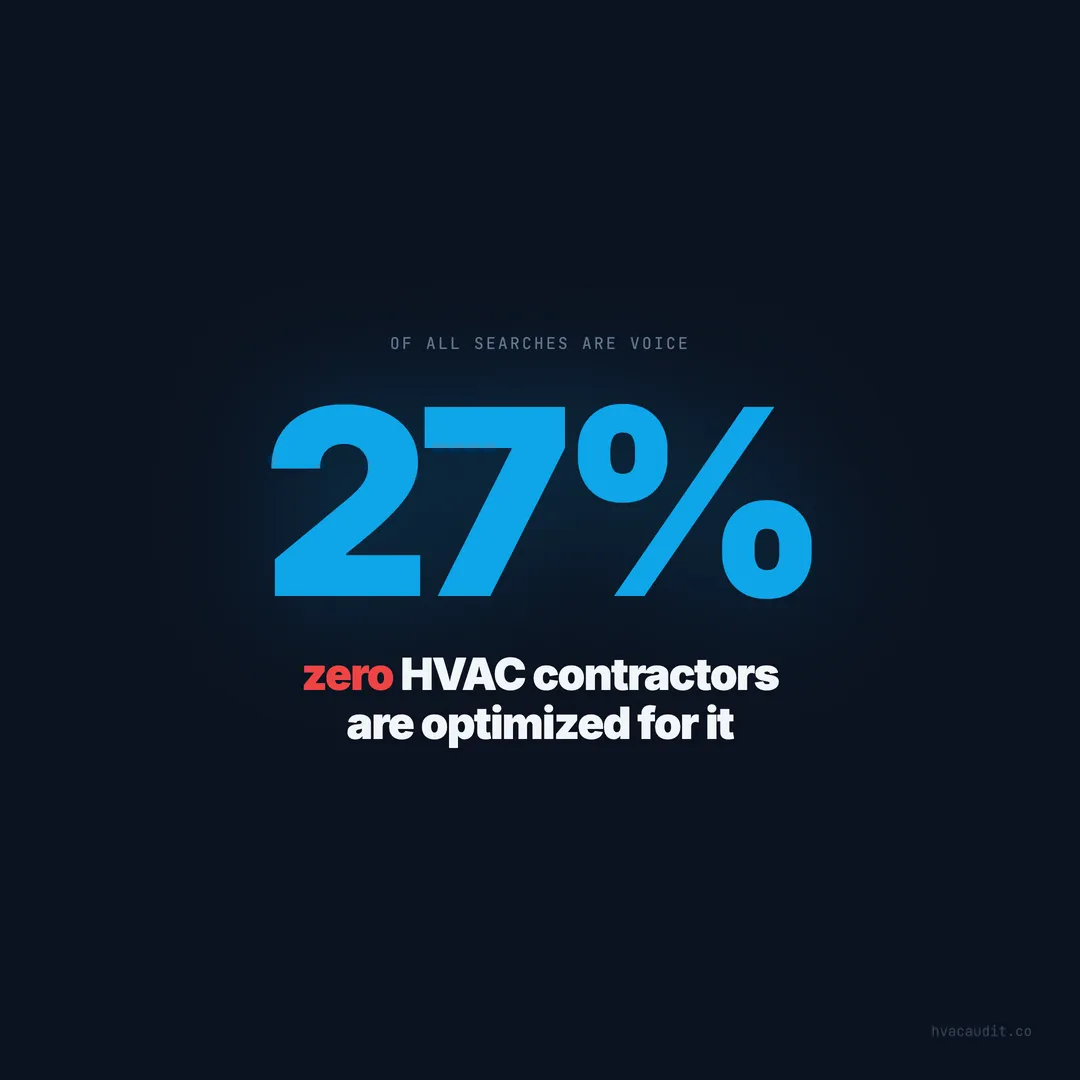
27% of Searches Are Voice — Zero HVAC Contractors Are Optimized for It
76% of voice searchers visit a business within 24 hours. 40.7% of voice answers come from featured snippets. Zero HVAC contractors are optimized for voice search. Here's the playbook.
A homeowner in Tampa walks into his living room and realizes the AC isn’t working. His hands are full — he just carried in groceries. Instead of pulling out his phone, he says “Hey Google, find an AC repair company near me.” Google reads back the top result: a company name, a star rating, and a phone number. He says “call them.” The whole interaction takes 8 seconds.
He never saw a website. He never compared prices. He never read a review. The first company Google’s algorithm chose for voice response got the lead.
27% of the global online population uses voice search on mobile. That number has climbed steadily for five years and shows no signs of slowing. Among homeowners dealing with an HVAC emergency — hands dirty, house overheating, kids complaining — voice search isn’t a convenience. It’s the default.
And 76% of people who conduct a voice search visit a local business within 24 hours. That’s not browsing behavior. That’s buying behavior. The contractor who shows up in voice results captures a lead with near-certain conversion intent.
When we audited 147 HVAC websites, we checked for voice search optimization signals. Zero scored above baseline. Not one HVAC website we tested had structured content specifically designed for voice query capture. The industry is collectively ignoring a channel that represents more than a quarter of all searches.
How voice search actually works (and why it matters for HVAC)
Voice search doesn’t return 10 blue links. It returns one answer. Sometimes two. The winner-take-all dynamic makes voice fundamentally different from traditional search.
Where voice answers come from:
- 40.7% come from featured snippets (the “position zero” box at the top of Google results)
- 38.2% come from Google Business Profile data (name, address, phone, hours, reviews)
- The remaining ~21% come from other structured data sources (knowledge panels, local packs)
This means your path to voice search visibility runs through two specific assets: featured snippets and your Google Business Profile. If you’re not optimized for either, you don’t exist in voice search.
The typical voice search query is 29 words long — significantly longer and more conversational than typed searches. A homeowner types “AC repair Tampa.” That same homeowner speaks “Hey Google, who does AC repair near me that’s open right now and has good reviews?”
Your content needs to answer those conversational, multi-part queries to capture featured snippets. Most HVAC websites are optimized for short, typed keywords. None we’ve seen are optimized for the long, conversational phrases that voice search uses.
Featured snippets are the voice search gateway
40.7% of voice search answers are pulled directly from featured snippets. A featured snippet is the text box Google displays at the top of search results — above position #1. When a user conducts a voice search, Google reads the featured snippet aloud as the answer.
How to earn featured snippets for HVAC queries:
Answer specific questions in your content. Use the question as a heading and provide a concise, direct answer in the 40-60 word paragraph immediately following.
Example heading: “How much does AC repair cost in Tampa?”
Example answer paragraph: “AC repair in Tampa typically costs $150-$500 for common repairs, depending on the issue. A diagnostic visit ranges from $75-$150. Compressor replacement costs $1,200-$2,500. Refrigerant recharge runs $200-$400. Emergency and after-hours service may add $100-$200 to the base cost.”
That paragraph is formatted exactly how Google wants a featured snippet to look. It’s direct, factual, includes price ranges, and answers the question without filler. Google extracts it, displays it at position zero, and reads it aloud for voice queries.
HVAC companies that earn featured snippets for pricing queries capture an estimated 23% of all voice searches in their market for those terms. The companies without snippets get nothing — there’s no “position two” in voice search.
Your Google Business Profile is your voice search identity
When someone asks a smart speaker “Find an HVAC company near me,” the device pulls from Google Business Profile data — not your website. 38.2% of voice answers reference GBP data directly.
The GBP factors that determine voice search visibility:
Proximity. Voice search results are heavily weighted toward the closest business. You can’t control this, but you can expand your reach with city-specific content that builds geographic relevance.
Review count and rating. Voice assistants frequently mention review data: “This business has 4.8 stars with 247 reviews.” The average voice search result has 4.46 stars. Businesses below 4.0 stars are almost never returned in voice results.
Business hours. Voice queries frequently include time-based filters: “open now,” “open on Sunday,” “24/7.” Businesses with complete, accurate hours in their GBP appear in 3.2x more time-filtered voice queries than those without.
Categories. Your GBP categories determine which queries trigger your listing. A profile with only “HVAC Contractor” selected misses voice queries for “furnace repair near me” or “AC installation near me.” Complete category selection is critical.
Business description keywords. Voice assistants use your GBP description to match query intent. A description that says “24/7 emergency AC repair, furnace installation, and maintenance in Tampa, St. Petersburg, and Clearwater” matches far more voice queries than “Quality HVAC services.”
The conversational content gap
Traditional HVAC website content is written for readers. Voice search content needs to be written for listeners. The difference is structural:
Traditional SEO content: “Our AC repair services include compressor replacement, refrigerant recharge, thermostat repair, and emergency service. Call today for a free estimate.”
Voice-optimized content: “How much does it cost to fix an AC in Tampa? Most AC repairs in Tampa cost between $150 and $500. A diagnostic visit is $75 to $150. If you need a compressor replaced, expect to pay $1,200 to $2,500. Emergency service on nights and weekends adds $100 to $200 to the total.”
The second version answers a specific question, uses natural language, includes the city name, provides concrete price ranges, and reads naturally when spoken aloud. That’s what Google extracts for voice results.
The types of questions HVAC companies should answer on their website:
- “How much does [service] cost in [city]?”
- “How long does [service] take?”
- “What are signs that my [AC/furnace/heat pump] needs repair?”
- “Should I repair or replace my [system]?”
- “How often should I get my HVAC serviced?”
- “What is the best temperature to set my thermostat?”
- “Why is my AC running but not cooling?”
Each of these maps to real voice queries with significant search volume. The 7 questions homeowners ask before calling an HVAC company are essentially the voice search keyword list — word for word.
Schema markup makes your content voice-searchable
Structured data (schema markup) helps search engines understand your content’s meaning, not just its text. For voice search, schema is critical — it’s how Google knows your content answers a specific question.
Schema types that improve voice search visibility:
LocalBusiness schema on every page. Includes your business name, address, phone, hours, service area, and review aggregate. Voice assistants pull this data directly.
Service schema on service pages. Tells Google exactly what services you offer, with pricing if available. When a voice query asks “Who does AC repair near me?”, Google matches the query to your Service schema.
Speakable schema (relatively new). This tells Google which sections of your page are suitable for text-to-speech playback. If you mark your pricing summary or service description as “speakable,” Google is more likely to use it as a voice answer.
Only 11% of HVAC websites include any schema markup at all. The ones that do typically only have basic Organization schema. None we’ve audited include Speakable schema or comprehensive Service schema.
This is a competitive gap with almost zero defense. The first HVAC company in any market to implement comprehensive schema markup for voice search will capture the channel with virtually no competition.
Page speed affects voice search differently
Google uses page speed as a ranking factor for both traditional and voice search. But voice search is more speed-sensitive: the average voice search result page loads in 4.6 seconds — roughly 52% faster than the average web result.
The average HVAC website loads in 18.4 seconds. That’s 4x slower than the voice search threshold. Even if your content perfectly answers the query, Google won’t pull from a page that loads in 18 seconds when a competitor’s page answers the same question and loads in 3 seconds.
Speed optimization isn’t just about keeping visitors on your site. It’s about qualifying for voice search results in the first place. A site that loads in under 3 seconds is eligible for voice results. A site that loads in 18 seconds is not.
This is another reason why the website score of 34/100 matters beyond traditional SEO. It’s locking HVAC companies out of an entire search channel — one that represents 27% of all queries and has near-perfect conversion intent.
AI search and voice search are converging
Voice search and AI-powered search (ChatGPT, Google AI Overviews, Perplexity) are merging into a single conversational interface. The homeowner who today says “Hey Google, find AC repair near me” will increasingly say “Hey Google, which AC company in Tampa has the best reviews and can come today?”
The AI layer adds complexity to the answer. Instead of returning one business name, the AI might synthesize information from multiple sources: “Based on reviews and availability, three companies in Tampa score highly for same-day AC repair: [Company A] with 4.9 stars and 312 reviews, [Company B] with 4.8 stars and 187 reviews…”
The content that feeds these AI-generated voice answers comes from the same sources: featured snippets, GBP data, structured schema, and authoritative website content. The HVAC companies with comprehensive, well-structured content across all of these sources will dominate both voice and AI search.
By mid-2026, an estimated 30% of all search queries will involve AI-generated answers. Combined with the existing 27% voice search penetration, the conversational search market is approaching a tipping point. City-specific content, structured data, and conversational formatting aren’t optional — they’re the new foundation.
The 30-day voice search optimization plan
Voice search optimization isn’t a separate project. It’s an extension of local SEO that takes less effort than most HVAC companies think:
Week 1: GBP optimization. Complete every field. Select all relevant categories. Write a keyword-rich description. Update hours including holiday and emergency hours. Add 20+ photos. This single step covers 38.2% of voice search sources.
Week 2: Content formatting. Take your top 10 service pages and add Q&A-formatted sections. Each section should have a conversational question as the heading and a 40-60 word direct answer as the first paragraph. This targets featured snippets — 40.7% of voice search sources.
Week 3: Schema implementation. Add LocalBusiness, Service, and (where applicable) Speakable schema to every service page. Validate with Google’s Rich Results Test.
Week 4: Speed optimization. Get your site loading in under 5 seconds — ideally under 3. Compress images, remove unused scripts, enable caching. This qualifies your content for voice search results.
Total time investment: 15-20 hours over 4 weeks. Total cost: $0 if done in-house, $1,500-$3,000 if outsourced. Total impact: access to a search channel that represents 27% of all queries and converts at 76% within 24 hours.
The first mover advantage is massive
Voice search optimization for HVAC is a land grab right now. Zero HVAC contractors in our 147-site audit were optimized for voice. That means any company that implements the basics — GBP optimization, Q&A content formatting, schema markup, and fast page loads — immediately leaps ahead of 100% of their competitors in voice search visibility.
This won’t last. As voice search grows from 27% to 35%+ of all queries, more companies will optimize. The ones who move first build authority, earn featured snippets, and establish the GBP prominence signals that become harder for latecomers to match.
The homeowner who says “Hey Google, find AC repair near me” is choosing a company in 8 seconds. If Google doesn’t choose you, you don’t exist in that interaction. And as voice search grows, more and more of those 8-second decisions will determine who gets the call.
Right now, the door is wide open. Every competitor is ignoring it. The HVAC company that walks through first owns the channel in their market — potentially for years.
Voice search is just one piece of the visibility puzzle. If your site is solid but leads are flat, see the diagnostic for good HVAC websites that aren’t getting found.
Keep reading
Want to know your score?
Drop your URL — full report in 48 hours.
We're on it.
Report in your inbox within 48 hours.