AI Search Is Changing How Homeowners Find HVAC Contractors
AI Overviews now appear in 50%+ of Google searches. Here's what HVAC contractors need to change to stay visible in 2026 and beyond.
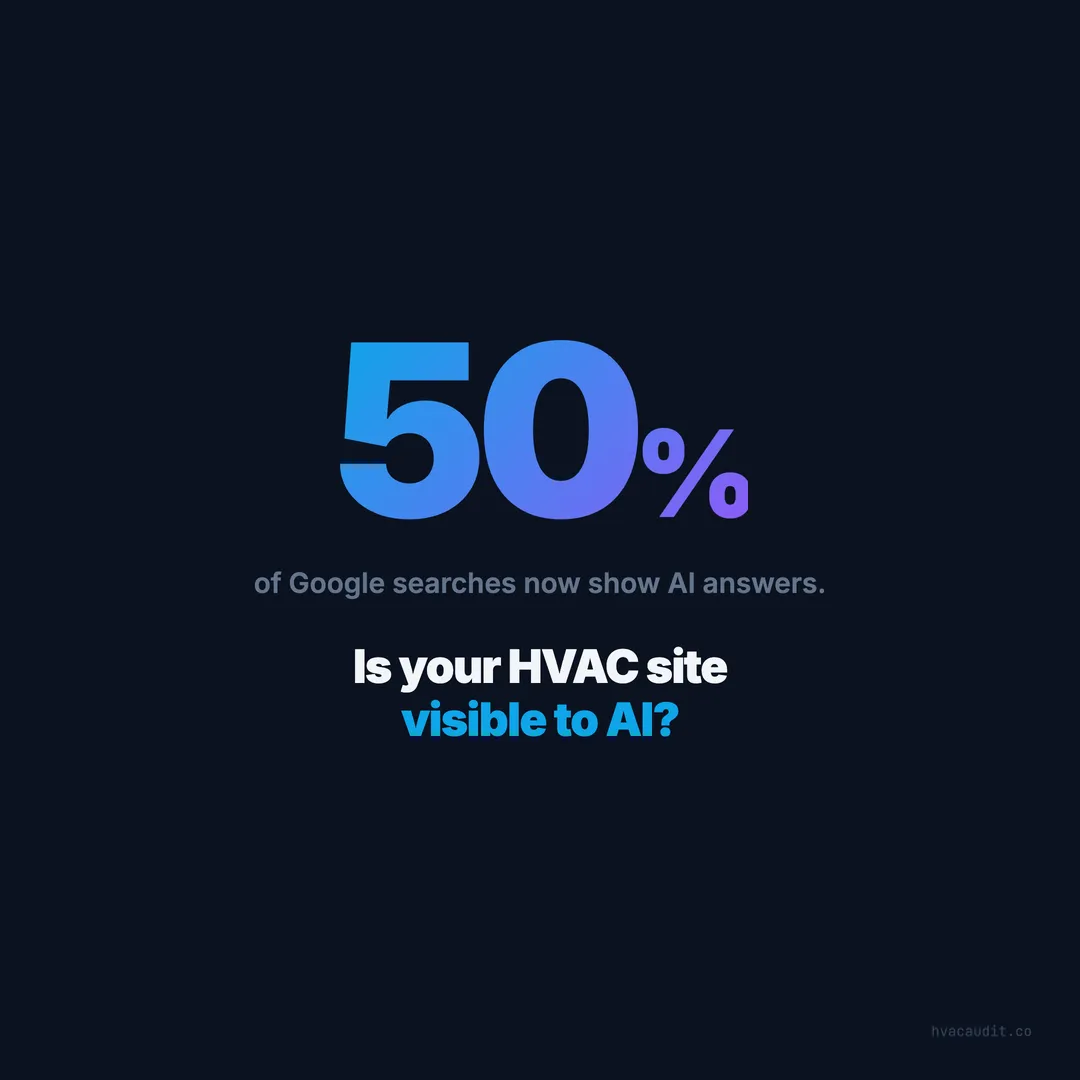
Google’s AI Overviews now appear in more than half of all search results. When someone Googles “how much does AC repair cost,” they get an AI-generated summary at the top — often without clicking a single website.
ChatGPT, Perplexity, and other AI assistants are answering questions like “who’s the best HVAC contractor near me” using data from review sites, Google Business Profiles, and structured website content.
This isn’t coming. It’s here. And most HVAC contractors are invisible to it.
What changed
Google AI Overviews
Previously, Google showed 10 blue links. Now, for many searches, it shows an AI-generated answer first — a boxed summary that pulls information from multiple websites and presents it as a direct answer. The answer cites sources, and if your website isn’t structured in a way AI can read, you’re not getting cited.
For HVAC contractors, this matters most for informational searches: “AC making noise,” “how often to change air filter,” “HVAC repair vs replace,” “how much does a new AC unit cost.” These are top-of-funnel searches where homeowners start their research before they’re ready to call anyone.
The contractors who get cited in these AI Overviews become the default recommendation. The ones who don’t are invisible at the exact moment potential customers are forming their shortlist.
Voice search and smart assistants
“Hey Google, find me an AC repair company near me” is increasingly how people search. Voice search favors businesses with strong Google Business Profiles, high review counts, and structured data that Google can parse cleanly.
Voice queries are typically longer and more conversational than typed searches: “who can fix my AC in Dallas today” instead of “AC repair Dallas.” Your content needs to match this conversational format to surface in voice results.
AI assistants (ChatGPT, Perplexity, Gemini)
When someone asks ChatGPT “who’s the best HVAC company in Dallas,” it pulls from review data, business directories, and website content. Perplexity searches the web in real-time and cites sources directly. Google Gemini integrates with Google’s own search data.
The companies that show up are the ones with the strongest, most consistent online presence — not necessarily the biggest or best at HVAC work. An HVAC contractor with 500 reviews, a comprehensive website, and consistent directory listings will get recommended by AI over a better contractor with 30 reviews and a thin website.
This is a fundamental shift: AI doesn’t rank websites. It recommends businesses. And it recommends businesses it can verify from multiple sources.
What HVAC contractors need to do
1. Write content that directly answers specific questions
AI pulls from content that directly answers questions — not content that talks around a topic. The difference is critical:
Bad: “Our experienced technicians provide top-quality AC repair services for homeowners in the greater Dallas area.”
Good: “AC repair in Dallas costs between $150 and $500 for most common issues. Emergency after-hours repairs typically run $300-$800. The most common AC repairs include refrigerant recharges ($200-$400), capacitor replacement ($150-$300), and compressor repair ($400-$1,200).”
The second version is what AI wants to cite. It has specific numbers, direct answers, and useful information. The first version is marketing copy that AI will skip entirely.
For every service you offer, create content that answers these questions with specific numbers:
- How much does [service] cost in [your city]?
- How long does [service] take?
- When should I repair vs. replace my [equipment]?
- What are the signs I need [service]?
- How often should [equipment] be serviced?
Each answer should be 2-3 sentences with concrete data. This is the format AI Overviews extract and display.
2. Use structured data markup on your website
Structured data (schema markup) tells Google and AI systems exactly what your content means. It’s code that says “this is a business name,” “this is a price range,” “this is a service area” — instead of making AI guess from context.
The most important schema types for HVAC contractors:
- LocalBusiness / ProfessionalService — your business name, address, phone, service area, hours
- Service — individual services with descriptions and price ranges
- Review / AggregateRating — your review data in machine-readable format
- BreadcrumbList — your site structure for navigation context
Add this markup to every page. It’s invisible to visitors but makes your content dramatically easier for AI to parse and cite.
Important note: Don’t use FAQ schema for rich results — Google restricted FAQ rich results to government and healthcare sites in August 2023. FAQ content on your pages is still valuable for AI citation, but the schema markup won’t generate special search results for commercial sites.
3. Strengthen your Google Business Profile
AI assistants heavily weight Google Business Profile data. Your GBP is often the first (and sometimes only) source AI checks when recommending local businesses.
Key actions:
- Post weekly — businesses with active GBPs get recommended more. Post photos of completed jobs, seasonal tips, promotions
- Active review management — respond to every review within 24 hours. AI reads your response patterns. Get 15+ reviews per month with a systematic approach
- Complete service listings — add every service with detailed descriptions. “AC Repair” is too vague. “Central AC Repair — Diagnosis and repair of all central air conditioning systems including refrigerant recharges, compressor replacement, and ductwork repairs” gives AI much more to work with
- Q&A section — seed your own Q&A with the 10 most common questions customers ask. Answer each one thoroughly. AI indexes this content
- Photos and updates — add photos of your team, trucks, completed jobs. Active visual content signals a legitimate, operating business
4. Build topical authority with comprehensive content
AI favors websites that cover a topic comprehensively. If you have one page about “AC repair” and nothing else, AI sees you as a thin resource. If you have 15+ pages covering specific repair types, costs by city, FAQs, maintenance guides, and seasonal tips, AI sees you as an authority worth citing.
Build a content library structured like this:
Service pages (bottom-of-funnel):
- AC Repair in [City]
- Furnace Installation in [City]
- Heat Pump Service in [City]
- Emergency HVAC Repair in [City]
- Duct Cleaning in [City]
Resource pages (middle-of-funnel):
- How Much Does AC Repair Cost in [City]?
- Repair vs Replace: When to Get a New AC Unit
- HVAC Maintenance Checklist by Season
- How to Choose the Right Furnace Size
Blog content (top-of-funnel):
- Why Your AC Is Making That Noise
- 5 Signs Your Furnace Is About to Fail
- How to Lower Your Energy Bill This Summer
- What SEER Rating Do You Actually Need?
Each page adds to your site’s topical depth. Over time, AI systems cite you more frequently because you’ve demonstrated comprehensive expertise. This is the same principle behind why Wikipedia gets cited so heavily — it covers topics exhaustively.
5. Get your data consistent everywhere (NAP consistency)
AI aggregates data from multiple sources: your website, Google Business Profile, Yelp, BBB, Angi, industry directories, and social media profiles. If your business name, address, phone number, or service list differs across these platforms, AI gets confused.
Common inconsistencies that confuse AI:
- “ABC Heating & Air” on your website vs “ABC Heating and Air Conditioning” on Yelp
- Different phone numbers on different directories
- Old address on some listings after a move
- Different service area descriptions
Audit every listing. Make them identical. Use the exact same business name, address format, and primary phone number everywhere. This is called NAP (Name, Address, Phone) consistency, and it’s been important for local SEO for years. With AI search, it’s even more critical because AI cross-references sources and downgrades businesses with conflicting information.
6. Make your content citable
AI doesn’t cite vague marketing copy. It cites specific, factual, structured content. To make your content citation-worthy:
- Lead with the answer — put the direct answer in the first sentence of each section, then explain
- Use specific numbers — “$150-$500” is citable. “Affordable prices” is not
- Structure with clear headings — H2 and H3 tags that match common search queries
- Include tables and lists — AI loves structured data it can extract cleanly
- Cite your own data — “Based on our 147 HVAC website audits” is more authoritative than “studies show”
What doesn’t change
The fundamentals still matter more than AI optimization. Site speed, mobile usability, review volume, and conversion optimization are still the foundation. AI search builds on these signals — it doesn’t replace them.
A contractor with a fast website, 500 Google reviews, and comprehensive content will dominate both traditional and AI search. A contractor with none of these won’t be found anywhere — not in blue links, not in AI Overviews, and not in ChatGPT recommendations.
The timeline
Here’s how AI search will impact HVAC lead generation over the next 1-2 years:
Now (2026): AI Overviews appear on 50%+ of informational searches. Contractors with structured content are getting cited. Most HVAC businesses haven’t adapted.
Mid 2026: AI Overviews expand to more transactional searches (“AC repair near me”). Click-through rates on traditional results drop 15-30%. Businesses without AI-ready content see organic traffic decline.
2027: AI assistants become a primary discovery channel for home services. Homeowners ask Siri, Alexa, ChatGPT, or Google Assistant for contractor recommendations before searching. Businesses with strong structured data and review profiles dominate these recommendations.
The opportunity
Most HVAC contractors haven’t adapted to AI search yet. The ones who add structured data, write answer-focused content, and maintain active online profiles now will have a significant advantage.
This is an early-mover opportunity. The playbook is clear. The contractors who execute first will capture the leads that others don’t even know they’re missing.
If your website is well-built but still isn’t generating leads, the issue is usually search visibility. See the full diagnostic for good HVAC websites that nobody finds.
Keep reading
Want to know your score?
Drop your URL — full report in 48 hours.
We're on it.
Report in your inbox within 48 hours.