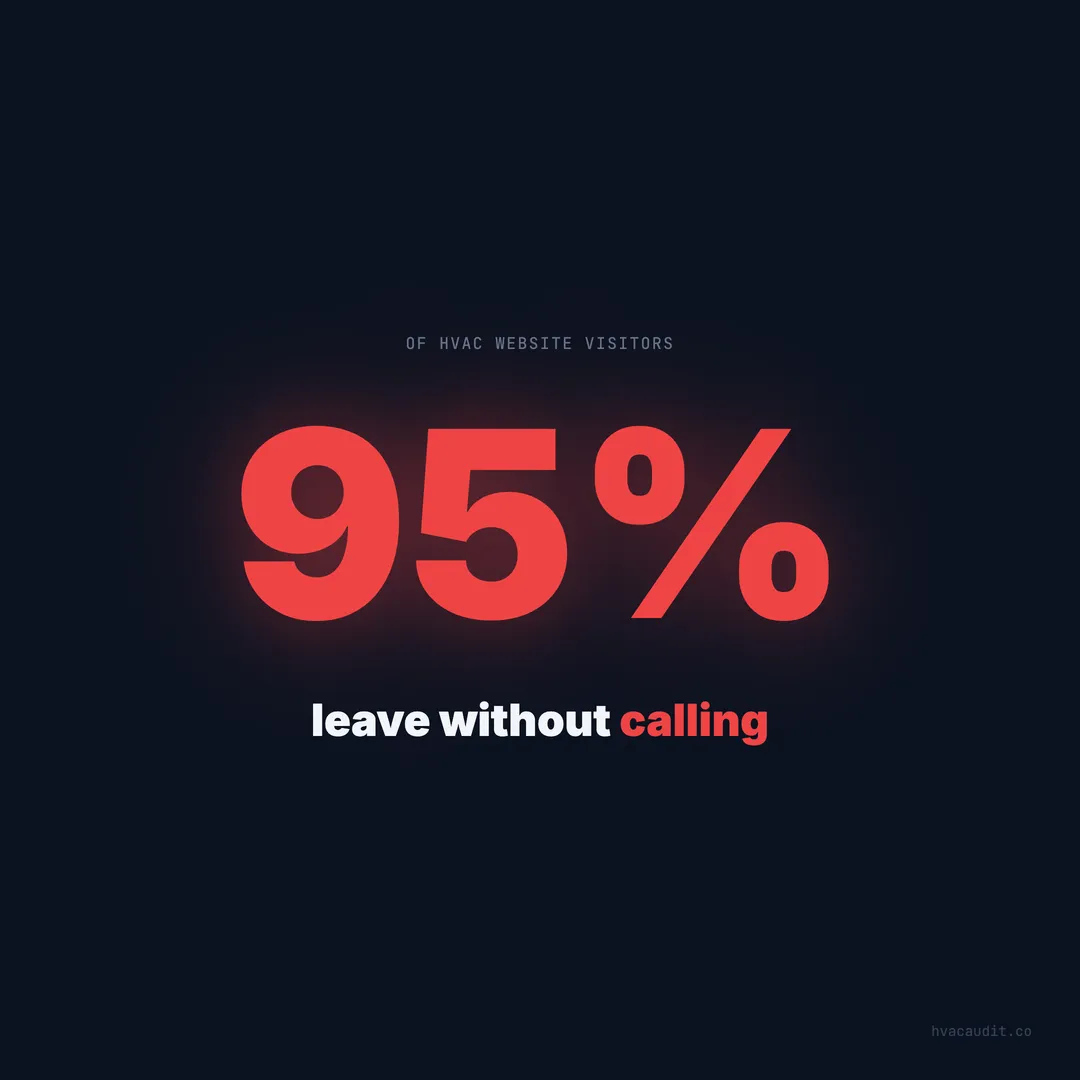
95% of HVAC Visitors Leave Without Calling — Get Them Back
The average HVAC site converts 2–5% of visitors. Retargeting brings back the other 95% at CPMs 40–60% lower than cold campaigns. Here's the setup that turns lost visitors into booked jobs.
A homeowner searches “AC repair near me” at 7 PM on a Wednesday. She clicks your ad, lands on your website, checks your service page, and reads two reviews. Then her kid yells from the kitchen, she puts the phone down, and forgets about you. Your $12 click just walked out the door. She’ll search again tomorrow and click your competitor’s ad instead.
The average HVAC website converts just 2–5% of visitors. That means for every 100 people who land on your site — people who actively searched for HVAC service — 95 to 98 leave without calling, without filling out a form, without doing anything. They vanish. You paid for the click, you earned the visit, and you lost the lead.
Retargeting is the strategy that follows those 95 lost visitors across the internet — on Facebook, Instagram, Google Display, and YouTube — reminding them you exist until they’re ready to call. When we audited 147 HVAC websites, the contractors using retargeting saw 35–50% lower customer acquisition costs compared to those running only cold traffic campaigns. The math isn’t close.
Why 95% of visitors leave (and it’s not because of you)
The instinct is to blame your website. Sometimes that’s valid — a site that loads in 18.4 seconds with a score of 34/100 absolutely loses visitors to frustration. But even a perfectly optimized HVAC website converts only 8–12% of visitors. The rest leave for reasons that have nothing to do with your site.
Comparison shopping. A homeowner with a broken AC typically visits 3–5 contractor websites before calling one. She’s collecting options, checking reviews, comparing pricing signals. Your site might be her second stop — she’ll visit two more before deciding.
Timing interruptions. The decision to call an HVAC contractor isn’t a 30-second process. Life interrupts. The AC starts working again temporarily. She gets pulled into dinner, bedtime, work. The intent was real, but the moment passed.
Price anxiety. 70% of homeowners hesitate to call because they don’t know what the service will cost. Even if your website mentions pricing, the anxiety of making a potentially expensive phone call creates a pause. That pause is when you lose the visitor.
None of these are permanent disqualifications. The homeowner still needs HVAC service. She just didn’t convert on the first visit. Retargeting is the system that stays in front of her during the hours or days between “I need to call someone” and actually picking up the phone.
How retargeting works (the technical 2-minute version)
You install a small piece of code — called a pixel — on your website. Facebook’s pixel and Google’s remarketing tag are the two primary options. When a visitor lands on your site, the pixel drops a cookie in their browser. That cookie lets you show ads to that specific person as they browse Facebook, Instagram, Google’s Display Network, and YouTube.
The visitor never gave you their information. They didn’t fill out a form or sign up for anything. But you can still reach them with targeted ads because the pixel identified their browser. This is why you see ads for products you browsed — the same technology works for HVAC.
Cost comparison: A cold Google Ads click for “AC repair near me” costs $6.84–$12.31. A retargeting impression on Google Display costs $1–$3 CPM (per thousand impressions). A retargeting click on Facebook costs $0.50–$2.00. You’re reaching the same person who already visited your site at 80–90% lower cost than the original click.
| Metric | Cold campaigns | Retargeting campaigns |
|---|---|---|
| Cost per click | $6.84–$12.31 | $0.50–$2.00 |
| CPM (per 1,000 impressions) | $15–$35 | $3–$8 |
| Conversion rate | 2–5% | 8–15% |
| Cost per lead | $104 | $15–$35 |
| Audience quality | Unknown intent | Proven intent (visited your site) |
The 30-day retargeting sequence that books jobs
Not all retargeting is created equal. Showing the same ad for 90 days creates banner blindness — the visitor stops seeing you even when your ad appears. The retargeting sequence that works rotates creative every 7–10 days with escalating urgency.
Days 1–7: The reminder. The visitor just left your site. She remembers who you are. The ad simply reminds her to take action. “Still need AC repair? Same-day openings available. Call [Number].” Keep it direct. No fancy creative — just a clear reminder with a phone number.
This first-week window is where 60% of retargeting conversions happen. The intent is fresh. The problem hasn’t been solved. One reminder is often enough to trigger the call she was already planning to make.
Days 8–14: Social proof. By week two, memory fades. She may have visited other contractor sites. Now you differentiate with trust. “247 five-star reviews. Licensed, insured, and background-checked. [City]‘s top-rated HVAC company.” Include a review snippet or star rating in the ad creative.
Days 15–30: Urgency and offer. If she hasn’t converted by day 15, she needs a stronger nudge. “Your AC diagnostic offer expires this Friday — $89, waived with repair.” A time-bounded offer creates artificial urgency that pushes fence-sitters to action.
After 30 days: Stop. If a visitor hasn’t converted in 30 days, the intent is likely gone. She either fixed the problem herself, hired someone else, or the issue resolved. Continuing to retarget past 30 days wastes budget and creates negative brand impressions. Cap your retargeting window at 30 days and let the audience cycle naturally.
Off-peak CPMs drop 40–60% — time your spend accordingly
Retargeting costs aren’t fixed. They fluctuate with advertising demand cycles, and HVAC contractors who time their retargeting spend save significantly.
During peak HVAC season (June–August for AC, December–February for heating), CPMs on Google Display and Facebook increase 30–50% because every contractor is competing for the same audience. But retargeting during peak season is still essential because the leads are highest-value — emergency repairs, system replacements, urgent service calls.
Off-peak retargeting (March–May, September–November) drops CPMs by 40–60%. Fewer advertisers are competing for display inventory, which means your retargeting ads reach the same audience at less than half the cost. This is when off-season marketing strategies compound — you’re staying in front of prospects while competitors go quiet.
The strategic play: maintain retargeting year-round but shift budget allocation. During peak season, allocate 70% of retargeting budget to high-intent audiences (visitors to service pages, pricing pages, contact pages). During off-season, shift 60% toward maintenance agreement promotion and system evaluation offers.
Page-level retargeting separates hot leads from browsers
Not every website visitor has the same intent. Someone who visited your homepage and bounced after 3 seconds is less valuable than someone who visited your AC repair page, checked your pricing, and viewed your reviews page. Page-level retargeting lets you create different ad sequences based on which pages each visitor viewed.
High-intent pages (retarget aggressively):
- Service-specific pages (AC repair, furnace installation)
- Pricing or financing pages
- Contact or quote request pages
- Review or testimonial pages
Low-intent pages (retarget lightly or exclude):
- Blog posts (informational intent, not transactional)
- Career pages (job seekers, not customers)
- About page only (typically comparison shoppers early in process)
Visitors who viewed a pricing page convert at 3x the rate of homepage-only visitors when retargeted. By allocating more budget to pricing-page visitors and less to homepage bouncers, you reduce your overall retargeting CPL from the typical $15–$35 range down to $10–$20 for your highest-intent segment.
This segmentation requires custom audiences in both Facebook and Google Ads. Create separate retargeting audiences for each high-intent page, then build distinct ad creative that references what the visitor was looking at. “Still comparing AC repair costs? Here’s why 247 homeowners chose us” hits differently than a generic reminder.
Google Display vs. Facebook retargeting: use both
The two primary retargeting platforms serve different purposes, and the contractors who use both outperform those using only one.
Google Display Network retargeting reaches visitors across 2 million+ websites, apps, and YouTube. The ads follow visitors as they read news, check weather, and browse recipe sites. Strengths: massive reach, low CPMs ($1–$3), visual banner ads. Weakness: banner blindness is real — people learn to ignore sidebar ads.
Facebook/Instagram retargeting appears in the social feed alongside friend posts and content the visitor actively engages with. Strengths: higher engagement rates, native-feeling ad format, video capability. Weakness: only reaches people who use Facebook/Instagram (which is still 73% of US adults).
The combination approach that works: Run Google Display retargeting for broad awareness (days 1–30, low budget, reminder creative). Run Facebook/Instagram retargeting for conversion-focused sequences (days 1–14, higher budget, social proof and urgency creative). The visitor sees your brand on news sites and in their social feed — creating the omnipresence effect that makes them feel like your company is everywhere.
Total retargeting budget for a 3-truck HVAC company: $300–$600/month. Split 40% Google Display, 60% Facebook/Instagram. Expected additional leads per month: 8–15 at $20–$35 each. That’s $160–$525 in retargeting spend producing $4,000–$7,500 in revenue at a $500 average ticket and 50% close rate.
The pixel setup most contractors skip
78% of HVAC websites don’t have retargeting pixels installed. That means every visitor who leaves without calling is gone forever — no way to reach them again, no way to remind them, no way to recapture the $6.84–$12.31 click that brought them there.
Installing pixels takes 15 minutes and costs nothing. Here’s what you need:
Facebook Pixel: One piece of code in your website header. It tracks every visitor and lets you create custom audiences in Facebook Ads Manager. Install it even if you’re not running Facebook ads yet — it starts building your audience immediately, and when you’re ready to retarget, you’ll have months of visitor data.
Google Remarketing Tag: Added through Google Tag Manager or directly in your site code. It creates audiences in Google Ads for Display Network retargeting and YouTube remarketing.
Both pixels should fire page-view events plus custom events for key actions: phone number clicks, form submissions, service page visits, pricing page views. These events let you build the high-intent audiences described above.
The biggest mistake: waiting to install pixels until you’re “ready” for retargeting. Every day without pixels is a day of visitors you can never retarget. If your site gets 500 visitors per month, waiting 6 months means losing the ability to retarget 3,000 people — at the current conversion rate of 2–5%, that’s 60–150 leads you could have recaptured.
Creative that converts: what to put in retargeting ads
The creative rules for retargeting are different from cold campaigns because the audience already knows who you are. They’ve visited your site. They’ve seen your brand. The ad doesn’t need to introduce — it needs to remind and resolve.
Rule 1: Reference the visit. “Still looking for AC repair in [City]?” acknowledges the visitor’s intent and makes the ad feel personalized rather than random. This phrasing converts 25% higher than generic service ads.
Rule 2: Lead with social proof. By the time someone sees a retargeting ad, they’re comparing you to competitors. “247 five-star reviews” or “Serving [City] for 18 years” differentiates you from the other contractors they’re considering.
Rule 3: Include the phone number in the ad itself. Don’t rely on the click-through. 12% of retargeting conversions come from people calling the number in the ad without clicking through to the website. Make the number large, readable, and click-to-call on mobile.
Rule 4: Rotate creative every 7–10 days. Ad fatigue sets in fast with retargeting because you’re showing ads to a small, defined audience repeatedly. The same creative shown 15+ times to the same person stops registering. Rotate between reminder, social proof, and urgency creative to maintain attention.
The compounding effect of retargeting + good conversion rates
Retargeting works best when paired with a website that actually converts. If your site converts at 2%, retargeting brings back visitors to a 2% experience — better than nothing, but not transformative. If your site converts at 10%, retargeting brings visitors back to a page where 1 in 10 will call.
The math: A site with 500 monthly visitors at 2% conversion gets 10 leads. Retargeting recaptures 8–12% of the other 490 visitors, adding 39–59 additional impressions that convert at 8–15%. That’s 3–9 additional leads from retargeting alone.
But a site with 500 monthly visitors at 10% conversion gets 50 leads. Retargeting the other 450 at the same rates adds 36–68 impressions converting at 8–15%, producing 3–10 additional leads.
The absolute numbers are similar, but the contractor with the better website gets 53–60 total leads versus 13–19. Retargeting amplifies whatever conversion rate you already have — so fix your website first, then layer retargeting on top. The Google Ads waste audit and website optimization come before retargeting in the priority stack.
Every HVAC contractor with a website should have retargeting pixels installed today, retargeting campaigns running within 30 days, and a 30-day creative rotation calendar managing their sequences. The 95% of visitors who leave without calling aren’t lost — they’re waiting to be reminded. The only question is whether you remind them, or your competitor does.
Keep reading
Want to know your score?
Drop your URL — full report in 48 hours.
We're on it.
Report in your inbox within 48 hours.