Why HVAC Facebook Ads Burn Money — and the One Setup That Doesn't
Most HVAC Facebook ad campaigns lose money because they target awareness instead of intent. The one setup that works: ZIP + homeowner targeting with 5-minute response. Here's the full breakdown.
A contractor drops $2,000 on Facebook ads promoting a “$49 AC tune-up special.” The ad gets 12,000 impressions, 340 clicks, and 6 leads. Four of those leads ghost when he calls back. One books but cancels. The sixth becomes a $49 tune-up with no upsell. He spent $2,000 to earn $49.
The average HVAC Facebook ad campaign loses money because it targets awareness instead of intent. Unlike Google Ads where someone is actively searching for “AC repair near me,” Facebook users are scrolling through vacation photos and recipe videos. They’re not looking for HVAC services. Interrupting them with a generic ad produces clicks from curious people, not calls from desperate homeowners.
But there’s one setup that works — and the contractors using it are generating leads at $28–$55 each, half the cost of Google Ads at $104/lead. The difference isn’t the platform. It’s how you use it.
The intent gap is why most HVAC Facebook ads fail
Google captures demand. Facebook creates awareness. That distinction costs HVAC contractors millions of dollars annually in wasted ad spend.
When a homeowner searches “AC repair near me” on Google, they have a broken AC. They’re ready to call, ready to pay, ready to book today. The conversion path is short: search → click → call.
When that same homeowner sees your Facebook ad while scrolling at 9 PM, they don’t have a broken AC. They might need a tune-up someday. They might remember your name. They might click out of curiosity. But they’re not ready to buy — and converting someone from “not thinking about HVAC” to “booking a service call” requires a completely different approach than capturing existing demand.
78% of HVAC contractors who run Facebook ads use the same strategy as Google Ads — service-focused ads with a phone number and “call now” CTA. This approach converts at 0.5–1.5% on Facebook compared to 3–8% on Google because the audience mindset is fundamentally different.
The one setup that works: ZIP + homeowner + urgency trigger
The HVAC Facebook ad setup that consistently generates $28–$55 leads follows a specific formula. Every element matters — skip one, and the economics break.
Targeting: ZIP code + homeowner + age 30–65. Facebook lets you target by homeownership status, which eliminates renters who don’t make HVAC purchasing decisions. Layer ZIP codes for your service area over this audience, and add an age filter to focus on the demographic most likely to own systems that need service.
This targeting combination produces audiences of 15,000–40,000 people per market — small enough for affordable reach, large enough for consistent lead flow. Broader audiences (100,000+) dilute your budget across people who’ll never convert.
Creative: problem-aware video under 15 seconds. The ad that works isn’t a logo animation or a stock photo of a smiling technician. It’s a 10–15 second video showing a real problem: ice on refrigerant lines, a thermostat reading 85° inside, yellow flame on a furnace. The visual creates instant recognition — “that looks like my house.”
Offer: bounded and specific. “$49 AC tune-up” is too generic. “Free AC diagnostic — this week only — for homeowners in [ZIP codes]” creates urgency, exclusivity, and a specific action. Bounded offers convert 3x higher than open-ended ones because they create a fear of missing the window.
Response time: under 5 minutes. This is where most HVAC Facebook campaigns die. A lead comes in at 8:47 PM. The contractor sees it the next morning at 7 AM. By then, the homeowner has forgotten about the ad, isn’t in “buying mode,” and doesn’t answer the callback.
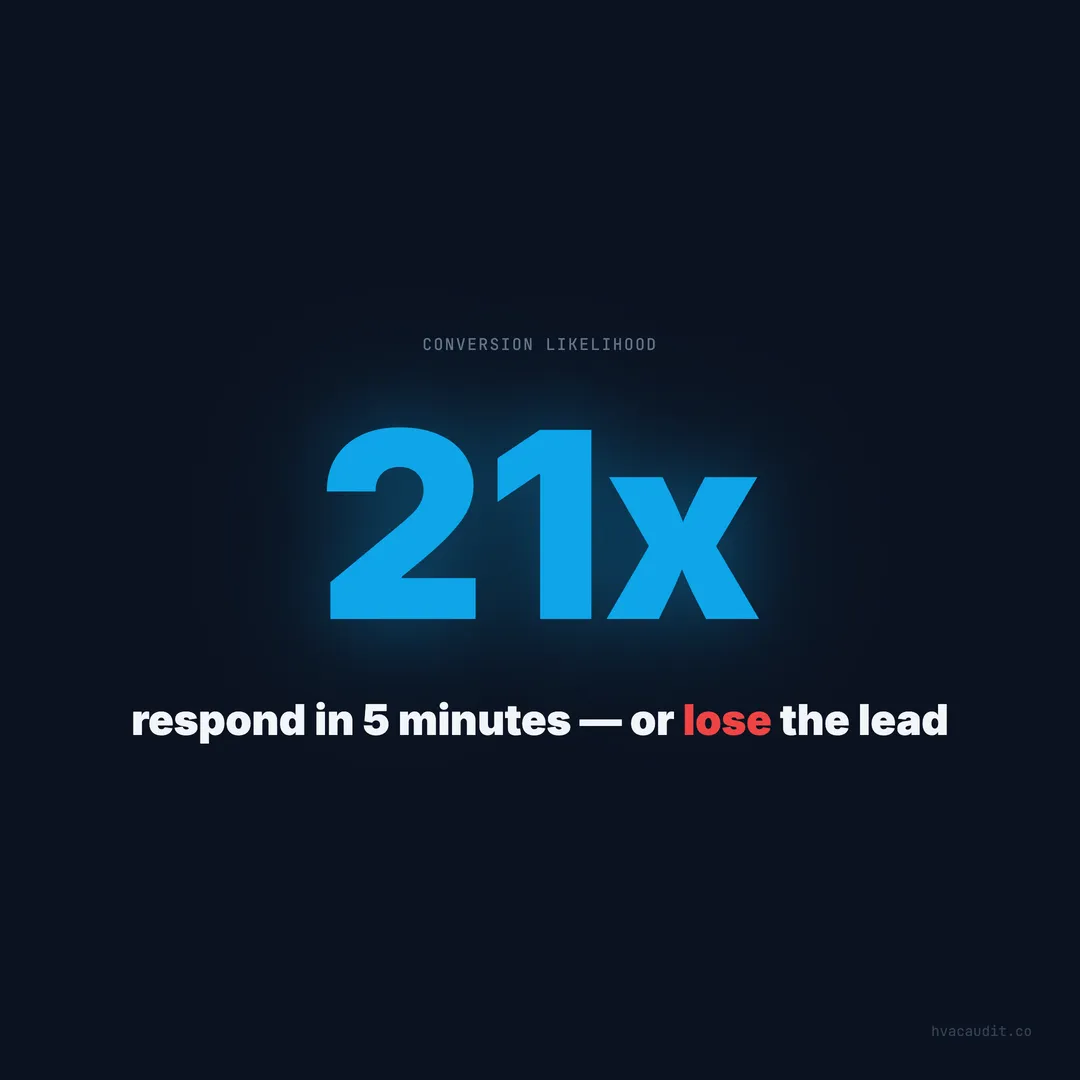
Responding to a Facebook lead within 5 minutes makes you 21x more likely to convert that lead compared to responding in 30 minutes. The speed-to-lead data is even more critical on Facebook than Google because Facebook leads are interruptive — they weren’t looking for you, so the window of interest is measured in minutes, not hours.
The lead form vs. landing page decision
Facebook offers two conversion paths: lead forms (Instant Forms) that open inside Facebook, and landing page clicks that send users to your website.
Lead forms generate 2–3x more leads at 40–60% lower cost per lead. The homeowner taps the ad, a pre-filled form appears with their name, email, and phone number, and they submit in two taps. Friction is nearly zero. Volume is high.
The downside: lead form quality is 30–40% lower than landing page leads. Because it’s so easy to submit, people fill out forms out of mild curiosity. They may not remember doing it when you call back. This is why the 5-minute response window is non-negotiable — you need to catch them while they still remember clicking the ad.
Landing page leads cost more ($55–$85 vs. $28–$45 for forms) but close at nearly double the rate. A homeowner who clicks an ad, waits for your page to load, reads your offer, and voluntarily fills out a form is more committed. The problem: most HVAC websites load in 18.4 seconds on average with a site score of 34/100. By the time the page loads, she’s already scrolled past and forgotten about the ad.
If you’re going to drive Facebook traffic to a landing page, that page must load in under 3 seconds and follow the HVAC landing page playbook — single CTA, pricing transparency, trust signals above the fold. Otherwise, use Instant Forms and invest in speed-to-lead infrastructure.
Seasonal targeting changes everything
HVAC Facebook ads aren’t a 12-month-same-strategy channel. The creative, offer, and targeting should shift with seasonal demand patterns.
Pre-season (March–April for AC, September–October for heating): Target homeowners with maintenance offers. “Is your AC ready for summer? $49 tune-up — limited spots this week.” Pre-season ads convert well because homeowners feel proactive urgency without emergency pressure.
Peak season (June–August for AC, December–February for heating): Shift to emergency-adjacent messaging. “AC struggling to keep up? Free diagnostic for [city] homeowners.” Peak-season leads are more expensive ($45–$70 vs. $28–$45 pre-season) but close at higher rates because the problem is real and present.
Off-season: Pivot to maintenance agreements and system evaluations. “Your furnace is 12+ years old — free efficiency check.” Off-season Facebook ads are 40–60% cheaper because competition drops. The off-season marketing strategy that works is building a maintenance agreement pipeline through Facebook when CPMs are at their lowest.
| Season | Best offer type | Avg CPL | Close rate | Best targeting |
|---|---|---|---|---|
| Pre-season | Tune-up/maintenance | $28–$40 | 15–25% | ZIP + homeowner + age |
| Peak season | Diagnostic/emergency | $45–$70 | 30–45% | ZIP + homeowner + interests |
| Off-season | Maintenance agreement | $22–$35 | 10–15% | ZIP + homeowner + home age |
Retargeting is where Facebook actually beats Google
Here’s the truth most agencies won’t tell you: Facebook’s primary value for HVAC isn’t cold lead generation — it’s retargeting.
A homeowner visits your website after a Google search. She browses your AC repair page, checks your reviews, looks at pricing — and leaves without calling. She’s not ready yet. Maybe she’s comparing three contractors. Maybe she wants to ask her husband. Maybe the AC started working again.
95% of HVAC website visitors leave without converting. But with a Facebook pixel on your website, you can show those visitors targeted ads for the next 30–90 days. The ad doesn’t need to introduce your company — she already knows you. It just needs to remind her and remove the last friction point.
HVAC retargeting ads on Facebook convert at 3–8x the rate of cold ads because the audience already expressed intent by visiting your website. The cost per lead drops to $15–$30 because you’re not paying to create awareness — only to complete a conversion that was already started.
The retargeting setup that works for HVAC:
- Day 1–7 after visit: “Still need AC repair? We have same-day openings this week.”
- Day 8–14: Social proof ad — “247 five-star reviews. Here’s what [City] homeowners say.”
- Day 15–30: Urgency ad — “Your $49 diagnostic offer expires Friday.”
This sequence produces 4–6 additional leads per 1,000 website visitors — leads that would have gone to competitors without the retargeting investment.
Instagram runs on the same system — with one difference
Facebook and Instagram ads run through the same platform (Meta Ads Manager). Your Facebook campaigns automatically run on Instagram unless you exclude it. For HVAC, Instagram placement typically performs 10–20% worse than Facebook because Instagram’s user base skews younger and includes more renters.
However, Instagram Stories ads — vertical video that fills the phone screen — produce higher engagement rates for before-and-after content. A 15-second Story showing a grimy air filter next to a clean one, or an iced-over coil before and after repair, generates curiosity clicks that standard feed ads don’t capture.
The winning approach: run your lead generation on Facebook feed and use Instagram Stories exclusively for retargeting. The homeowner who visited your website sees a fullscreen video of your latest 5-star review or a before-and-after installation. It’s a reminder, not a cold pitch — and it converts at 2–4x the rate of cold Instagram ads.
Budget allocation that doesn’t burn money
Most HVAC contractors who fail at Facebook ads spend their entire budget on cold traffic. The marketing budget allocation that works:
60% retargeting ($600 of a $1,000 monthly Facebook budget). This targets website visitors, past customers, and service area lookalikes. CPL: $15–$30. Close rate: 25–40%.
25% seasonal lead generation ($250). Cold targeting using the ZIP + homeowner formula with seasonal offers. CPL: $28–$55. Close rate: 10–20%.
15% brand awareness ($150). Testimonial videos, before-and-after content, community involvement posts. No direct CTA — these build familiarity so when the homeowner does need HVAC service, your brand is recalled first. This is the long play that compounds over 6–12 months.
Total expected leads from $1,000/month Facebook budget: 25–45 leads. Compare that to Google Ads at $104/lead producing 9–10 leads for the same budget. The per-lead cost is lower, but you need the 5-minute response system to make it work. Without instant follow-up, Facebook lead quality drops below profitable thresholds.
The contractors who skip Facebook entirely are losing a channel that, when properly configured, produces the cheapest leads in HVAC marketing. The contractors who throw $2,000 at boosted posts with no strategy are funding Meta’s stock price. The difference between those two outcomes is the setup — and the 5-minute response window that turns a curious click into a booked call.
If your ad spend is climbing but conversions aren’t, the problem is usually the website your ads send traffic to. See the full diagnostic for ads that aren’t working.
Keep reading
Want to know your score?
Drop your URL — full report in 48 hours.
We're on it.
Report in your inbox within 48 hours.