HVAC Off-Season Marketing: Keep the Phone Ringing Year-Round
Most HVAC companies go dark in shoulder seasons and panic-spend in summer. Here's how to maintain steady lead flow year-round.
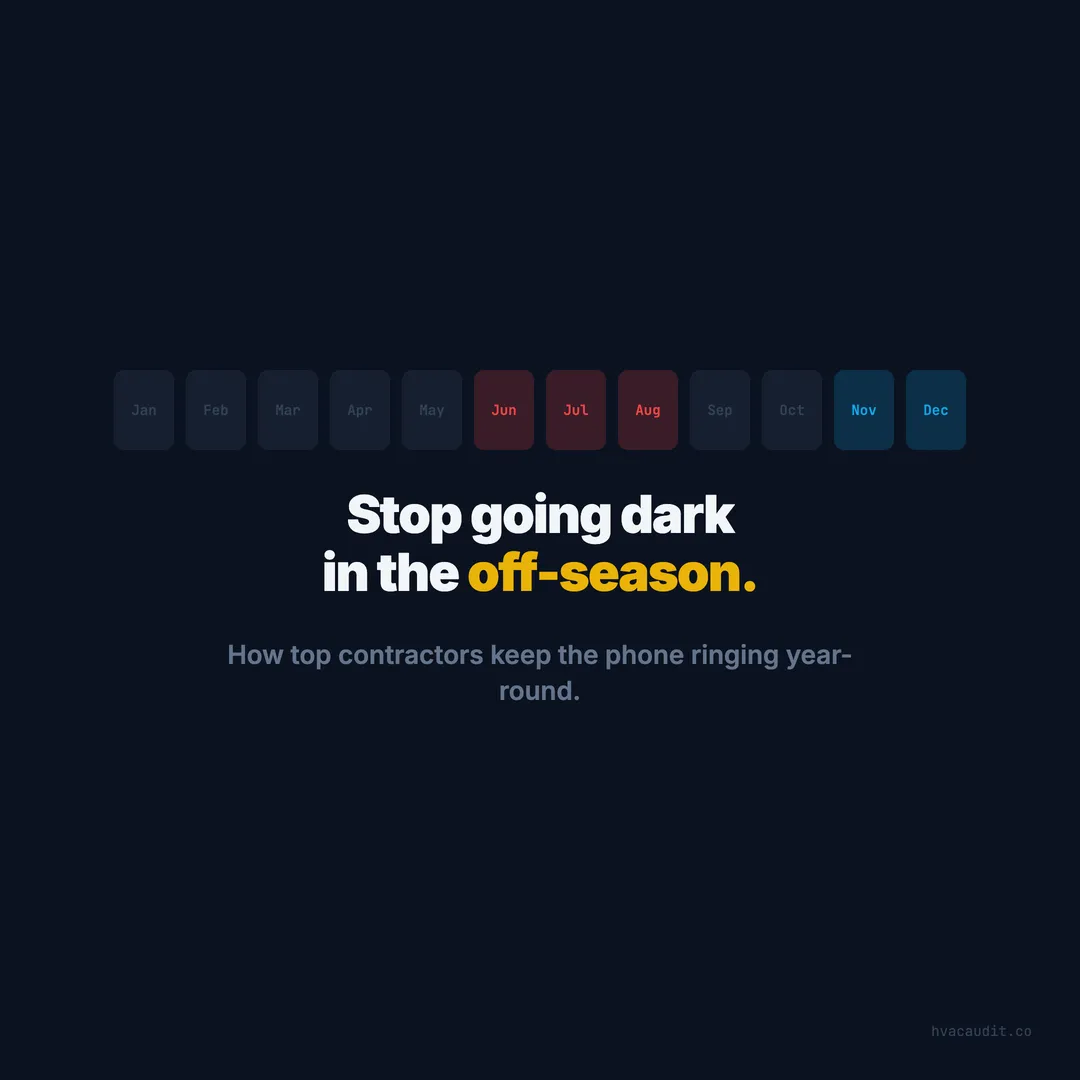
Every HVAC contractor knows the cycle. June hits, the phone explodes. October arrives, it goes silent. By November, you’re laying off technicians. By June, you can’t hire them fast enough.
This feast-or-famine pattern isn’t inevitable. The top 5% of HVAC companies maintain steady lead flow year-round. Here’s how.
Why the phone dies in shoulder seasons
The obvious reason: nobody’s thinking about their AC in April or their furnace in October. Demand drops because need drops.
But demand doesn’t drop to zero. It drops because most HVAC companies stop marketing in shoulder seasons. They pull ad budgets, stop posting content, and stop asking for reviews. The phone dies because you stopped feeding it.
Meanwhile, the contractors who keep marketing in March-May and September-November have less competition and lower ad costs. They’re picking up leads for half the price because everyone else went dark.
The math behind shoulder season marketing
During peak season, Google Ads costs for HVAC keywords can hit $40-$50 per click. During shoulder seasons, the same keywords cost $15-$25 per click — a 40-60% reduction.
Here’s what that looks like in practice:
| Season | Cost per Click | Clicks/Month ($2K budget) | Conversion Rate | Leads | Cost/Lead |
|---|---|---|---|---|---|
| Peak (Jun-Sep) | $40-$50 | 40-50 | 10% | 4-5 | $400-$500 |
| Shoulder (Mar-May, Oct-Nov) | $15-$25 | 80-130 | 8% | 6-10 | $200-$250 |
| Off-peak (Dec-Feb) | $10-$20 | 100-200 | 6% | 6-12 | $167-$333 |
The counterintuitive insight: shoulder seasons can generate more leads at a lower cost than peak season because competition drops faster than demand. The homeowners who do search during shoulder seasons are serious — they’re planning ahead or dealing with a real issue, not casually browsing.
The maintenance agreement play
Maintenance agreements are the off-season’s best friend. They guarantee recurring revenue, keep trucks rolling, and — critically — put your technicians inside customer homes during shoulder seasons.
Why this matters for marketing:
1. Upsell opportunities
A spring tune-up often reveals issues the customer didn’t know about. A $150 maintenance visit turns into a $3,000 repair or replacement conversation. Not because you’re upselling dishonestly — because a 15-year-old system genuinely needs attention, and the homeowner didn’t know until your technician pointed it out.
The upsell numbers: On average, 20-30% of maintenance visits generate additional work — either a repair, a part replacement, or a conversation about system replacement. For a contractor doing 80-100 maintenance visits in April, that’s 16-30 additional repair or replacement conversations.
At an average additional ticket of $800-$2,000, maintenance visits generate $12,800-$60,000 in shoulder season revenue from upsells alone.
2. Review generation
Every maintenance visit is a review opportunity. If you’re doing 80-100 maintenance calls in April, that’s 15-20 new Google reviews per month during a time when competitors get zero.
This compounds over 12 months. By the time summer hits, you’ve added 60-80 reviews that competitors didn’t add. Your review count grows, your Map Pack position improves, and you enter peak season with a ranking advantage built during shoulder months.
3. Referrals
Maintenance customers are your most loyal customers. They see your technicians twice a year. They trust you. They refer friends and family.
One off-season marketing push to sell maintenance agreements creates a referral engine for peak season. A customer who signs up for a maintenance agreement in March and gets great spring service will recommend you to their neighbor whose AC breaks in July.
How to sell maintenance agreements online
Create a dedicated page on your website — not a paragraph buried in your services section. A full page with:
- Clear pricing — “$189/year for two seasonal tune-ups” or “$15.99/month with no annual commitment”
- What’s included — itemize every check and service performed during each visit
- Savings calculation — “Members save $150-$300/year compared to one-time service calls”
- Priority scheduling — “Members get same-day emergency service with no after-hours surcharge”
- Easy sign-up — a simple form or phone number to enroll
Promote it everywhere:
- Email your customer list in February-March (spring) and August-September (fall)
- Post about it on your Google Business Profile weekly during shoulder months
- Run Facebook ads targeting past customers and lookalike audiences
- Add a maintenance agreement CTA to every service page on your website
- Have technicians mention it at every service call
Target numbers: A well-promoted maintenance program should enroll 5-10% of your annual customer base. If you served 500 customers last year, that’s 25-50 maintenance agreements in the first year. At $189/year each, that’s $4,725-$9,450 in guaranteed recurring revenue — plus the upsell opportunities from each visit.
The seasonal content calendar
Content marketing costs the same in March as it does in July. But in March, you have less competition for rankings. Blog posts published in shoulder seasons have months to build organic traffic before peak season hits.
Spring (March-May)
- “Is Your AC Ready for Summer? A Pre-Season Checklist”
- “5 Signs You Need to Replace Your AC Before Summer”
- “How Much Does a New AC Unit Cost in [City] in 2026?”
- “Spring HVAC Maintenance: What’s Included and Why It Matters”
- “SEER Rating Guide: What Rating Do You Actually Need in [State]?”
- “Central AC vs Mini-Split: Which Is Right for Your Home?”
Why spring content matters: A blog post published in March about “How Much Does a New AC Unit Cost in [City]” takes 2-3 months to build search rankings. By June, it’s ranking on page one and capturing high-intent searches from homeowners ready to buy. If you wait until June to publish it, it won’t rank until August or September — after peak season has passed.
Fall (September-November)
- “Furnace Not Turning On? 7 Things to Check Before Calling”
- “When to Replace Your Furnace: Age, Efficiency, and Cost Guide”
- “Fall HVAC Tune-Up: Preparing for [City] Winters”
- “Heat Pump vs Furnace: Which Is Better for [State]?”
- “How to Lower Your Heating Bill This Winter”
- “Carbon Monoxide and Your Furnace: What Every Homeowner Should Know”
The safety angle: Fall content about carbon monoxide and furnace safety gets shared more than typical HVAC content. It’s genuinely helpful, builds brand trust, and drives organic traffic from safety-conscious searches. This type of content also performs well in AI search results because AI systems prioritize safety-related information.
Content publishing frequency
Aim for 2-4 posts per month during shoulder seasons. This is when you build the content library that drives peak season traffic. Each post should:
- Target a specific keyword (use Google’s autocomplete suggestions for ideas)
- Answer a question homeowners actually ask
- Include your city name naturally
- Link to relevant service pages
- Include a clear CTA (schedule maintenance, call for assessment, book online)
This is how top-performing HVAC websites build consistent traffic year-round instead of relying solely on peak season demand.
Email marketing
If you have a customer list (and you should), off-season is when email marketing shines. Your past customers are your warmest audience — they’ve already hired you and (presumably) had a good experience.
The shoulder season email strategy
March-April emails:
Subject: “Summer’s coming. Your AC might not be ready.”
Body: “Last summer, we saw a 3-week wait for AC repairs in [City]. The homeowners who booked spring tune-ups avoided the rush entirely. Book your AC inspection now — $89, takes 45 minutes, and catches problems before they leave you sweating in June. [Book Now Button]”
September-October emails:
Subject: “Your furnace sat idle for 6 months. Here’s why that’s a problem.”
Body: “A furnace that hasn’t run since March can develop cracked heat exchangers, clogged filters, and ignition problems. Our fall inspection catches these before the first cold night. $89 for members, $129 one-time. [Book Now Button]”
Monthly (year-round):
Subject: “[Month] HVAC Tips for [City] Homeowners”
Body: One helpful tip (seasonal maintenance reminder, energy-saving tip, common question answered). Keep it short — 100-150 words max. Include a CTA for whatever’s most relevant: maintenance, tune-up, or assessment.
Email performance benchmarks for HVAC
| Metric | Industry Average | Good | Great |
|---|---|---|---|
| Open rate | 20% | 25-30% | 35%+ |
| Click rate | 2% | 4-5% | 7%+ |
| Bookings per 1,000 emails | 2-3 | 5-8 | 10+ |
A customer list of 2,000 emails sending one monthly email should generate 4-20 bookings per month — almost entirely from shoulder season content. These are existing customers who already trust you, so the close rate is high and the acquisition cost is nearly zero.
Retargeting the warm audience
Everyone who visited your website during peak season but didn’t call is a warm lead. They had intent but didn’t convert. Retargeting ads on Google Display and Facebook during shoulder seasons are cheap (CPMs drop 40-60% in off-peak months) and effective.
How to set up HVAC retargeting
- Install the Facebook Pixel and Google Ads remarketing tag on your website (if not already done)
- Create an audience of visitors from the past 90-180 days who didn’t call or submit a form
- Create ads with shoulder season messaging:
Spring retargeting ads:
- “Still need AC service? We’re booking now with no wait time.”
- “Spring AC Tune-Up Special: $89. Book before the summer rush.”
- “Remember looking at AC repair in [City]? We’re running a spring special.”
Fall retargeting ads:
- “Is your furnace ready for winter? Schedule a $89 inspection.”
- “Don’t wait for the first cold snap. Book your furnace check now.”
- “Maintenance agreement members get priority scheduling all year. Sign up today.”
Retargeting budget
$200-$500/month in shoulder seasons is typically enough for an HVAC contractor’s retargeting campaigns. At reduced CPMs, this reaches your warm audience multiple times per week. The ROI is exceptional because you’re not paying to acquire new visitors — you’re re-engaging people who already showed interest.
Lower your ad costs by staying on
Google Ads costs drop significantly in shoulder seasons because most HVAC companies pause campaigns. The contractors who keep running ads during March-May get the same clicks for 30-50% less per lead.
Even a small budget ($500-$1,000/month) during off-season keeps your campaigns active, maintains your quality score, and ensures you’re capturing the leads that do search during these months.
Why pausing campaigns hurts you
Google Ads rewards consistency. When you pause a campaign and restart it, you lose:
- Quality Score momentum — Google needs time to re-evaluate your ads and landing pages
- Bid optimization data — Smart Bidding algorithms need 2-4 weeks to recalibrate after a pause
- Ad rank history — competitors who stayed on have accumulated better ad performance metrics
- Learning period — when you restart, Google puts your campaign through another learning period with higher costs
The result: it costs more to get back to your pre-pause performance level. A contractor who maintains a $500/month budget through shoulder season spends $3,000 to stay active. A contractor who pauses and restarts spends $0 on ads but loses 2-3 weeks of optimization when they restart — which costs more than $3,000 in wasted ad spend during the relearning period.
The compound effect
A contractor who markets year-round doesn’t just get more off-season leads. They enter peak season with:
- Higher Google rankings — from months of content and SEO work
- More reviews — from maintenance visit requests during shoulder months
- A warmer audience — from retargeting and email engagement
- Lower ad costs — from maintained quality scores and continuous optimization
- Full trucks — from maintenance agreements that keep technicians productive
- Better cash flow — from steady shoulder season revenue instead of feast-or-famine
The contractors who go dark for 4 months every year restart from scratch twice a year. The ones who stay on compound their advantage continuously. After 2-3 years of year-round marketing, the gap becomes nearly insurmountable — they’ve built review counts, content libraries, and SEO authority that can’t be replicated in a single peak season.
The year-round marketing budget
Here’s how to allocate your marketing budget by season:
| Quarter | Budget % | Focus |
|---|---|---|
| Q1 (Jan-Mar) | 20% | SEO, content, maintenance agreement push, pre-season ads |
| Q2 (Apr-Jun) | 35% | Peak season ads, review generation, conversion optimization |
| Q3 (Jul-Sep) | 30% | Peak season ads, content for fall, review generation |
| Q4 (Oct-Dec) | 15% | Heating content, maintenance push, planning for next year |
Don’t spend the same amount every month. Shift budget toward peak season while maintaining a baseline during shoulder months. The baseline ($500-$1,500/month depending on company size) is what keeps your marketing engine warm.
Keep reading
Want to know your score?
Drop your URL — full report in 48 hours.
We're on it.
Report in your inbox within 48 hours.