Private Equity Is Coming for Your HVAC Business — Now What
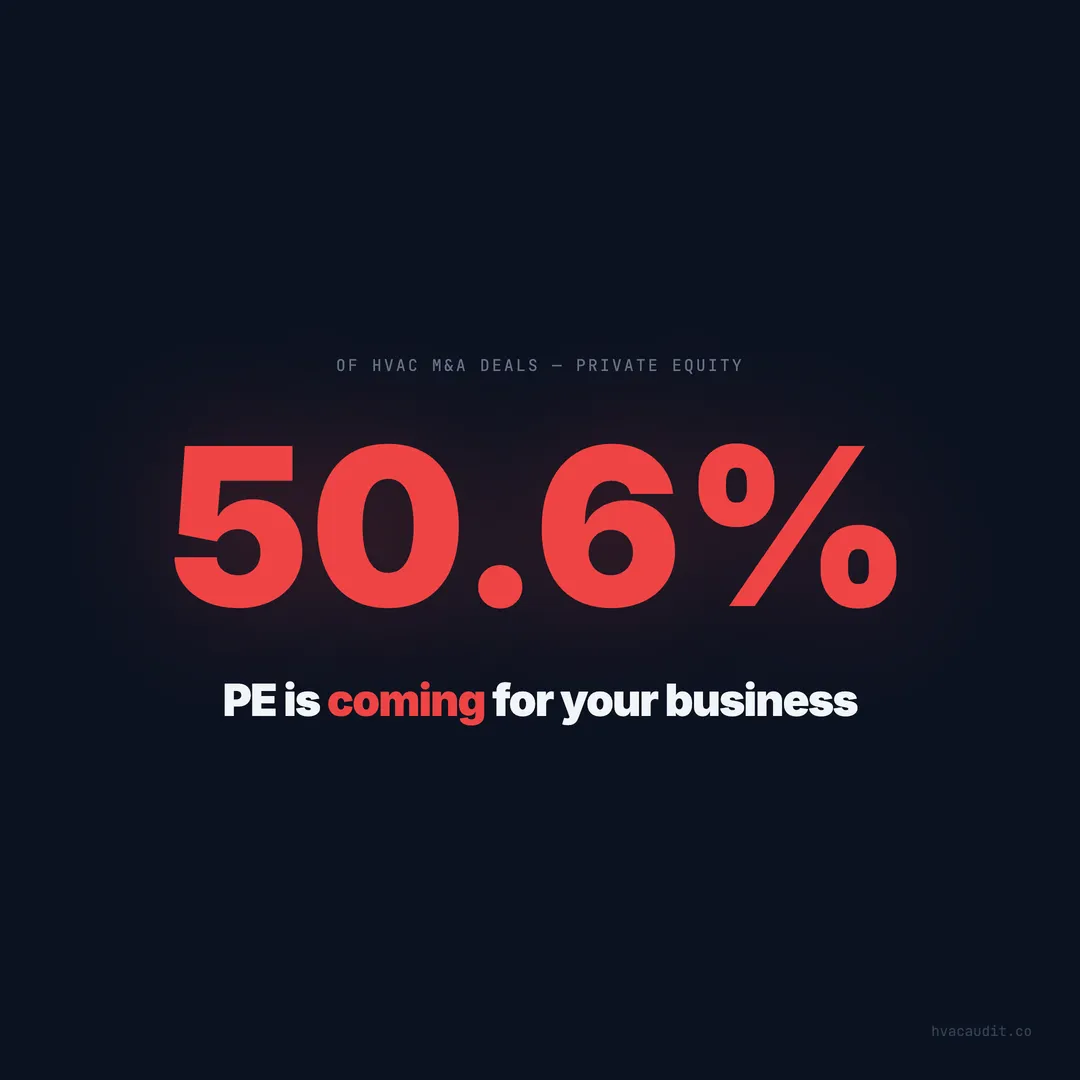
Private equity accounted for 50.6% of all HVAC M&A deals in H1 2025 — an 88% increase year over year. Here's how PE rollups are reshaping the industry and what independent contractors should do about it.
A three-truck HVAC company in Charlotte gets a phone call from a “strategic partner” offering to buy the business for 5x EBITDA. The owner, who clears $76,000 a year after a decade of 60-hour weeks, does the math. It sounds life-changing. What he doesn’t realize is that the buyer has already acquired 14 other HVAC companies in his market, consolidated them under one brand, and plans to use the combined entity’s marketing budget to outspend every remaining independent by 10:1.
Private equity accounted for 50.6% of all HVAC M&A deals in the first half of 2025. That’s not a typo — more than half of all HVAC business sales now involve PE firms. And the pace is accelerating. PE deal volume in HVAC increased 88% year over year from H1 2024 to H1 2025.
This isn’t a trend. It’s a structural transformation of the HVAC industry. And if you’re an independent contractor who plans to still be in business in five years, you need to understand what’s happening, why, and what it means for your daily operations.
Why private equity is targeting HVAC
PE firms don’t invest in industries randomly. They follow a specific playbook, and HVAC checks every box:
Recurring revenue potential. Maintenance agreements create predictable cash flow that PE firms can model and value. HVAC companies with maintenance agreement penetration above 30% command 1.5-2x higher acquisition multiples than those without. PE firms know they can increase that penetration post-acquisition through systematic sales processes.
Fragmented market. The HVAC industry is still dominated by small, independent operators. 87% of HVAC companies have fewer than 20 employees. This fragmentation means a PE firm can acquire dozens of companies, consolidate operations, and create a regional or national brand with economies of scale that no individual operator can match.
Essential service with pricing power. When your AC breaks in July, you’re not comparison shopping for three weeks. You’re calling someone today. HVAC has lower price elasticity than most home services — customers pay what’s quoted because the alternative is suffering in the heat. PE firms see this as built-in pricing power they can systematically exploit.
Aging infrastructure. The average U.S. residential HVAC system is 15-20 years old. 78 million homes need HVAC replacement or major repair in the next decade. PE firms see a generational demand wave and want to be positioned to capture it.
Technician scarcity creates a moat. With 110,000 unfilled HVAC jobs, labor is the primary bottleneck. PE-backed companies can offer higher wages, better benefits, and career paths that independents can’t match. Acquiring companies is partly about acquiring their technician workforce.
The rollup math that’s reshaping the industry
Here’s how PE rollups work in HVAC:
Step 1: Platform acquisition. The PE firm buys a well-run HVAC company with $5-15M in revenue as the “platform.” They pay 6-8x EBITDA for this anchor company because it has management, systems, and brand equity.
Step 2: Tuck-in acquisitions. They then acquire 10-30 smaller HVAC companies at 3-5x EBITDA. These are the companies that sell for less because they’re smaller, less sophisticated, and have fewer options. The average tuck-in acquisition in HVAC is $1.2-$3M.
Step 3: Consolidation. All companies are merged under one brand, one phone system, one CRM, one marketing operation. Duplicate overhead is eliminated. PE firms typically cut 15-25% of combined overhead through consolidation.
Step 4: Growth. With consolidated buying power, the combined entity negotiates better equipment pricing, hires a professional marketing team, and scales ad spend. PE-backed HVAC companies spend an average of 14% of revenue on marketing — nearly double the 8% independent average.
Step 5: Exit. After 3-7 years, the PE firm sells the combined entity for 8-12x EBITDA — far more than the 3-5x they paid for individual tuck-in acquisitions. The arbitrage between small-company multiples and large-company multiples is where PE makes its money.
This isn’t theoretical. It’s happening in every major HVAC market right now. The top 10 PE-backed HVAC platforms collectively acquired over 190 companies in 2024-2025 alone.
What PE-backed competitors do differently
Once a PE firm acquires and consolidates HVAC companies, the competitive dynamics in that market shift permanently. Here’s what independent contractors face:
Professional marketing at scale. PE-backed companies hire full-time marketing directors, digital agencies, and content teams. They produce more content, run more ads, and optimize more aggressively than any independent can afford. Average marketing budget for a PE-backed HVAC platform: $800,000-$2M/year. Average marketing budget for an independent: $48,000-$72,000/year.
Branded fleet and uniforms. Consistent branding across 40-80 trucks creates top-of-mind awareness that compounds daily. Every truck is a rolling billboard. Brand recognition in PE-served markets increases 34% within 18 months of the rollup.
Centralized call center. Professional dispatchers answer every call within 3 rings, 24/7. No missed calls, no voicemail, no “I’ll call you back.” Speed to lead is built into the operation, not dependent on whether the owner is on a job site.
Systematic review generation. PE platforms implement automated review request systems across all technicians. PE-backed companies generate 3-5x more reviews per month than independents because the process is systematized, not optional.
Equipment purchasing power. Buying Trane, Carrier, or Lennox equipment across 15 locations yields volume discounts that independents can’t access. PE-backed companies pay 8-15% less for equipment, improving margins on every installation.
The markets where PE is most active
PE consolidation isn’t uniform across the country. Certain markets are experiencing more intense rollup activity:
Southeast (Florida, Georgia, Carolinas, Tennessee): The fastest-growing region for PE-backed HVAC acquisitions. Year-round demand, growing populations, and relatively lower acquisition costs make this the primary target zone. 38% of all HVAC PE deals in 2024-2025 were in the Southeast.
Texas: The second-most active region. Houston and Dallas-Fort Worth have seen 15+ PE-backed acquisitions each. Texas HVAC SEO is already competitive — PE marketing budgets make it more so.
Midwest (Ohio, Indiana, Michigan, Minnesota): PE firms are targeting the Midwest for heating-dominant markets with strong replacement demand and lower competition for acquisitions.
Southwest (Phoenix, Las Vegas, Albuquerque): Extreme heat markets with growing populations. PE sees the demographic tailwinds and is positioning accordingly.
What happens to independents when PE enters their market
The honest answer: it depends on how prepared you are.
Scenario 1: The unprepared independent. A three-truck company with no website (or a website that scores 34/100), 17 Google reviews, no maintenance agreements, and no marketing strategy. When PE enters their market with 10x marketing budget, professional branding, and systematic review generation, this company loses 20-40% of lead volume within 12-18 months. 74% of HVAC companies that close within 3 years of PE market entry were in this category.
Scenario 2: The prepared independent. A company with a high-performing website, 200+ reviews, strong customer lifetime value through maintenance agreements, and a clear brand identity. This company doesn’t just survive — it can thrive. Independents with strong digital presence retain 85-95% of their leads even after PE entry because their local trust and review history are assets that PE can’t replicate overnight.
Scenario 3: The sellout. Some owners see PE as the exit strategy. If you’ve built a profitable, well-run company, selling to a PE firm at 4-6x EBITDA might be the right financial decision. But understand the terms: most PE deals require the owner to stay on for 2-3 years at a reduced role, and earnout provisions mean the full purchase price isn’t guaranteed.
How to compete without PE backing
Independent HVAC companies that survive (and beat) PE-backed competitors share specific characteristics:
They own their online presence. A website that converts, a complete Google Business Profile, a steady stream of reviews, and local content depth that PE platforms can’t replicate at scale. PE companies have breadth. Independents win with depth.
They build maintenance agreement programs. Recurring revenue stabilizes cash flow and increases company valuation. HVAC companies with 30%+ maintenance agreement penetration are valued at 5-7x EBITDA — approaching the multiples PE pays for platform acquisitions.
They focus on customer lifetime value, not just customer acquisition. PE firms optimize for volume. Independents can optimize for relationship depth. A customer who’s been with you for 8 years, has a maintenance agreement, and refers two friends per year is worth more than three new customers acquired through $50 Google Ads clicks.
They systemize without corporatizing. Professional processes (CRM, dispatching, automated follow-ups) don’t require abandoning the personal touch that customers love about independents. 72% of homeowners prefer independent HVAC contractors over branded franchise operations — but only when the independent offers comparable professionalism and responsiveness.
They specialize. PE rollups serve everyone. An independent that specializes in high-efficiency systems, geothermal, or commercial HVAC for specific building types creates a niche that PE can’t easily absorb.
The business failure rate in PE-dominated markets
Here’s the number nobody wants to talk about: HVAC business failure rates increase 22-30% in markets where PE rollups reach 30%+ market share. The failures aren’t randomly distributed. They cluster among undifferentiated independents with weak digital presence, no maintenance agreements, and reactive (not proactive) marketing.
The survivors share a profile: strong online reviews, websites that convert, maintenance agreement penetration above 25%, and a local brand identity that customers choose even when a larger competitor offers a lower price.
Busy but broke companies are the most vulnerable. They have revenue but no margin, no systems, and no time to invest in the things that would protect them. When PE enters their market and compresses their lead volume by 20-30%, the already-thin margins evaporate entirely.
Whether to sell, compete, or specialize
The decision depends on three factors:
Your age and exit timeline. If you’re 55+ and want to retire in 5-7 years, selling to PE might make sense. The multiples are historically high right now — average HVAC acquisition multiples increased from 4.2x to 5.8x EBITDA between 2022 and 2025. But multiples could compress as interest rates rise and deal flow slows.
Your market’s PE saturation. If PE already controls 30-40% of your market, competing requires significant investment in marketing, technology, and team development. If PE hasn’t entered your market yet, you have a window to build the defenses that make you either acquisition-proof or acquisition-attractive.
Your company’s digital moat. A company with a website that scores 80+ (not the industry average of 34), 200+ Google reviews, a complete maintenance agreement program, and strong local brand recognition can compete with PE indefinitely. These companies retain 85-95% of their leads regardless of PE activity because their local trust is deeper than any PE brand can build in 12-18 months.
The HVAC industry is consolidating. That’s a fact, not a prediction. The question isn’t whether PE will affect your business — it’s whether you’ll be positioned to compete, sell at a premium, or get squeezed out.
Start positioning now. The contractors who wait until PE enters their market are already too late.
Keep reading
Want to know your score?
Drop your URL — full report in 48 hours.
We're on it.
Report in your inbox within 48 hours.