One HVAC Call Is Worth $12,000 — If You Keep the Customer
A single HVAC service call leads to $12,000+ in lifetime revenue — maintenance agreements, replacements, and referrals. But most contractors lose the customer after the first visit. Here's why retention beats acquisition.
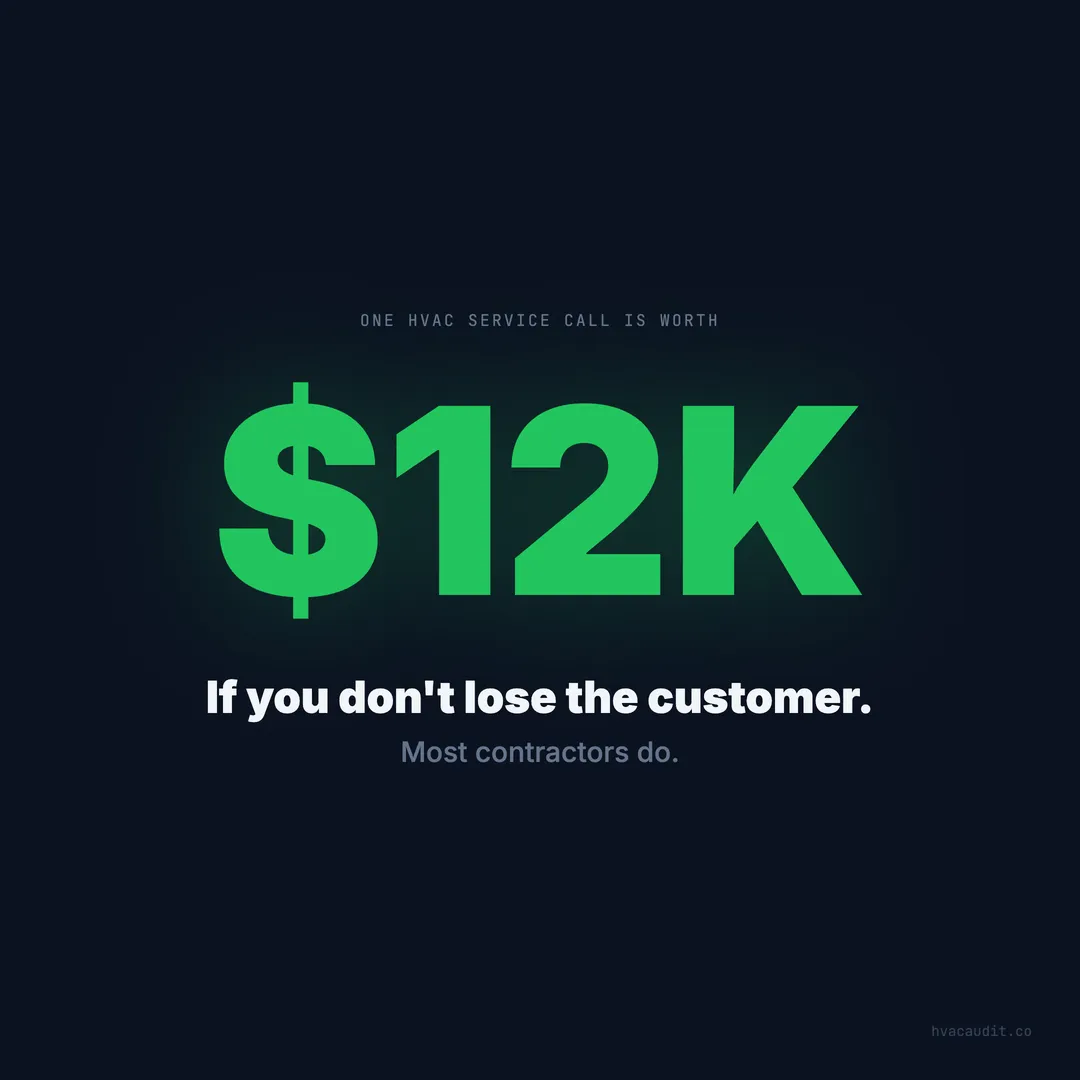
A homeowner calls for an AC repair. You send a tech. He fixes a capacitor. You charge $285. The homeowner pays and you never hear from them again.
That’s not a $285 transaction. That’s a $12,000 relationship you just lost.
A single HVAC customer is worth $12,000–$15,000 over their lifetime — annual maintenance, emergency repairs, and eventually a full system replacement. But most contractors treat every service call as a one-time transaction, collect the check, and wait for the phone to ring with a new customer.
Meanwhile, the customer you just served needs a tune-up next spring. They’ll call someone. If you didn’t follow up, they’ll call whoever shows up first in their search — and that might not be you.
The math behind $12,000 per customer
The lifetime value of an HVAC customer isn’t theoretical. It’s arithmetic.
| Revenue event | Average value | Frequency |
|---|---|---|
| Initial service call | $285–$600 | Once |
| Annual maintenance (tune-up) | $150–$250 | Yearly × 7–10 years |
| Emergency repairs | $300–$800 | 2–3 times over ownership |
| System replacement | $5,500–$12,000 | Once (every 15–20 years) |
| Referrals to friends/family | $500–$2,000 | 1–3 referrals |
A customer who stays with you for 10 years — maintenance agreements, occasional repairs, one system replacement, and two referrals — generates $12,000–$18,000 in total revenue. Maintenance agreement customers are 5–7x more valuable than one-time repair customers because they don’t churn to a competitor between visits.
Increasing customer retention by just 5% increases profit by 25–95%. That’s not HVAC-specific — it’s a baseline business reality that hits even harder in a seasonal industry where acquiring a new customer costs $400+.
Why contractors lose customers after the first visit
The problem isn’t the quality of work. Most HVAC techs do a good job. The problem is what happens after the invoice is paid: nothing.
No follow-up email. No “how did we do?” text. No maintenance agreement offer. No seasonal reminder. The customer gets a receipt, and the contractor moves on to the next call. Six months later, the homeowner needs a tune-up and can’t remember who fixed their AC.
The average homeowner uses HVAC services every 1–2 years. Between those touchpoints, you’re invisible unless you stay in contact. The contractor who sends a quarterly email, offers a maintenance plan, and reaches out before peak season captures the next service call. The one who doesn’t is starting from zero with a customer who already paid them once.
This is the gap between an acquisition-focused business and a retention-focused business. The first one spends $400 to find every customer. The second one spends $10 to keep the customers they already have.
Maintenance agreements turn transactions into relationships
A $199/year maintenance agreement changes the entire economics of your business. It converts a one-time customer into a recurring revenue source with predictable cash flow.
Here’s what a book of 200 maintenance agreements produces:
- $39,800/year in recurring revenue at predictable margins (60–70%)
- Priority service expectations that keep customers from calling competitors
- Replacement pipeline — you’re the first call when the system dies
- Referral base — satisfied agreement customers refer at 3–5x the rate of one-time customers
- Cash flow smoothing — renewals spread across all 12 months, filling the winter valley
The lifetime value of a maintenance agreement customer versus a one-time customer isn’t close. The agreement customer generates $4,500–$7,000 over five years from maintenance alone. Add in the eventual replacement (which you’ll get because you’re their “HVAC company”) and referrals, and the total exceeds $12,000.
Most HVAC websites don’t sell agreements online. When we audited 147 sites, fewer than 20% had a maintenance agreement page with pricing. That’s leaving recurring revenue on the table.
The retention math destroys the acquisition math
Compare two contractors with identical revenue:
Contractor A (acquisition-focused):
- Acquires 200 new customers/year at $412 CAC = $82,400 in marketing
- Average transaction: $450
- 90% of customers never return
- Annual revenue from new customers: $90,000
- Net after marketing: $7,600
Contractor B (retention-focused):
- Acquires 100 new customers/year at $300 CAC = $30,000 in marketing
- Retains 80% of previous customers (160 returning)
- Average transaction: $450 (new) + $199 maintenance (returning)
- Annual revenue: $45,000 (new) + $71,640 (returning) = $116,640
- Net after marketing: $86,640
Contractor B spends less, earns more, and has predictable revenue. The difference isn’t marketing budget — it’s what happens after the first service call.
Your website is either building retention or ignoring it
How homeowners choose is well-documented: 73% call someone they already know. That means the single most valuable marketing asset you have is the list of customers who’ve already paid you. If you stay top of mind, you get 73% of the market without competing for it.
Your website plays a role here. A customer who visits your site after service should find:
- A maintenance agreement offer with clear pricing and online sign-up
- Easy re-booking for seasonal tune-ups
- A review request that converts their satisfaction into public social proof
- Seasonal content that keeps your name in their inbox
When your website only speaks to new customers — “Learn about our services!” — you’re ignoring the most profitable audience you have: the people who already trust you.
Every service call is an audition for the next $12,000
The tech who fixes a capacitor and leaves a business card just performed a $285 transaction. The tech who fixes the capacitor, explains what he found, offers a maintenance agreement, asks for a review, and follows up with a thank-you text just started a $12,000 relationship.
The difference isn’t talent. It’s process. The companies with the highest customer lifetime values have systems for every post-service touchpoint — automated follow-ups, agreement offers, seasonal reminders, and review requests.
Your next $12,000 customer is already in your database. They paid you once. They were satisfied enough not to leave a bad review. And right now, they’re slowly forgetting your name — because you haven’t given them a reason to remember it.
The cost to remind them is $10. The cost to replace them is $412. The math is obvious. The execution is where most contractors fail.
Keep reading
Want to know your score?
Drop your URL — full report in 48 hours.
We're on it.
Report in your inbox within 48 hours.