Nextdoor for HVAC: 77% Homeowners, 17% Conversion Rate
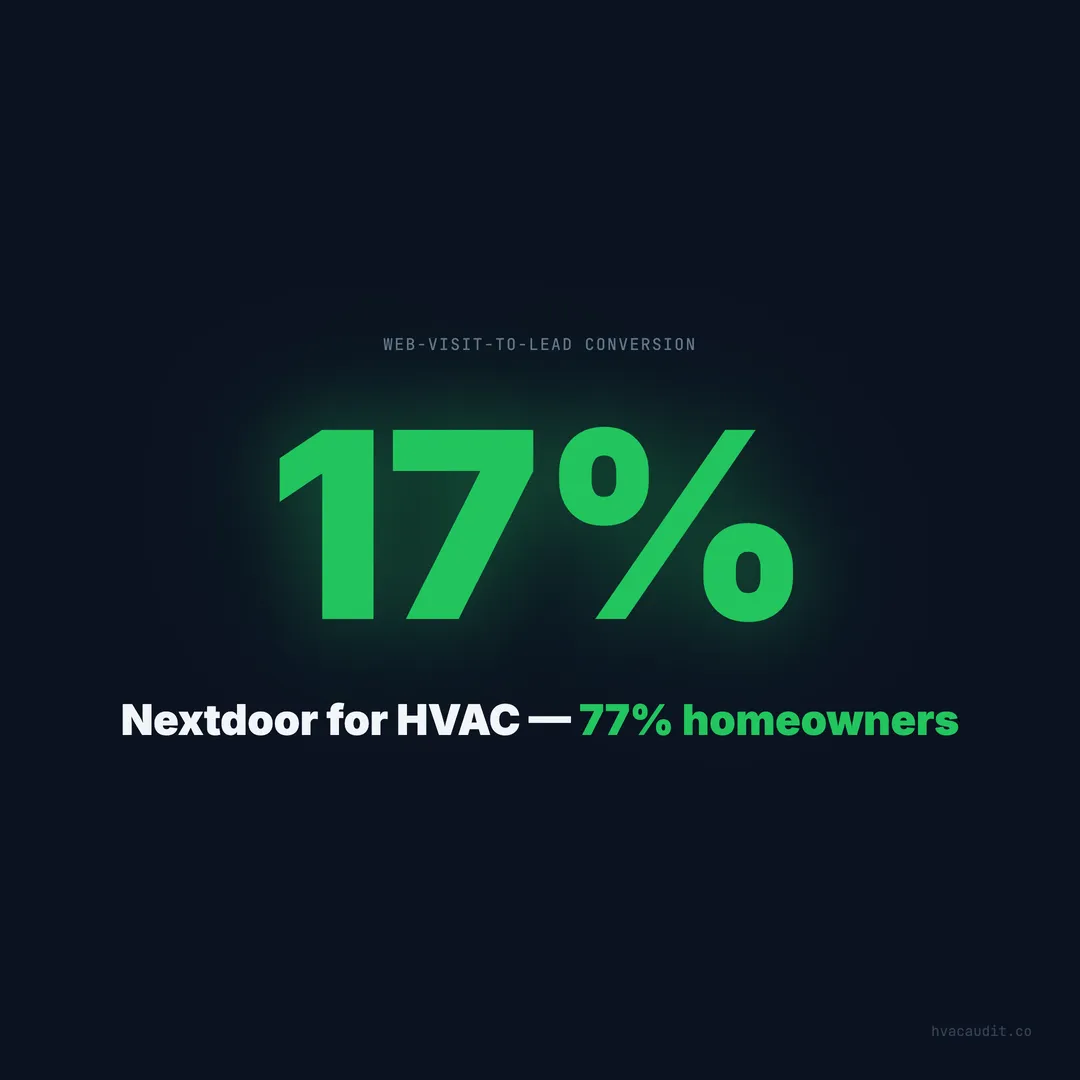
Nextdoor reaches 1 in 3 US households, 77% are homeowners, and HVAC posts see a 17% web-visit-to-lead conversion rate. But most contractors use it wrong. Here's the full setup.
A homeowner in a Nextdoor neighborhood feed sees a post from a neighbor: “Can anyone recommend a good AC company? Ours died last night.” Within 45 minutes, the post has 14 comments. Eight of them recommend the same contractor. The homeowner clicks the contractor’s Nextdoor business page, sees their 4.8 rating and 52 neighborhood recommendations, visits their website, and calls within 10 minutes.
That contractor didn’t pay for that lead. They didn’t run an ad. They didn’t even know the post existed. Their reputation on Nextdoor generated a zero-cost lead with a close rate above 60% — because it came with 8 personal endorsements from real neighbors.
1 in 3 US households is active on Nextdoor, and 77% of those users are homeowners. For HVAC contractors, this is the highest concentration of your ideal customer on any social platform. And the contractors who set up Nextdoor properly see a 17% web-visit-to-lead conversion rate — 4–5x higher than the average HVAC website conversion rate of 2–5%.
Why Nextdoor converts higher than any other social platform
The conversion rate difference isn’t random. It’s structural. Nextdoor has three characteristics that no other platform offers for local service businesses.
Verified addresses. Every Nextdoor user verifies their home address to join. That means every person who sees your business page lives in your service area. There’s no geographic bleed, no out-of-area clicks, no wasted impressions on people who’ll never become customers. Compare that to Facebook where geographic targeting leaks 10–15% of spend to irrelevant audiences.
Neighbor recommendations carry more weight than reviews. When we studied how homeowners choose HVAC contractors, recommendations from neighbors ranked higher than Google reviews, BBB ratings, and advertising combined. 92% of consumers trust recommendations from people they know over any other form of marketing. Nextdoor makes those recommendations visible, public, and searchable.
The audience is pre-qualified. Nextdoor’s user base is 77% homeowners with a median household income of $95,000. These are people who own the HVAC systems they’re asking about, have the budget to pay for repairs and replacements, and make purchasing decisions for their homes. No other platform offers this level of pre-qualification at zero targeting cost.
The organic strategy that builds a lead machine
Paid Nextdoor ads work — we’ll cover them below. But the highest ROI on Nextdoor comes from organic activity that costs nothing but time.
Claim your business page. This is step one, and 60% of HVAC contractors haven’t done it. An unclaimed business page means neighbors can still recommend you, but those recommendations link to a bare profile with no contact information, no website link, and no way to convert interest into a call.
A claimed page displays your:
- Phone number (click-to-call on mobile)
- Website link (this drives the 17% conversion rate)
- Business hours
- Service area
- Neighbor recommendations (displayed prominently)
- Your replies to recommendations (builds trust)
Post helpful content 2–3 times per week. Not ads. Not promotions. Helpful content. “5 signs your AC needs a tune-up before summer” or “Why your furnace keeps short-cycling — and when it’s a $50 fix vs. a $2,000 problem.” These posts get engagement because they solve problems neighbors are already thinking about.
The engagement algorithm on Nextdoor rewards helpfulness over promotion. Posts that get likes, comments, and shares from neighbors appear in more feeds. Promotional posts (“20% off AC tune-ups!”) get buried. Helpful posts that generate conversation get amplified. The best-performing HVAC Nextdoor posts get 3,000–8,000 impressions in a single neighborhood cluster — all from a free post.
Reply to every recommendation request. When a neighbor asks “Can anyone recommend an AC company?”, replying as a business is allowed and expected. The key: don’t pitch, advise. “Hi [Name], we’d be happy to take a look. Common causes of [their problem] include X, Y, and Z — sometimes it’s a $50 fix. Feel free to give us a call and we can diagnose it.” This response gets upvoted by neighbors, builds trust, and generates calls.
Neighbor recommendations are worth more than Google reviews
This is a controversial claim, but the data supports it. Nextdoor recommendations from verified neighbors convert at higher rates than Google reviews for one reason: proximity. A Google review from “John S.” could be from anywhere. A Nextdoor recommendation from “John S. on Oak Street” is from someone the homeowner might actually know.
The average HVAC contractor on Nextdoor with 30+ recommendations gets 2–4 organic leads per month without spending a dollar. That’s leads from neighbors searching the Nextdoor app for “HVAC” or “AC repair” and finding a business with visible social proof from people in their neighborhood.
Building recommendations requires a simple system:
- After every completed job, ask the homeowner: “Would you be willing to recommend us on Nextdoor?”
- Send a follow-up text with a direct link to your Nextdoor business page
- Thank every person who leaves a recommendation with a public reply
Only 12% of HVAC contractors actively request Nextdoor recommendations. The ones who do it consistently build a recommendation count that dominates their local market. A contractor with 75 Nextdoor recommendations in a neighborhood cluster has more visible social proof than a competitor with 300 Google reviews — because every recommendation comes from a verified neighbor, not an anonymous reviewer.
This doesn’t replace Google review strategy — it supplements it. The best approach is asking satisfied customers for both: a Google review for search visibility and a Nextdoor recommendation for neighborhood trust.
Paid Nextdoor ads: lower cost, narrower reach
Nextdoor offers paid advertising through “Local Deals” and “Neighborhood Sponsorship” programs. The economics are different from Facebook and Google because the audience is smaller but more qualified.
Local Deals: You create an offer (e.g., “$49 AC tune-up for [Neighborhood] residents”) that appears in the Nextdoor feed for selected neighborhoods. Cost: $3–$6 per click with typical lead costs of $25–$50. The click-to-lead conversion rate is higher than Facebook because every click comes from a verified homeowner in your service area.
Neighborhood Sponsorship: You pay a flat monthly fee ($75–$200 per neighborhood) to be the sponsored business in a category. Your business appears at the top of the neighborhood’s business directory and in sponsored posts. This works best in neighborhoods with 2,000+ households where your brand presence compounds over time.
The paid strategy that produces the best ROI: Run Local Deals with seasonal maintenance offers during pre-season (March–April, September–October). Pre-season Nextdoor deals convert at 22–28% because homeowners see the offer in the context of neighbors also preparing for the season. The social proof is built into the platform.
| Nextdoor ad type | Monthly cost | Avg leads/month | CPL | Best use |
|---|---|---|---|---|
| Local Deals | $200–$500 | 8–15 | $25–$50 | Seasonal offers |
| Neighborhood Sponsorship | $75–$200/neighborhood | 3–6 | $25–$65 | Brand presence |
| Organic posts (free) | $0 | 2–4 | $0 | Year-round |
The reputation flywheel effect
Nextdoor creates a compound growth effect that no other marketing channel matches. Here’s how it works:
Month 1: You claim your page, post helpful content 2–3 times per week, and ask 5 customers for recommendations. You get 3 recommendations and 1 organic lead.
Month 3: You have 15 recommendations. Your posts get 1,500–2,500 impressions each. You’re generating 2–3 organic leads per month. Neighbors are starting to mention your company name in recommendation threads without being asked.
Month 6: You have 40+ recommendations. Your posts regularly get 4,000–6,000 impressions. You’re generating 4–6 organic leads per month. Your business appears first when anyone in your service area searches “HVAC” on Nextdoor. The cost per lead on this channel is effectively zero.
Month 12: You have 75+ recommendations. Your company is the default HVAC recommendation in 3–5 neighborhood clusters. Organic lead flow reaches 6–10 per month — generating $3,000–$5,000 in monthly revenue from a channel that costs nothing but 30 minutes of posting per week.
This flywheel effect is why the contractors who start early on Nextdoor build an almost unassailable competitive advantage. A competitor entering the platform 12 months after you needs to generate 75+ recommendations just to match your current position. By the time they catch up, you’ll have 150.
Common mistakes that kill Nextdoor results
Posting ads instead of advice. “20% off all AC services!” gets buried by the algorithm and ignored by neighbors. “Your AC filter should be changed every 60–90 days — here’s why skipping it costs you $200+ in efficiency” gets shares, comments, and profile visits. The platform rewards helpfulness.
Not replying to recommendation threads. When a neighbor asks for HVAC recommendations and three people tag your company, you need to reply. Not replying signals that you’re not active, not responsive, and not interested. Businesses that reply to recommendation threads within 2 hours get 3x more profile clicks than those that reply days later or not at all.
Ignoring negative feedback. Nextdoor conversations are public and hyperlocal. A single negative comment from a neighbor reaches hundreds of households in your service area. Responding professionally and offering to resolve the issue publicly turns a negative into a trust-building moment. Ignoring it lets the narrative grow unchallenged.
Not connecting Nextdoor to your overall lead strategy. Nextdoor leads should flow into the same CRM and call tracking system as your Google, Facebook, and referral leads. Without tracking, you can’t measure the channel’s ROI and you risk letting high-value leads fall through the cracks.
Nextdoor vs. every other HVAC marketing channel
When we compare Nextdoor to other lead sources for HVAC, it occupies a unique position: highest conversion rate, lowest cost, but moderate volume. You won’t build a business on Nextdoor alone, but ignoring it means leaving the cheapest, highest-converting leads on the table.
The role of Nextdoor in your marketing stack: It’s the referral program you never built, running 24/7, fueled by happy customers who voluntarily recommend you to their neighbors. Every other marketing channel tries to create trust from scratch. Nextdoor starts with trust already established.
The contractor who claims their business page, posts helpful content consistently, asks for recommendations after every job, and replies to neighborhood threads within 2 hours will generate 6–10 organic leads per month within a year. At a 60% close rate and $500 average ticket, that’s $1,800–$3,000 in monthly revenue from a channel that costs nothing but 30 minutes of attention per week.
The contractor who skips Nextdoor is handing those leads — and those neighborhood endorsements — to the competitor who shows up. On a platform where 77% of users are homeowners and 17% of website visitors become leads, choosing not to participate is choosing to lose.
Keep reading
Want to know your score?
Drop your URL — full report in 48 hours.
We're on it.
Report in your inbox within 48 hours.