HomeAdvisor vs Google Ads vs SEO: Where HVAC Leads Actually Come From
We compared cost per lead, close rate, and cost per sale across every major channel. Here's what the data says.
Every HVAC contractor wants to know: where should I spend my marketing dollars?
The answer depends on one thing most people ignore — not cost per lead, but cost per acquired customer. A $20 lead that never books is more expensive than a $60 lead that converts every time.
Here’s the real comparison.
The data
| Channel | Cost/Lead | Close Rate | Cost/Customer | Lead Quality |
|---|---|---|---|---|
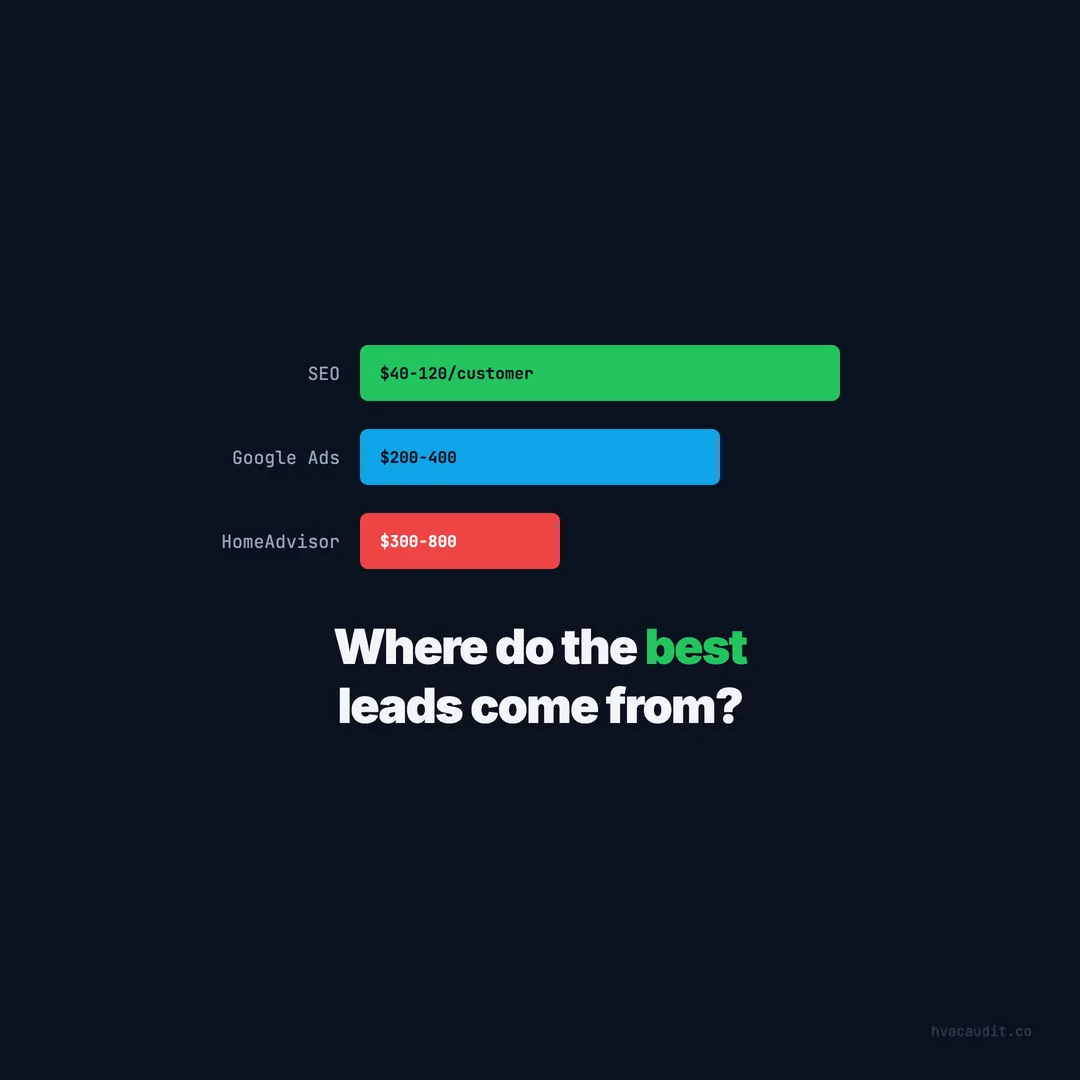
| Google Ads | $35-75 | 15-25% | $200-400 | High intent |
| SEO (organic) | $10-30 | 20-35% | $40-120 | Highest intent |
| HomeAdvisor/Angi | $30-80 | 8-15% | $300-800 | Shared, mixed |
| Thumbtack | $20-60 | 10-18% | $150-500 | Moderate |
| Facebook Ads | $15-40 | 5-10% | $200-600 | Low intent |
| Referrals | $0 | 50-70% | ~$0 | Best quality |
The standout: organic search leads close at 2-3x the rate of paid leads. When someone Googles “AC repair near me,” clicks an organic result, and calls — that person has high intent and hasn’t been sent to five other contractors simultaneously.
Why cost per lead is misleading
Most HVAC companies track “cost per lead” as their primary marketing metric. This is a mistake. A lead is just a phone call or form submission — it’s not a customer until they book and pay.
Consider two scenarios:
Scenario A: HomeAdvisor
- 20 leads at $50 each = $1,000 spent
- 10% close rate = 2 customers
- Cost per acquired customer: $500
Scenario B: Google Ads to a proper landing page
- 15 leads at $60 each = $900 spent
- 22% close rate = 3-4 customers
- Cost per acquired customer: $225-$300
Scenario A looks cheaper per lead. Scenario B is dramatically cheaper per customer. The second metric is the only one that matters — it’s the one that directly ties to revenue.
Channel-by-channel breakdown
Google Ads (Search)
Best for: Immediate lead flow, emergency services, new market entry
Google Ads puts you at the top of search results for any keyword you’re willing to pay for. For HVAC, the most valuable keywords are emergency and repair searches — “AC repair near me,” “emergency HVAC [city],” “furnace not working.”
The numbers:
- Cost per click: $15-$50 depending on market and keyword
- Average clicks to generate one lead: 5-8
- Cost per lead: $35-$75
- Close rate: 15-25%
- Cost per acquired customer: $200-$400
Why it works: These are high-intent searches. Someone Googling “AC repair” at 2pm in July wants their AC fixed today. They’re not browsing. They’re buying.
The catch: Google Ads only works when your landing page converts. If you’re sending ad clicks to your homepage (which most HVAC contractors do), you’re converting 2-3% of those clicks into calls. With a dedicated landing page, you can hit 8-15%. Same spend, 3-5x more leads.
Common waste: Most contractors waste 30-50% of their ad spend on broad-match keywords that attract irrelevant clicks (“HVAC jobs near me,” “AC repair training,” “how to fix my own AC”). Tight keyword targeting and negative keyword lists are essential. Without them, you’re paying $50 per click for someone who wants to learn HVAC repair as a career, not hire a contractor.
SEO (Organic Search)
Best for: Long-term, compounding lead flow at the lowest cost per customer
Organic search is the cheapest lead source in the long run, but it requires patience and upfront investment. The payoff is enormous: once you rank for “AC repair [city],” every click is free. Forever.
The numbers:
- Monthly investment: $1,500-$5,000 (agency) or $0 (DIY with time investment)
- Cost per lead (once ranking): $10-$30
- Close rate: 20-35%
- Cost per acquired customer: $40-$120
- Time to results: 4-8 months
Why close rates are highest: When someone finds you through organic search, they chose you. They scrolled past ads, found your result, read your title and description, and decided to click. By the time they reach your site, they’re already predisposed to trust you — especially if your site has good reviews, fast speed, and professional service pages.
What organic requires:
- A website that loads fast and converts (this is the foundation — without it, nothing else matters)
- Individual service pages targeting specific keywords (“AC Repair in Dallas,” “Furnace Installation in Fort Worth”)
- Active Google Business Profile with weekly updates
- Consistent review generation (15+ per month)
- Monthly content publishing (blog posts targeting informational keywords)
The compounding effect is powerful. After 6 months, your cost per lead starts dropping. After 12 months, organic becomes your lowest-cost, highest-quality lead source. After 24 months, you’re generating leads at a fraction of what your competitors pay on HomeAdvisor.
HomeAdvisor / Angi
Best for: Filling gaps, supplementing lead flow. Not as a primary source.
HomeAdvisor and Angi sell the same lead to 3-5 contractors. The homeowner’s phone rings five times in two minutes. First callback wins, regardless of quality.
The numbers:
- Cost per lead: $30-$80+
- Close rate: 8-15%
- Cost per acquired customer: $300-$800
- Lead exclusivity: shared with 3-5 competitors
Why the math is brutal: At $50/lead with a 10% close rate, you’re paying $500 to acquire one customer. For a $300 repair job, you’re losing money. For a $5,000 installation, the margins are thin once you factor in labor, parts, and overhead.
The deeper problem: HomeAdvisor leads don’t know you. They requested “a quote” — not your quote. There’s zero brand loyalty or trust built into this interaction. They’re comparing you against 4 other contractors simultaneously, and price is often the deciding factor.
This creates a race to the bottom. The contractor who quotes lowest gets the job, even if their quality is worse. Your margins shrink. Your brand becomes interchangeable. And if HomeAdvisor raises their lead prices (which they do regularly), you have no leverage.
When HomeAdvisor makes sense: As a supplemental source during slow months, or when entering a new market where you have no organic presence yet. Budget 10-15% of your marketing spend here, not 50-80%.
Thumbtack
Best for: Targeted leads with slightly better exclusivity than HomeAdvisor
Thumbtack sends leads to fewer contractors (usually 2-3) and gives you more control over which leads you bid on. The quality is moderate — better than HomeAdvisor, worse than organic.
The numbers:
- Cost per lead: $20-$60
- Close rate: 10-18%
- Cost per acquired customer: $150-$500
Thumbtack works better for installation leads (where the ticket justifies the cost) than for repair leads (where margins are thinner).
Facebook Ads
Best for: Brand awareness, seasonal promotions, maintenance agreement signups
Facebook Ads are cheap to run but low in intent. Nobody opens Facebook thinking “I need my AC repaired.” They see your ad, maybe click out of curiosity, but they weren’t actively searching for your services.
The numbers:
- Cost per lead: $15-$40
- Close rate: 5-10%
- Cost per acquired customer: $200-$600
Where Facebook works: Seasonal pushes (spring tune-up specials, fall maintenance promotions), maintenance agreement signups, and brand building in your local market. It’s also useful for retargeting — showing ads to people who visited your website but didn’t call.
Where Facebook fails: Emergency and repair leads. Someone with a broken AC at 2pm isn’t scrolling Facebook. They’re on Google.
Referrals
Best for: Everything. The holy grail of lead sources.
Referrals close at 50-70% because the customer already trusts you through someone they know. They cost nothing. They’re the highest-quality leads in any business.
How to generate more referrals:
- Ask every happy customer: “Do you know anyone who might need HVAC work?”
- Follow up after installations with a referral card or email
- Offer a referral incentive ($50 off next service for both parties)
- Do great work — the most powerful referral engine is a job well done
The limit of referrals is scale. You can’t control volume. That’s why you need other channels to supplement — but referrals should always be cultivated as a primary source.
Why shared leads are killing your margins
The fundamental problem with HomeAdvisor, Angi, and similar platforms is the shared lead model. When the same lead goes to 5 contractors, several destructive dynamics kick in:
- Speed beats quality — the first contractor to call back wins, regardless of whether they’re the best fit
- Price competition intensifies — the homeowner has 5 quotes, so they default to the cheapest
- No relationship is built — the customer doesn’t know your brand, your values, or your reputation
- The platform controls your business — they can raise prices, change rules, or reduce your lead flow at any time
Contractors who build their business on shared leads are renting their marketing. When the rent goes up (and it always does), they have no alternative.
Why owned channels win long-term
Your website and your Google Business Profile are owned channels. You control them. Nobody can raise your prices, share your leads, or change the rules overnight.
When someone finds your site through organic search, reads your reviews, sees your service pages, and calls — that’s a warm lead. They already trust you before picking up the phone. That’s why organic leads close at 20-35%.
The catch: SEO takes 4-8 months to build. You need a website that actually converts first. No point ranking #1 if your site takes 18.4 seconds to load.
The hybrid approach that works
Most successful HVAC companies don’t pick one channel. They layer them:
Foundation (months 1-3): Fix the website. Ensure it loads fast, has click-to-call, shows reviews, has individual service pages. This makes every other channel work better because every channel eventually sends traffic to your website.
Immediate leads (months 1-6): Run Google Ads to generate cash flow while SEO builds. Send traffic to dedicated landing pages, not your homepage. Track every call with proper attribution.
Compounding growth (months 4-12): SEO starts delivering. As organic leads grow, reduce ad spend proportionally. Your blended cost per lead drops every month.
Ongoing: Google Business Profile optimization, review generation, and content marketing compound over time. After 12 months, the contractors who invested in owned channels are paying $40-120 per customer while competitors are still paying $500 on HomeAdvisor.
The 12-month projection
| Month | Google Ads Leads | Organic Leads | Total | Blended Cost/Lead |
|---|---|---|---|---|
| 1-3 | 10-15 | 0-2 | 12-17 | $55-$65 |
| 4-6 | 10-15 | 3-6 | 13-21 | $40-$50 |
| 7-9 | 8-12 | 6-10 | 14-22 | $30-$40 |
| 10-12 | 6-10 | 10-15 | 16-25 | $20-$30 |
By month 12, you’re generating more leads at a lower cost — and the organic leads keep growing while your ad spend stays flat or decreases.
Real example
Look at two Houston contractors we audited. Air Tech of Houston scored 30 — slow site, minimal SEO, relying heavily on paid leads. The Chill Brothers scored 70 — fast site, strong GBP, organic visibility.
Same city. Same services. One is paying 5-10x more per customer than the other because they never invested in their website and search presence.
The bottom line
If you’re spending $3,000+ per month on HomeAdvisor or Angi, take half of that and invest it in your website and SEO. In 6 months, you’ll have a lead source that costs less, converts better, and you actually own.
The data is clear: contractors who invest in owned channels outperform those who rent leads — every time.
No matter which channel you pick, every lead lands on your website. If the site can’t convert, your ads aren’t working — and it’s a website problem.
Keep reading
Want to know your score?
Drop your URL — full report in 48 hours.
We're on it.
Report in your inbox within 48 hours.