Your Best Customers Aren't Referring You — Here's Why
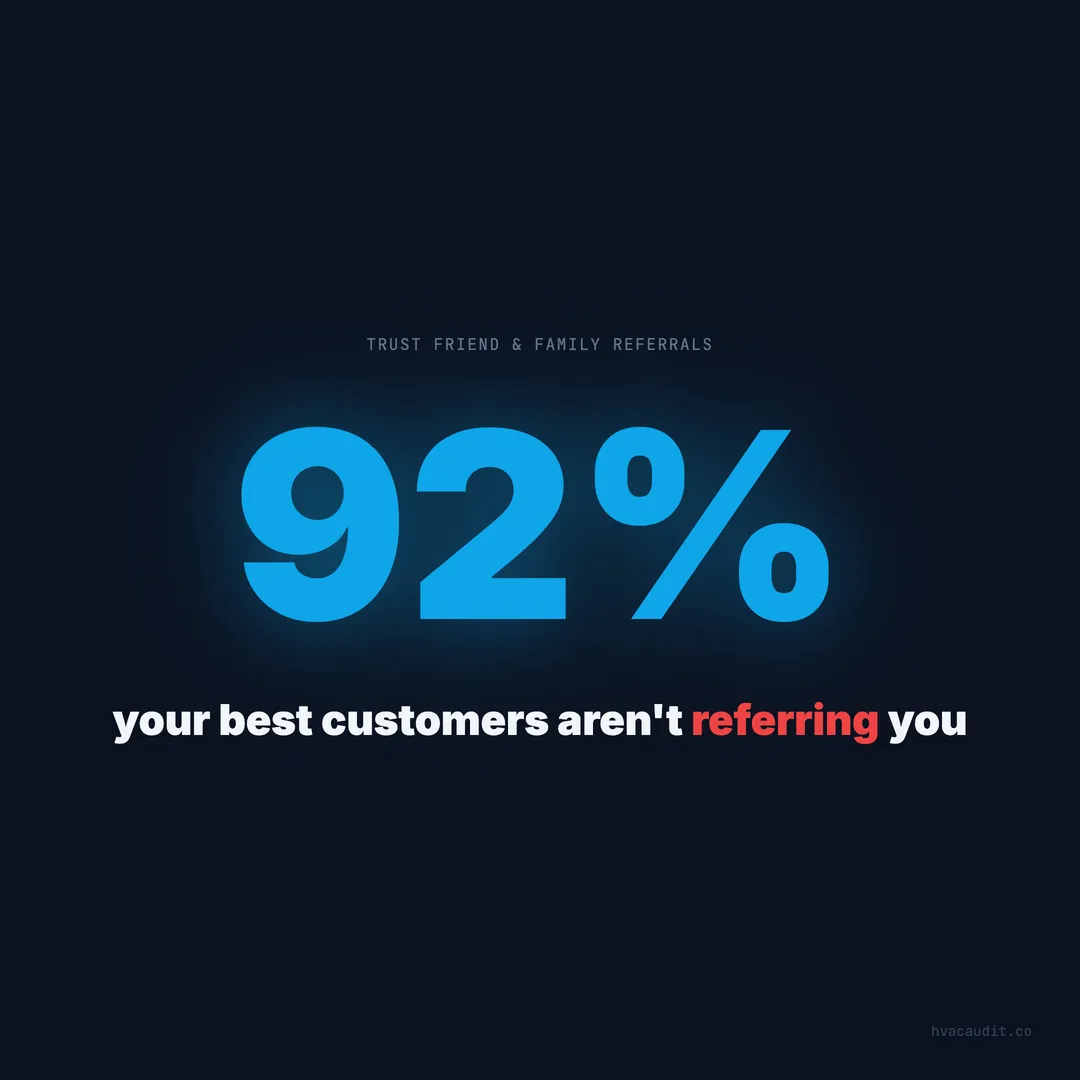
92% of consumers trust referrals from friends and family, and referred customers are 77% more likely to buy. But most HVAC contractors have no referral system. Here's how to build one that generates consistent leads.
A homeowner just had her AC replaced. Your team showed up on time, finished in 6 hours, cleaned up, and walked her through the thermostat. She’s thrilled. She tells her husband, “They were great.” Then she goes about her life and never mentions your company to anyone else — unless someone specifically asks.
Your best customers aren’t referring you. Not because they’re dissatisfied. Not because they wouldn’t recommend you. Because nobody asked them to, nobody made it easy, and nobody gave them a reason to do it right now. The single most valuable marketing channel in HVAC — word of mouth — is running on accident instead of by design.
92% of consumers trust recommendations from friends and family over any other form of marketing. That’s higher than Google reviews, higher than advertising, higher than anything else in the trust hierarchy. And referred customers are 77% more likely to make a purchase than customers acquired through ads or cold outreach. Yet the average HVAC contractor generates fewer than 2 referrals per month because they have no system to capture them.
The referral gap costs more than your ad budget
When we audited 147 HVAC contractor marketing operations, we found that 83% had no formal referral program. No referral cards, no follow-up emails, no incentive structure, no tracking. They relied entirely on organic word of mouth — which generates leads, but at a fraction of what a structured program produces.
The average HVAC contractor gets 1–3 organic referrals per month. A structured referral program generates 8–15 referrals per month from the same customer base. That’s a 4–7x increase in the highest-converting, lowest-cost lead source in the business.
Let’s put numbers on it. A referred customer has a close rate of 60–80% compared to 25–30% for a Google Ads lead. At a $500 average ticket, here’s what the referral gap costs:
| Metric | Without referral program | With referral program |
|---|---|---|
| Monthly referrals | 1–3 | 8–15 |
| Close rate | 60–80% | 60–80% |
| Booked jobs from referrals | 1–2 | 5–12 |
| Revenue from referrals | $500–$1,000 | $2,500–$6,000 |
| Cost per referral lead | $0–$25 | $25–$75 (incentive cost) |
| Annual referral revenue gap | — | $24,000–$60,000 |
That’s $24,000–$60,000 in annual revenue that the contractor without a referral program is leaving on the table. And that doesn’t account for customer lifetime value — each referred customer is worth $12,000–$15,000 over their lifetime.
Why customers don’t refer (even when they’re happy)
The assumption is that happy customers naturally refer. They don’t. Research on referral behavior identifies three barriers that prevent even delighted customers from referring.
Barrier 1: Forgetting. The moment of highest satisfaction — right after a completed job — passes quickly. Within 48 hours, the emotional peak fades and your company becomes a memory, not a story they’re actively telling. If you don’t ask for a referral within 24 hours of service completion, the probability of getting one drops by 70%.
Barrier 2: Effort. Even when a customer wants to refer you, the mental effort of remembering your company name, finding your phone number, and actively bringing it up in conversation is too high. Most referrals die in the “I should tell my neighbor about them” phase because the customer never follows through.
Barrier 3: No trigger. Referrals happen when someone asks, “Do you know a good AC company?” That question might not come up for months. Without a trigger — a referral card, a follow-up email, an incentive — there’s nothing prompting the customer to actively generate referral opportunities instead of waiting for them to appear organically.
A structured referral program solves all three barriers. It asks at the right time (within 24 hours), makes it effortless (one-click sharing or physical referral cards), and creates a trigger (the incentive gives the customer a reason to bring you up proactively rather than reactively).
The referral program that generates 8–15 leads per month
The system has five components. Skip any one of them, and volume drops by 40–60%.
Component 1: The ask (within 24 hours). Your technician asks at the end of every job: “If you were happy with our work today, we’d really appreciate it if you’d share our name with a friend or neighbor who needs HVAC service. We’ll send you a referral card with a $50 credit for each person who books.” This ask is scripted, trained, and expected of every technician on every job.
Component 2: The referral card (physical + digital). Leave two physical referral cards with every customer. Each card has: your company name, phone number, website, a unique referral code, and the incentive offer (“Your friend gets $50 off their first service. You get $50 credit toward your next service.”). Also send a digital version via text within 4 hours of job completion.
53% of referrals happen within the first 2 weeks when the customer has a physical card or a text message to share. Without a tangible reminder, the referral window closes and doesn’t reopen.
Component 3: The incentive structure. The incentive needs to benefit both the referrer and the referred. One-sided incentives (only the referrer gets a reward) produce 40% fewer referrals than dual-sided incentives. The sweet spot for HVAC:
- Referrer: $50 service credit or $25 gift card per booked referral
- Referred friend: $50 off first service or free diagnostic
- Cost to you: $50–$75 per referral that books
- Revenue per booked referral: $500+ average ticket
At $50–$75 cost and $500+ revenue, the referral program ROI is 6:1 to 10:1 — making it the highest-ROI marketing channel available to HVAC contractors. Compare that to Google Ads at 2:1 to 3:1 ROI and you see why referrals should be the foundation of every contractor’s marketing strategy.
Component 4: Tracking and attribution. Every referral needs a unique code or tracking method so you know: who referred whom, when the referral was made, whether it converted, and when to send the reward. Use your CRM or a simple spreadsheet — the format matters less than the habit of tracking every referral from source to close.
Component 5: The thank-you loop. When a referral books, immediately text the referrer: “Your neighbor [First Name] just booked with us — thanks for the recommendation! Your $50 credit has been applied.” This confirmation does three things: it rewards the behavior, it reminds the customer you have a referral program, and it triggers them to think about who else they could refer.
Customers who receive a thank-you message refer 2.3x more often than those who don’t. The thank-you isn’t just polite — it’s a conversion mechanism for the next referral.
Maintenance agreement customers are your best referrers
Not all customers are equally likely to refer. Maintenance agreement customers refer at 3–4x the rate of one-time service customers because they have an ongoing relationship with your company, they interact with your team multiple times per year, and they have more opportunities to discuss HVAC with neighbors.
The referral-from-maintenance strategy:
- At every tune-up visit, remind the customer about the referral program
- Include referral card inserts with every maintenance reminder email
- Offer enhanced incentives for maintenance customers: “$75 credit per referral” instead of $50
- Track referral rates by customer type and double down on the segments that produce
A contractor with 200 maintenance agreements who generates 0.5 referrals per customer per year adds 100 referral leads annually. At 65% close rate and $500 average ticket, that’s $32,500 in annual revenue from a customer base that’s already generating recurring maintenance revenue.
This is the compound effect of building a maintenance agreement pipeline: the agreements generate recurring revenue AND a steady stream of referral leads that cost almost nothing to acquire.
The timing of your referral ask changes everything
Most contractors ask for referrals at the wrong time. They ask during the service call (when the customer is focused on the repair), at invoice (when the customer is focused on the cost), or never at all.
The optimal referral ask timing:
For repairs: Ask 2–4 hours after completion, via text. “Hi [Name], glad we could get your AC running today! If you know anyone who needs HVAC service, we’d love to help them too — and you’ll both get $50 off. Here’s your referral link: [link]”
For installations: Ask 48 hours after completion, after the customer has lived with the new system. “Hi [Name], how’s the new system treating you? If you’re happy with the experience, we’d really appreciate you sharing our name with a neighbor. Here’s a referral card: [link]”
For maintenance visits: Ask at the end of the visit, in person. The tech hands the customer two referral cards and says, “If any of your neighbors need a tune-up, have them mention your name — you’ll both get $50 off.”
Timing referral asks to the moment of peak satisfaction increases conversion by 45%. For repairs, that’s when the AC is blowing cold air again. For installations, it’s when the customer has enjoyed the new system for a full day. For maintenance, it’s when the tech confirms everything is running perfectly.
Digital referral tools that automate the process
Manual referral programs work but don’t scale. Automated referral tools increase referral volume by 2–3x because they remove friction and ensure consistent follow-up.
Text-based referral links: Tools like NiceJob, Birdeye, and Podium let you send automated referral texts with unique tracking links. The customer taps “share,” selects a contact, and the referral is sent via text with a pre-written message and your booking link.
Email referral sequences: Automated email sequences sent 24 hours, 7 days, and 30 days after service keep the referral ask visible without being pushy. Each email includes the referral link and a reminder of the incentive.
Review-to-referral bridge: After a customer leaves a Google review, an automated message says, “Thanks for the review! Know anyone who needs HVAC help? Share your referral link and you’ll both save $50.” This captures customers at peak satisfaction — they just took the time to write a positive review, which means they’re primed to refer.
The automation ROI: A manual referral program costs $0 in software but requires consistent technician execution. An automated system costs $100–$200/month but generates 2–3x more referrals with zero reliance on technician follow-through. For a program generating $2,500–$6,000/month in referral revenue, the $200 software cost is a 12:1–30:1 ROI.
Tracking referrals to prove ROI
The referral program only survives long-term if you can prove it works. Track these five metrics monthly:
1. Referral volume: Total referral leads received. Target: 8–15/month for a 3-truck company.
2. Referral close rate: % of referral leads that book. Target: 60–80%. If it drops below 50%, the referral quality is declining — check that incentives aren’t attracting low-intent referrals.
3. Revenue per referral: Average ticket size from referral customers. Referral customers typically spend 15–25% more than ad-acquired customers because trust is pre-established and they’re less price-sensitive.
4. Referral rate per customer: What % of your customers generate at least one referral. Target: 15–25% with a structured program. Without a program, this number sits at 3–5%.
5. Referral program cost: Total incentive payouts + software costs divided by total referral revenue. Target: under 10% cost-to-revenue ratio. A well-run program spends $1 on incentives for every $8–$12 in referral revenue.
Most contractors who launch referral programs see a 200–400% increase in referral volume within 90 days. The customer acquisition cost from referrals is the lowest of any channel, the close rate is the highest, and the customer lifetime value is 16% above average because referred customers stay longer and refer others at higher rates.
The contractor down the street has customers who love their work but never tell anyone about it. Yours are handing out referral cards, texting links to neighbors, and earning credits that keep them coming back. Same quality of work. Different systems. Dramatically different growth trajectories.
Build the system. Your best customers want to refer you — they just need the ask, the tool, and the incentive to do it now instead of someday.
Keep reading
Want to know your score?
Drop your URL — full report in 48 hours.
We're on it.
Report in your inbox within 48 hours.