The HVAC Follow-Up System That Books Jobs While You Sleep
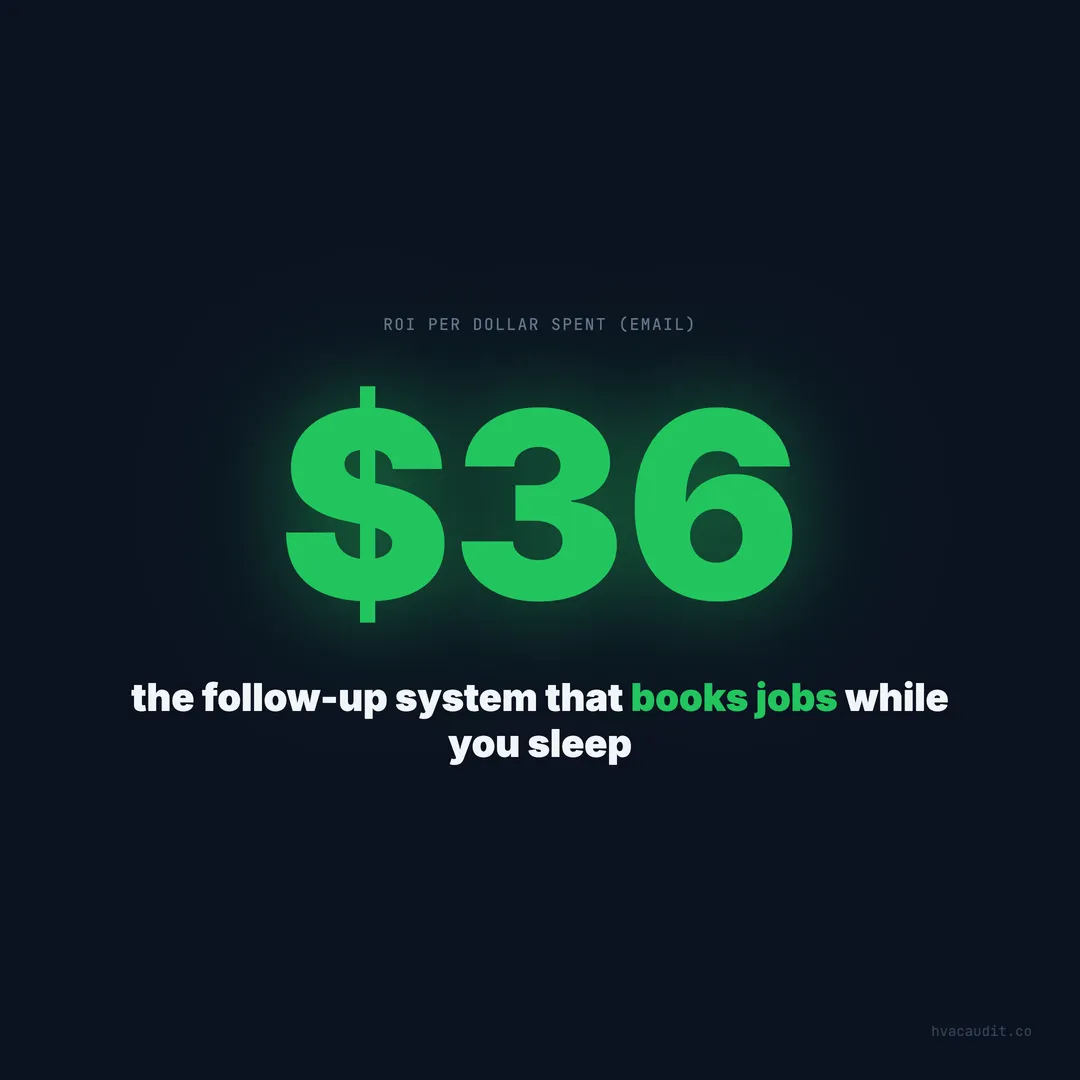
Email returns $36 for every dollar spent. SMS has a 98% open rate. Automated follow-ups recover 15–20% of lost leads. Here's the HVAC follow-up system that books jobs without a single manual phone call.
A homeowner calls your office on a Thursday afternoon about an AC issue. Your CSR gives a quote over the phone — $350 for the repair. The homeowner says, “Let me think about it.” She never calls back. Your CSR moves on to the next call. That lead is dead.
Except it didn’t have to be. An automated text at 6 PM that evening — “Hi Sarah, just following up on the AC repair we discussed. We have a tech available tomorrow morning if you’d like to get it taken care of before the weekend. Reply YES to confirm.” — would have recovered the job 15–20% of the time. No manual effort. No CSR time. Just a $0.02 text message sent automatically by your CRM.
Email returns $36 for every dollar spent — the highest ROI of any marketing channel. SMS messages have a 98% open rate and are read within 3 minutes on average. And automated follow-up sequences recover 15–20% of leads that would otherwise be lost. Yet the average HVAC contractor uses none of these tools. No automated follow-ups. No email campaigns. No SMS sequences. Every lead that doesn’t book on the first call is abandoned.
The follow-up gap is costing you $5,000–$15,000/month
When we audited 147 HVAC contractor operations, we found that 87% have no automated follow-up system. A lead calls, the CSR tries to book, and if the homeowner says “let me think about it” or “I’ll call back,” that lead enters a black hole.
The average HVAC booking rate on first contact is 42%. That means 58% of leads — real homeowners with real HVAC problems — don’t book on the first call. Without follow-up, those leads are gone. Most of them eventually hire a competitor who stayed in contact.
Let’s quantify the loss for a 3-truck company getting 80 leads per month:
- Leads that don’t book on first contact: 46 (58%)
- Leads recoverable with automated follow-up: 7–9 (15–20%)
- Average ticket: $500
- Monthly recovered revenue: $3,500–$4,500
- Annual recovered revenue: $42,000–$54,000
That’s $42,000–$54,000 per year in revenue sitting in your missed call list and “thinking about it” pile. The cost to capture it: $100–$300/month in automation software and $0.02–$0.05 per SMS message.
The speed-to-lead data shows that responding within 5 minutes makes you 21x more likely to convert a lead. But what happens when the homeowner doesn’t convert even with a fast response? The automated follow-up sequence keeps working long after your team has moved on.
Email: $36 ROI per dollar and the channel most HVAC contractors ignore
Email marketing returns $36 for every $1 spent — higher than paid search, social media, direct mail, or any other channel. For HVAC contractors, email is the most powerful tool for generating repeat business, promoting maintenance agreements, and staying top-of-mind between service calls.
Why HVAC contractors skip email: They think email is for e-commerce — product promotions, newsletters, discount codes. But residential service businesses have a massive email advantage: you already have the customer’s email. Every service call, every quote, every maintenance agreement generates a customer record with contact information.
A contractor with 2,000 past customers sitting in their CRM has a 2,000-person email list that costs nothing to acquire. Sending those customers a monthly email generates $500–$2,000 in direct bookings per month at a cost of $30–$100 for the email platform.
The three email campaigns every HVAC contractor should run:
1. Seasonal maintenance reminders (2x/year). “Your AC needs a tune-up before summer. Book now and save $25 — schedule in 30 seconds.” Sent in March/April and September/October. Seasonal reminder emails generate 8–15 bookings per send for a list of 2,000+ customers.
2. Monthly value emails. Not promotions — useful content. “5 signs your furnace is losing efficiency” or “Why your energy bill spiked this month (and how to fix it).” These emails maintain top-of-mind awareness so when the customer needs service, your company is the first they think of. Open rates on value-focused HVAC emails run 25–35% — 2x higher than promotional emails.
3. Post-service follow-ups (automated). 24 hours after service: “How did we do? Reply to this email with any questions.” 7 days after service: “Here are 3 ways to keep your system running efficiently.” 30 days after service: “Want to lock in a maintenance agreement? Here’s what’s included.” This sequence builds the relationship that turns one-time customers into lifetime customers worth $12,000–$15,000.
SMS: 98% open rate and the fastest path to rebooking
SMS has a 98% open rate. Not 98% delivery rate — 98% of text messages are actually opened and read. Compare that to email at 25–35% open rate and phone calls at 8–12% connection rate. If you need a homeowner to see your message, text is the channel.
The average text message is read within 3 minutes of receipt. That makes SMS the ideal channel for time-sensitive follow-ups: appointment confirmations, lead responses, same-day availability notifications, and the “still thinking about it?” nudge that recovers lost leads.
The five SMS automations every HVAC contractor should run:
1. Instant lead response (0–2 minutes after inquiry). “Hi [Name], this is [Company]. We got your request for AC service. Can we call you in the next 5 minutes to discuss?” This text goes out automatically when a lead fills out a form or calls and doesn’t book. It buys time and signals responsiveness.
2. Appointment confirmation (24 hours before). “Your AC repair appointment is tomorrow at 2 PM. Your tech is [Name]. Reply C to confirm or R to reschedule.” Confirmation texts reduce no-show rates by 35–45% — and every no-show costs you $150–$300 in lost revenue and wasted drive time.
3. On-my-way notification (30 minutes before arrival). “Your tech [Name] is on the way and will arrive in about 30 minutes.” This reduces “where’s the tech?” calls to your office by 60% and improves customer satisfaction scores.
4. Post-service review request (2 hours after completion). “Thanks for choosing [Company]! Would you mind leaving us a quick review? [Google Review Link].” SMS review requests produce 3x more reviews than email requests because the friction is lower — one tap to open the link, 30 seconds to leave a rating.
5. Lost lead recovery (24 hours after no-book). “Hi [Name], just following up on the AC service we discussed. We have openings tomorrow if you’d like to get it scheduled. Reply YES or call [Number].” This single automation recovers 15–20% of leads that said “let me think about it.”
The automated follow-up sequence that recovers 15–20% of lost leads
Here’s the exact sequence, with timing and channel, that top HVAC contractors use to recover leads that don’t book on first contact.
Hour 0 (immediate): SMS — “Hi [Name], thanks for calling [Company]. We’d love to help with your [AC/Heating] issue. Can we schedule a time that works?” Sent automatically when a lead calls and doesn’t book.
Hour 4: Email — Subject: “Your [AC/Heating] Quote from [Company].” Body includes the quoted price, what’s included, financing options, and a one-click booking link. Attach your license number, insurance info, and a recent 5-star review for trust building.
Day 2: SMS — “Hi [Name], just checking in. We still have availability this week for your [service]. Reply YES to book or call [Number].”
Day 5: Email — Subject: “Before your [AC/Heating] gets worse.” Body includes educational content about why delaying the repair/maintenance could cost more long-term. Subtle urgency without being pushy.
Day 10: SMS — “Last follow-up from [Company] about your [service]. If you’ve gone with another company, no worries! If not, we’d still love to help. [Number]”
After Day 10: Stop. If a lead hasn’t responded after 5 touchpoints across 10 days, continuing to contact them damages your brand. Move the lead to a monthly email nurture list instead.
This sequence recovers 15–20% of unconverted leads — but only if it starts within the first hour. Every hour of delay reduces recovery rates by 10–15%. The contractors who wait until the next morning to follow up recover less than 5% of their lost leads.
Maintenance agreement marketing through email + SMS
The highest-value use of email and SMS isn’t lead recovery — it’s converting one-time customers into maintenance agreement holders.
A maintenance agreement customer is worth 4–6x a one-time customer over their lifetime. They pay $150–$300/year for tune-ups, they buy replacements from you instead of shopping around, and they refer at 3–4x the rate of one-time customers.
The maintenance agreement email sequence (post-repair):
Day 3 after repair: “Your AC repair is covered by our 90-day workmanship warranty. Want to make sure it keeps running all season? Our maintenance plan covers 2 tune-ups per year, priority scheduling, and 15% off all repairs. [Link to learn more]”
Day 14: “Did you know that regular maintenance extends your HVAC system’s life by 5–7 years? That means the $12,000 system you’ll eventually replace lasts until 2038 instead of 2031. Here’s what our plan includes: [Link]”
Day 30: “Last chance to lock in this season’s maintenance rate. Plans start at $149/year — less than $13/month. [Book your first tune-up]”
This three-email sequence converts 8–12% of repair customers into maintenance agreement holders. For a contractor doing 40 repairs per month, that’s 3–5 new agreements monthly — adding $450–$1,500 in recurring annual revenue each month.
Platform selection: what to actually buy
The automation tools available range from free to $500/month. Here’s what works at each budget level.
Under $50/month: Mailchimp (free tier for email) + Google Voice ($0 for basic SMS). Manual-ish, but functional. Good for contractors just starting with automation. Limited SMS automation capability.
$100–$200/month: Jobber, Housecall Pro, or ServiceTitan Starter. These field service management platforms include built-in email and SMS automation, appointment reminders, review requests, and basic follow-up sequences. Best value for most HVAC contractors because the automation is integrated with scheduling and invoicing.
$200–$500/month: GoHighLevel, Podium, or ServiceTitan Pro. Full CRM with advanced automation workflows, multi-step sequences, pipeline management, reputation management, and detailed analytics. Worth it for contractors doing 100+ jobs/month who need sophisticated lead nurture and customer lifetime value tracking.
The mistake most contractors make: buying the most expensive platform before they have the processes to use it. Start with $100–$200/month tools, master the five core automations (lead response, appointment confirmation, on-my-way, review request, lost lead recovery), then upgrade when those systems are generating consistent results.
After-hours automation catches the leads your team can’t
35% of HVAC leads come in outside business hours — evenings, weekends, and holidays. These are often the highest-value leads: emergency repairs from homeowners willing to pay premium rates. Without after-hours automation, every one of these leads goes to voicemail and 68% never call back.
The after-hours call strategy should include automated responses for leads that come in when nobody’s at the office.
Missed call auto-text (within 60 seconds): “Hi, this is [Company]. We missed your call but want to help. For emergencies, press the link to reach our on-call tech: [Link]. For non-emergencies, reply with a good time to call back tomorrow.”
After-hours form submission auto-response (immediate): “Thanks for contacting [Company]. We received your request and will call you first thing tomorrow morning. If this is an emergency, call our after-hours line: [Number].”
Weekend lead auto-sequence: SMS at submission, email 30 minutes later with FAQ and pricing info, SMS Monday at 8 AM with booking link. This keeps the lead warm over the weekend so they don’t call competitors on Monday morning.
After-hours automations recover 25–35% of off-hours leads that would otherwise be lost to voicemail. For a contractor getting 15 after-hours leads per month, that’s 4–5 additional bookings worth $2,000–$2,500/month.
Compliance: what you can and can’t text
SMS marketing is regulated by the Telephone Consumer Protection Act (TCPA) and requires explicit opt-in consent before sending marketing messages. Violating TCPA can result in fines of $500–$1,500 per message.
What requires opt-in: Promotional messages, marketing offers, maintenance reminders, referral requests. The customer must explicitly agree to receive these messages — usually via a checkbox on your website form or a verbal agreement recorded in your CRM.
What doesn’t require opt-in: Transactional messages directly related to a service the customer requested — appointment confirmations, on-my-way notifications, quote follow-ups, invoice reminders. These are considered part of the business relationship.
The safe approach: Add an SMS opt-in checkbox to every form on your website and every intake process. “Text me updates about my service: Yes/No.” This gives you permission to send both transactional and marketing messages. Most HVAC customers opt in at 75–85% rates because they prefer text communication over phone calls.
Every text should include an opt-out mechanism: “Reply STOP to unsubscribe.” This is legally required and practically necessary — a customer who can’t opt out will complain, leave negative reviews, and potentially file a TCPA complaint.
The contractors who build compliant email and SMS automation systems don’t just recover lost leads — they create a follow-up infrastructure that books jobs during off-season, fills scheduling gaps during slow weeks, and maintains customer relationships that compound into lifetime value worth $12,000–$15,000 per customer. The ones who skip it are losing 15–20% of their leads to silence.
Keep reading
Want to know your score?
Drop your URL — full report in 48 hours.
We're on it.
Report in your inbox within 48 hours.