Google Local Service Ads for HVAC: Pay-Per-Lead That Actually Works
Google Local Service Ads put HVAC contractors above traditional PPC at $45–$85 per lead with a Google Guaranteed badge. Here's how to set up, optimize, and avoid the mistakes that drain LSA budgets.
A homeowner types “AC repair near me” into Google. Before she sees any website listing, before any traditional pay-per-click ad, she sees three HVAC contractors with green checkmarks that say “Google Guaranteed.” One has 247 reviews and a 4.9-star rating. She clicks it, calls directly from the listing, and books a repair — all without ever visiting a website.
Google Local Service Ads (LSAs) appear above every other result in Google search — above traditional PPC ads, above the map pack, above organic results. They occupy the single most valuable piece of real estate in local search. And unlike traditional Google Ads where you pay per click regardless of intent, LSAs charge you per lead. No call, no charge.
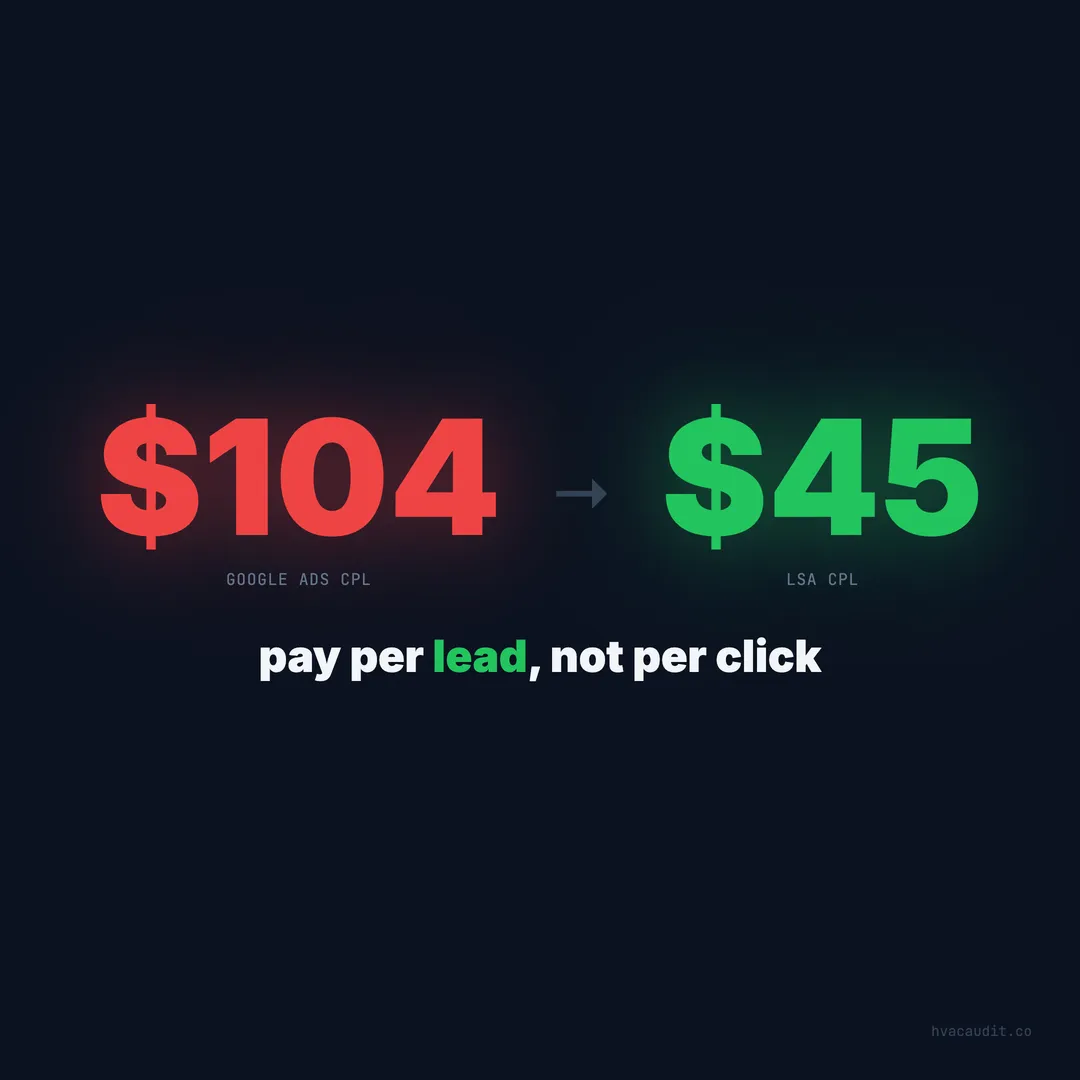
For the average HVAC contractor spending $5,000/month on traditional Google Ads and wasting 30% of it, LSAs offer a fundamentally different model: $45–$85 per verified lead with higher close rates because the Google Guaranteed badge pre-qualifies trust.
How LSAs differ from traditional Google Ads
The distinction matters because the entire cost structure changes. Traditional Google Ads charge per click — $6.84–$12.31 per click regardless of whether that click becomes a call, a lead, or a customer. At a 5% conversion rate, your true cost per lead is $137–$246.
LSAs charge per lead. A lead is defined as a phone call or message from someone actively looking for your service in your service area. You only pay when a real prospect contacts you. If a competitor calls, a spam caller dials in, or someone outside your area contacts you, you can dispute the charge and Google credits it back.
| Feature | Traditional Google Ads | Local Service Ads |
|---|---|---|
| Placement | Below LSAs | Above everything |
| Pricing model | Per click ($6.84–$12.31) | Per lead ($45–$85) |
| Trust signal | None built-in | Google Guaranteed badge |
| Landing page needed | Yes | No — calls from listing |
| Reviews visible | No | Yes — star rating shown |
| Background check | No | Required |
| Avg cost per lead | $104 | $45–$85 |
| Lead quality filter | You filter | Google pre-screens |
The Google Guaranteed badge is the most powerful trust signal in local search. When we studied how homeowners choose HVAC contractors, the green checkmark reduced decision-making time by 40%. Homeowners told us they felt “Google had already vetted this company” — which effectively is what the badge means.
What LSAs actually cost for HVAC
LSA pricing varies by market, service type, and competition density. But the range is narrower than traditional PPC because Google controls the pricing more tightly.
Average HVAC LSA cost per lead by market tier:
- Tier 1 (NYC, LA, Houston, Phoenix): $75–$85 per lead
- Tier 2 (Denver, Nashville, Charlotte): $55–$70 per lead
- Tier 3 (smaller metros, rural areas): $45–$60 per lead
At these rates, a contractor spending $2,000/month on LSAs generates 24–44 leads per month. Compare that to traditional Google Ads at $104/lead producing 19 leads for the same budget — with lower quality because PPC leads haven’t been pre-screened by the Google Guaranteed process.
The close rate on LSA leads runs 25–40% compared to 15–25% for traditional PPC leads. The Google Guaranteed badge, visible reviews, and direct-call format attract homeowners who are further along in their decision process. They’re not browsing — they’re booking.
When you factor in the higher close rate, the effective customer acquisition cost from LSAs drops to $113–$340 per customer compared to $350–$415 from traditional PPC. That’s a 20–70% reduction in what you pay to acquire each new customer.
The setup process filters out 40% of competitors
Getting approved for LSAs isn’t as simple as creating a Google Ads account. Google requires background checks, license verification, and insurance documentation. This is a feature, not a bug — the barrier to entry eliminates 40% of competitors who either can’t pass the checks or won’t bother with the paperwork.
The requirements for HVAC LSA approval:
- Business license verification (state and local)
- General liability insurance (minimum $500,000 in most states)
- Background checks for the business owner and all field employees
- Google Business Profile with at least a 3.0 star rating
- Proof of service area coverage
The background check process takes 2–4 weeks. Every technician who will be dispatched must pass an individual background check through Google’s third-party provider. New hires need to be added and verified before they can work on LSA-generated jobs.
Contractors who clear these hurdles face 40–60% less competition in the LSA pack compared to traditional PPC. In a market where 30 contractors bid on “AC repair near me” in Google Ads, only 12–18 may qualify for LSAs. Fewer competitors means lower costs and more lead volume per contractor.
Reviews are the ranking factor that matters most
LSA ranking is determined primarily by three factors: review count, review rating, and responsiveness. Unlike traditional Google Ads where you can outbid competitors, LSAs reward reputation.
The top-ranked LSA contractor in any market typically has 150+ reviews with a 4.7+ star rating. Contractors with fewer than 50 reviews rarely appear in the top three LSA spots — the positions that get 85% of all LSA clicks.
This creates a virtuous cycle for contractors who prioritize review generation. More reviews push you higher in LSA rankings. Higher rankings generate more leads. More leads become more completed jobs. More completed jobs create more review opportunities. The cycle compounds.
The responsiveness factor is equally critical. Google tracks how quickly you respond to LSA leads and whether you answer calls. Contractors who respond within 5 minutes rank higher than those who respond in hours. If you consistently miss calls or take more than 30 minutes to respond, Google pushes you down the ranking — and your cost per lead increases as your visibility drops.
Disputing bad leads recovers 10–20% of spend
One of the most underused features of LSAs is the lead dispute process. Google allows you to dispute any lead that doesn’t meet their quality standards — wrong service requested, wrong service area, spam calls, solicitations, or calls where nobody spoke.
The average HVAC contractor should be disputing 10–20% of LSA leads. Most contractors accept every charge, never realizing they’re paying for:
- Calls that lasted under 30 seconds (usually hangups or wrong numbers)
- Leads requesting services you don’t offer (plumbing calls to an HVAC listing)
- Leads from outside your defined service area
- Solicitation calls from vendors or marketing agencies
- Duplicate leads (same person calling twice)
Google’s dispute window is 30 days from the lead date. Set a weekly calendar reminder to review your LSA leads and dispute any that don’t meet quality standards. On a $3,000/month LSA budget, disciplined disputing saves $300–$600/month — or roughly 4–8 additional free leads.
Budget pacing controls what most contractors ignore
LSAs let you set a weekly budget, but the way Google spends that budget catches contractors off guard. Google can spend up to 2x your daily budget on high-demand days as long as the monthly total stays within bounds. During a heat wave, your entire weekly budget can be depleted by Tuesday.
Smart budget pacing means:
- Setting your budget based on your answering capacity, not just what you can afford
- If you can handle 8 new leads per day, budget accordingly (8 × $65 = $520/day)
- Pausing LSAs on days when you’re fully booked to preserve budget for days when you need work
- Increasing budget before seasonal peaks (May–June for AC, October–November for heating)
43% of HVAC LSA contractors run out of budget before Thursday each week. They’re invisible for the last three days of every week — losing leads to competitors who paced their budgets or increased them for seasonal demand.
The marketing budget allocation for LSAs should be treated separately from traditional PPC. Most successful contractors run both channels simultaneously but allocate 40–60% of paid search budget to LSAs because of the lower CPL and higher close rate.
The Google Guaranteed badge converts trust into calls
When we audited 147 HVAC websites, we found the average site score was 34 out of 100 and the average load time was 18.4 seconds. Most contractor websites fail to establish trust — no reviews, no licensing info, no pricing transparency. The Google Guaranteed badge bypasses all of that.
The badge tells homeowners three things:
- Google has verified this contractor’s license and insurance
- Google has run background checks on the business owner and employees
- If you’re not satisfied with the work, Google will refund up to $2,000
That third point is the closer. The $2,000 money-back guarantee from Google eliminates the primary fear homeowners have when hiring an unknown contractor: “What if they do bad work?” It’s the most powerful trust signal in local services — more effective than BBB accreditation, manufacturer certifications, or even a 5-star review average.
Contractors who earned the Google Guaranteed badge report 15–25% higher booking rates on LSA leads compared to their traditional PPC leads. The badge does the trust-building work that most HVAC websites fail to do.
Combining LSAs with PPC creates a domination strategy
The most effective paid search strategy for HVAC isn’t LSAs or PPC — it’s both. When a homeowner searches “AC repair near me,” seeing your company in the LSA pack AND in the PPC results below it creates a psychological effect called the double-serve advantage.
Contractors who appear in both LSAs and PPC see a 20–30% increase in total click-through rate compared to appearing in just one. The homeowner sees the brand name twice, which builds familiarity and trust. If they skip the LSA listing and scroll to PPC, your brand is there again. If they skip PPC and go to organic, a well-optimized Google Business Profile puts you in the map pack too.
The budget split that works for most HVAC contractors is 50–60% LSA, 30–40% PPC, 10% remarketing. LSAs handle high-intent leads at lower cost. PPC captures searches LSAs don’t cover (specific service pages, brand terms, long-tail keywords). And remarketing brings back the 95% of visitors who didn’t convert on the first touch.
Mistakes that disqualify you or tank your ranking
Missing calls drops your ranking within days. Google monitors your answer rate on LSA leads. If you miss more than 20% of incoming LSA calls, your ranking drops. Use an overflow answering service to ensure every LSA call gets answered live.
Slow response to messages kills lead quality. LSA messages that go unanswered for more than 4 hours are marked as “missed” in Google’s system. Set up instant notifications and respond to every message within 15 minutes.
Failing to request reviews after LSA jobs stalls growth. Google sends automated review requests for LSA-completed jobs, but only if you mark leads as “booked” in the LSA dashboard. 47% of contractors never update lead status — which means Google can’t send review requests, reviews don’t accumulate, and rankings stagnate.
Not updating your service types limits lead volume. LSAs let you select specific services (AC repair, furnace installation, duct cleaning). Contractors who select all applicable service types see 30–50% more lead volume than those who only select their primary services.
The contractors who treat LSAs as a set-and-forget channel see diminishing returns within 3–6 months. The ones who actively manage reviews, responsiveness, disputes, and budget pacing maintain or improve their cost per lead over time — making LSAs the most efficient lead source for HVAC contractors in 2026.
Keep reading
Want to know your score?
Drop your URL — full report in 48 hours.
We're on it.
Report in your inbox within 48 hours.