ServiceTitan vs Jobber vs Housecall Pro: The Real Cost
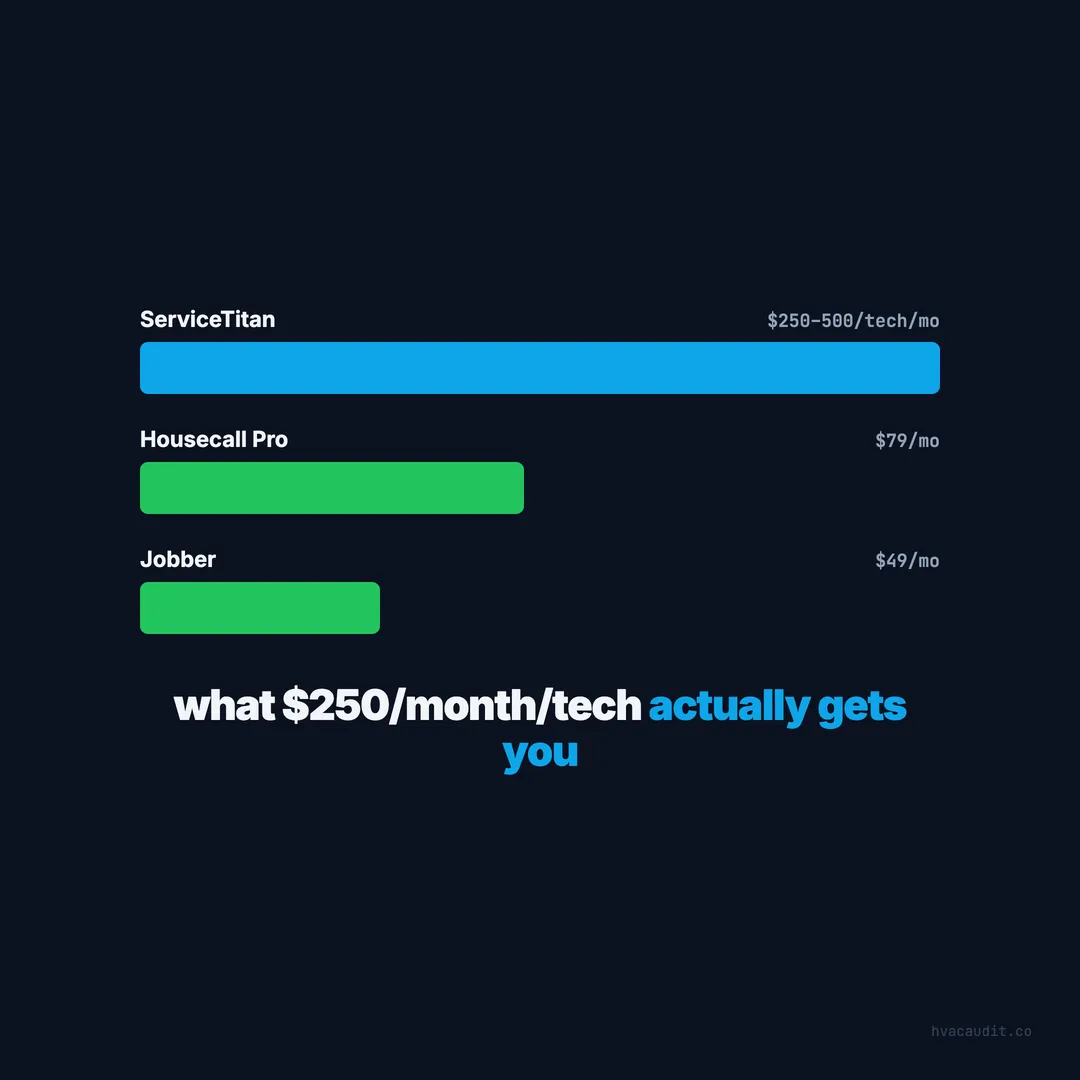
ServiceTitan costs $250-500/tech/month with $5K-50K setup. Jobber starts at $39/month. Here's what each CRM actually delivers — and which one fits your operation.
A three-truck HVAC company in Charlotte signs up for ServiceTitan after a convincing demo. The setup fee is $12,000. The monthly cost is $750 ($250/tech). Four months later, the owner realizes nobody on his team uses half the features, the integration with his existing accounting software doesn’t work properly, and he’s paying $9,000/year for a tool that his $39/month Jobber subscription used to handle.
He’s not alone. CRM adoption in the HVAC industry has reached 67%, but only 31% of companies report being “satisfied” with their current platform. The problem isn’t the software — it’s the mismatch between what a company needs and what they’re paying for.
HVAC companies that use a CRM effectively see 47% higher customer retention compared to those managing customer data in spreadsheets, notebooks, or not at all. The CRM itself isn’t optional. But paying $250-$500/tech/month when your operation needs a $49/month tool is a margin killer for a company that’s already operating at 2.5-5% net profit.
This is the honest comparison. No affiliate links. No sponsored endorsements. Just data on what each platform costs, what it does, and which size operation it actually fits.
The three dominant HVAC CRMs and their real costs
ServiceTitan
Who it’s built for: Mid-size to large HVAC companies with 10+ technicians, $2M+ revenue, and a dedicated office team.
Real costs:
- Monthly: $245-$500 per technician per month
- Setup: $5,000-$50,000 (depending on integrations, data migration, and training)
- Annual minimum: approximately $30,000-$60,000 for a 10-tech operation
- Hidden costs: custom integrations ($2,000-$10,000), additional modules ($50-$200/month each), API access fees
What you actually get:
- Full dispatching and scheduling with drag-and-drop board
- Pricebook management with flat-rate pricing templates
- Marketing scorecards and ROI tracking by campaign
- Customer financing integration (GreenSky, Synchrony)
- Automated review requests post-job
- Call tracking and recording (additional cost)
- Comprehensive reporting dashboard
- Mobile app for technicians (estimates, invoices, photos, signatures)
- Inventory management
- Payroll integration with ADP, Gusto
The honest assessment: ServiceTitan is the most powerful HVAC CRM on the market. It’s also the most expensive and the most complex. The average ServiceTitan implementation takes 3-6 months before the team is proficient. Companies with fewer than 8-10 techs consistently report that the complexity and cost aren’t justified by the feature set they actually use.
The ROI threshold: To justify ServiceTitan’s cost, a company needs to generate at least $180,000-$250,000 in revenue per technician per year. Below that, the software cost as a percentage of revenue becomes unjustifiable.
Jobber
Who it’s built for: Small to mid-size HVAC companies with 1-15 technicians who need simplicity and speed.
Real costs:
- Core plan: $39/month (1 user)
- Connect plan: $119/month (up to 5 users)
- Grow plan: $239/month (up to 15 users)
- Setup: $0-$500 (self-service onboarding, optional paid training)
- Annual minimum: $468-$2,868
What you actually get:
- Job scheduling and dispatching
- Customer management and communication
- Quotes and invoicing
- Online booking
- Automated follow-up messages
- GPS tracking
- Basic reporting
- Client hub (customer portal)
- QuickBooks and Xero integration
- Two-way texting
The honest assessment: Jobber is the best value CRM for companies with 1-10 technicians. It does 80% of what ServiceTitan does at 15-20% of the cost. Average setup time is 1-2 weeks. The trade-off: less granular reporting, no built-in pricebook management, and limited marketing analytics.
The sweet spot: HVAC companies doing $200,000-$1.5M in annual revenue get the highest ROI from Jobber. At this size, the tool handles everything needed without the overhead of enterprise features nobody uses.
Housecall Pro
Who it’s built for: Small to mid-size HVAC companies who want more features than Jobber without ServiceTitan’s complexity.
Real costs:
- Basic plan: $65/month (1 user)
- Essentials plan: $169/month (up to 5 users)
- MAX plan: Custom pricing (~$250-$400/month for 5-15 users)
- Setup: $0-$1,000 (some onboarding costs for MAX)
- Annual minimum: $780-$4,800
What you actually get:
- Scheduling and dispatching
- Estimates and invoicing with digital signatures
- Customer financing integration (Wisetack)
- Automated marketing (email campaigns, postcards)
- Online booking and review management
- QuickBooks integration
- Real-time GPS tracking
- Price book (Essentials and MAX)
- Reporting and analytics
- Instapay (next-day direct deposit)
The honest assessment: Housecall Pro sits between Jobber and ServiceTitan in both price and capability. Its strongest differentiation is built-in marketing automation — automated review requests, email campaigns, and postcard mailers. Average setup time is 2-4 weeks. The trade-off: reporting is less robust than ServiceTitan, and the mobile app occasionally lags behind in feature parity.
The sweet spot: HVAC companies doing $500,000-$3M with 3-15 technicians who want marketing automation built into their CRM rather than running separate tools.
The features that actually move the needle for HVAC companies
Not every CRM feature matters equally. Based on the data, here are the features with the highest ROI:
Automated review requests (+47% review velocity)
After every completed job, the CRM sends an automated text or email asking for a Google review. HVAC companies using automated review requests generate 47% more reviews per month than those relying on manual requests.
- ServiceTitan: Built-in, highly customizable
- Jobber: Built-in (basic)
- Housecall Pro: Built-in, with follow-up sequences
This single feature pays for any of these CRMs. More reviews mean better Google Business Profile rankings, which means more Map Pack visibility, which means more leads.
Unsold estimate follow-up (+23% close rate)
Most HVAC companies send an estimate and wait. 68% of unsold HVAC estimates are never followed up on. CRM automation changes that — sending reminders at 48 hours, 7 days, and 30 days after the initial estimate.
- ServiceTitan: Fully automated with customizable sequences
- Jobber: Automated follow-up reminders
- Housecall Pro: Automated with pre-built templates
HVAC companies using automated estimate follow-up close 23% more estimates. On a company sending 50 estimates per month at $3,000 average ticket, that’s an additional 11.5 jobs — $34,500/month in recovered revenue.
Speed to lead optimization
CRM systems with instant dispatch and automated customer communication reduce response time from hours to minutes. The contractor who responds in under 5 minutes wins the job 78% of the time. Without a CRM, most calls go to voicemail during busy periods.
- ServiceTitan: Real-time dispatch board, automated SMS to customer on dispatch
- Jobber: Dispatch with automated booking confirmations
- Housecall Pro: Online booking with instant confirmation
Customer history and lifetime value tracking
Knowing that a customer has spent $12,000 with you over 5 years changes how you handle their call. CRM systems that track customer history, equipment installed, maintenance schedules, and total spend enable:
- Priority scheduling for high-value customers
- Proactive maintenance reminders (revenue generator)
- Equipment replacement timing based on install date
- Personalized service that builds retention
HVAC companies tracking customer lifetime value retain customers 34% longer than those that treat every call as a one-time transaction.
The integration question: does your CRM talk to everything else?
A CRM that doesn’t integrate with your accounting software, payment processing, and marketing tools creates data silos that waste time. The average HVAC office manager spends 6-8 hours per week on manual data entry when systems don’t integrate.
Key integrations by platform:
| Integration | ServiceTitan | Jobber | Housecall Pro |
|---|---|---|---|
| QuickBooks | Yes | Yes | Yes |
| Xero | Limited | Yes | No |
| Google Ads | Yes (built-in tracking) | Via Zapier | Via Zapier |
| Google Business Profile | Limited | Limited | Yes (review management) |
| Customer financing | GreenSky, Synchrony | Wisetack | Wisetack |
| Call tracking | Built-in | Via integration | Via integration |
| Email marketing | Built-in | Via integration | Built-in |
| Payment processing | Built-in (Pantheon) | Built-in | Built-in (Instapay) |
ServiceTitan has the most native integrations but charges for many of them. Jobber and Housecall Pro rely more on Zapier and third-party connectors, which adds $20-$50/month but provides more flexibility.
The integration that matters most: accounting software sync. If your CRM doesn’t push invoices and payments directly to QuickBooks, you’re duplicating every transaction. At 100+ jobs per month, that’s 10-15 hours of wasted labor.
Call tracking and marketing ROI
Your marketing budget is probably your second-largest expense after labor. Knowing which marketing channels produce jobs — not just clicks or calls — requires CRM-level tracking.
ServiceTitan’s marketing scorecards track revenue back to individual marketing channels. You can see: Google Ads produced $43,000 in revenue, SEO produced $28,000, HomeAdvisor produced $12,000. This level of attribution requires ServiceTitan’s call tracking add-on ($200-$400/month additional).
Jobber and Housecall Pro don’t offer this natively. You need separate call tracking (CallRail at $45-$145/month) and manual source tagging. It works, but it requires discipline from whoever answers the phone.
The companies that track marketing ROI at the CRM level spend 22% less on marketing while generating the same lead volume — because they cut channels that don’t produce and double down on channels that do. Without this tracking, you’re guessing with $48,000-$72,000/year.
The implementation reality check
ServiceTitan implementation:
- Timeline: 3-6 months to full adoption
- Training required: 20-40 hours for office staff, 8-16 hours for technicians
- Ongoing training: Monthly for new features
- Dedicated admin needed: Yes (part-time minimum)
- Failure rate: approximately 25% of implementations don’t reach full adoption within 12 months
Jobber implementation:
- Timeline: 1-2 weeks to full adoption
- Training required: 4-8 hours for office staff, 2-4 hours for technicians
- Ongoing training: Minimal
- Dedicated admin needed: No
- Failure rate: approximately 8% don’t reach full adoption
Housecall Pro implementation:
- Timeline: 2-4 weeks to full adoption
- Training required: 8-16 hours for office staff, 4-8 hours for technicians
- Ongoing training: Quarterly for new features
- Dedicated admin needed: No (but helpful)
- Failure rate: approximately 12% don’t reach full adoption
The most expensive CRM is the one your team doesn’t use. A $39/month tool that everyone uses daily produces more value than a $250/month/tech tool that sits idle.
The maintenance agreement CRM advantage
All three platforms handle maintenance agreements, but the depth varies significantly:
ServiceTitan: Full membership management with automated renewal, visit scheduling, membership-specific pricing tiers, and revenue reporting by membership type. The most comprehensive membership management in the industry.
Housecall Pro: Recurring service plans with automated scheduling and payment processing. Solid for standard maintenance agreements. Less flexible for complex multi-tier programs.
Jobber: Basic recurring job scheduling. Maintenance plans require more manual management. Works for simple annual or bi-annual service plans.
The CRM’s role in maintenance agreements extends beyond scheduling. It’s the difference between a tech who walks into a maintenance visit cold and one who sees: “This customer has been a member for 3 years, has a 2019 Trane XR15, last visit found corroded evaporator coil — check status.” That context creates better service and better upsell opportunities.
The decision framework
Choose Jobber if:
- You have 1-10 technicians
- Revenue is under $1.5M
- You need to be up and running this week
- Budget is a primary concern
- You want simplicity over features
Choose Housecall Pro if:
- You have 3-15 technicians
- Revenue is $500K-$3M
- Marketing automation matters to you
- You want built-in review management
- You can invest 2-4 weeks in setup
Choose ServiceTitan if:
- You have 10+ technicians
- Revenue exceeds $2M
- You need granular marketing attribution
- You have dedicated office staff to manage the platform
- You can invest $5,000-$50,000 in implementation and 3-6 months in training
The worst choice is the one that doesn’t match your operation. A two-truck company on ServiceTitan is overpaying. A 15-truck company on the basic Jobber plan is under-tooled. Match the tool to the operation, not the sales pitch.
Keep reading
Want to know your score?
Drop your URL — full report in 48 hours.
We're on it.
Report in your inbox within 48 hours.