Angi, Thumbtack, HomeAdvisor: The $1,400-Per-Job Trap You Can't Quit
HomeAdvisor was fined $7.2M by the FTC for selling fake leads. Angi charges $1,400+ per booked job. Yet HVAC contractors keep paying. Here's the real math — and what to do instead.
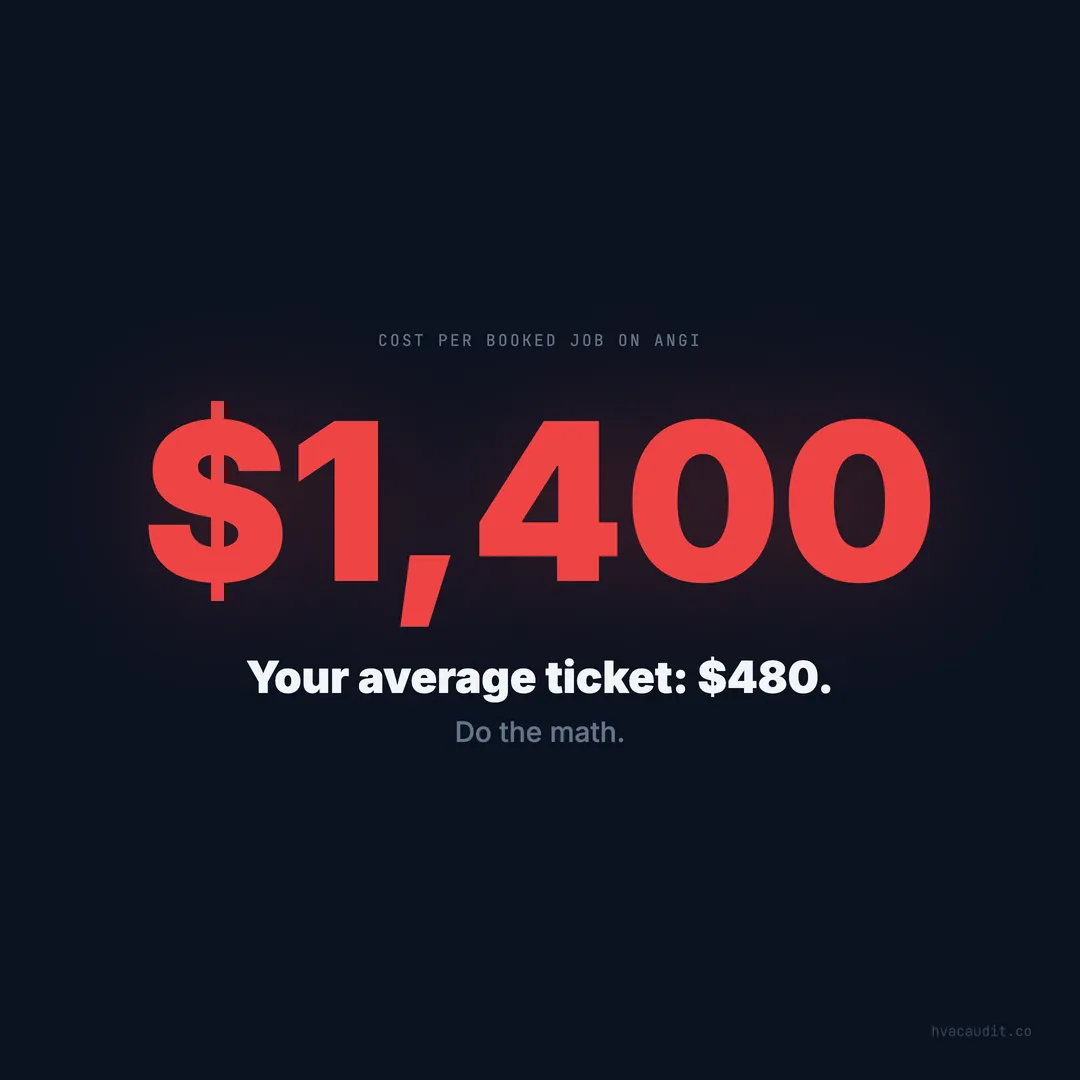
An HVAC contractor signs up for Angi Leads. The salesperson promises “high-intent homeowners in your area.” The first month, he gets 22 leads at $75 each — $1,650 total. Of those 22 leads, 8 answer the phone. Of those 8, 3 book an appointment. Of those 3, 1 actually becomes a paying customer.
His cost per booked job: $1,650. His average ticket: $480. He just paid $1,650 to earn $480.
He calls Angi to complain. They credit him for 3 “bad leads” and tell him his close rate needs improvement. He signs up for another month because he doesn’t know where else to get leads.
The average cost per booked job on Angi Leads exceeds $1,400. And this is after the FTC fined HomeAdvisor (Angi’s predecessor) $7.2 million for selling leads that were fabricated, recycled, or from consumers who never requested service.
The lead gen platform math doesn’t work for HVAC
The fundamental problem with lead gen platforms isn’t the cost per lead — it’s the cost per customer. Lead gen companies advertise their cost per lead ($30–$150 depending on the service category), but the conversion rate from lead to paying customer is where the economics fall apart.
| Platform | Avg cost per lead | Answer rate | Booking rate | True cost per job |
|---|---|---|---|---|
| Angi Leads | $75–$150 | 40–50% | 15–25% | $1,200–$1,800 |
| Thumbtack | $15–$85 | 30–40% | 10–20% | $400–$850 |
| HomeAdvisor (legacy) | $50–$200 | 35–45% | 10–15% | $1,000–$2,000 |
| Google Ads (comparison) | $6–$12 per click | 60–70% | 25–35% | $250–$500 |
| Google Business Profile | $0 | 70–80% | 40–60% | $0–$125 |
The reason the true cost is so high: lead gen leads are shared. When a homeowner requests a quote on Angi, that lead goes to 3–4 contractors simultaneously. You’re not the only one calling. By the time you reach the homeowner, they may have already booked with the contractor who called first — and you still paid for the lead.
Speed to lead matters enormously. 30% of HVAC calls go unanswered during peak season. If you’re buying leads from Angi and your office can’t answer the phone within 5 minutes, you’re paying $75–$150 for a lead that your competitor converts.
The FTC fine tells you everything you need to know
In 2022, the FTC fined HomeAdvisor (now Angi Leads) $7.2 million for deceptive practices including selling leads generated from consumers who never requested home services, misrepresenting the quality and source of leads, and charging contractors for leads that didn’t meet promised criteria.
The FTC found that HomeAdvisor had been selling “leads” that were actually generated from sweepstakes entries, survey responses, and other sources where the consumer never expressed interest in hiring a contractor. Contractors were paying premium prices for leads from people who didn’t want their services.
Angi Leads continues to operate under a different brand name, but the business model — charging contractors per lead with no guarantee of quality — hasn’t fundamentally changed. The leads are real now (the FTC order requires it), but the economics are still brutal.
Why contractors stay on platforms that lose money
The reason is psychological, not financial. Lead gen platforms provide a tangible input — the phone rings. For contractors who don’t have other lead sources, that ringing phone feels like the business is working, even when the math says otherwise.
Three traps keep contractors paying:
The sunk cost trap. “I’ve already spent $3,000 this month. If I quit now, I lose all that investment.” The $3,000 is gone regardless. Continuing to spend doesn’t recover it.
The attribution trap. Lead gen companies count every lead they send, including ones that don’t answer, don’t book, or were going to find you anyway through Google. The “47 leads delivered” metric looks great in a monthly report. The “2 paying customers” metric doesn’t.
The alternative gap. Most contractors on lead gen platforms don’t have strong organic lead sources. Their website scores 34/100, their Google Business Profile is half-complete, and they have 18 reviews. They stay on Angi because they don’t know how to replace those leads with cheaper ones.
What to spend that money on instead
The $1,650/month going to Angi Leads could fund the entire infrastructure needed to generate organic leads at 1/10th the cost.
Google Business Profile optimization: $0. A complete GBP with photos, Q&A, regular posts, and a review generation system generates leads at effectively zero cost. 44% of all local clicks go to the Map Pack. If your profile is complete and has 100+ reviews, you’re capturing leads that would otherwise go to Angi.
Google Ads (self-managed or agency): $1,000–$2,000/month. At an average CPC of $8–$12 and a 25–30% conversion rate, Google Ads produces customers at $250–$500 per acquisition — 3x cheaper than Angi. And unlike Angi, Google Ads leads aren’t shared with competitors.
Website fixes: one-time $2,000–$5,000. The 7 fixes that get your phone ringing — click-to-call, speed optimization, pricing page, reviews on site, after-hours messaging — convert more of the traffic you’re already getting. This investment pays back every month, across every channel.
SEO: $1,000–$2,000/month. Organic search leads convert at 30–40% and cost a fraction of paid leads over time. Within 6–12 months, a basic SEO investment produces leads at $50–$150 per customer — 10x cheaper than Angi.
The total cost to replace $1,650/month in Angi spend: approximately $2,000–$3,500/month across Google Ads, SEO, and website improvements. Within 6 months, the organic channels start producing leads at $100–$200 per customer, and the total cost drops while lead quality increases.
The exit plan
Quitting cold turkey creates a lead gap. Here’s the transition:
- Month 1–2: Keep Angi at current spend. Simultaneously optimize your Google Business Profile, fix your website speed and conversion elements, and launch Google Ads.
- Month 3–4: Reduce Angi spend by 50%. Your organic leads and Google Ads should be producing 5–10 leads/month by now.
- Month 5–6: Cancel Angi entirely. Your organic pipeline should match or exceed what Angi was producing — at a fraction of the cost.
- Ongoing: Reinvest the savings into review generation and content that compounds over time.
The lead gen trap works because the alternative feels harder
Paying Angi $1,650/month is easy. Building an organic lead machine takes work — optimizing your GBP, generating reviews, fixing your website, and running ads that you actually track.
But the math is clear. The contractor paying $1,400 per customer on Angi and the contractor paying $125 per customer on organic search don’t have different levels of skill. They have different levels of infrastructure. The second one built the infrastructure. The first one is still renting leads from a company that was fined $7.2 million for selling fake ones.
The phone ringing isn’t the goal. Profitable customers are.
Keep reading
Want to know your score?
Drop your URL — full report in 48 hours.
We're on it.
Report in your inbox within 48 hours.