Fake Reviews Are Attacking HVAC Businesses — Google Removes 20%
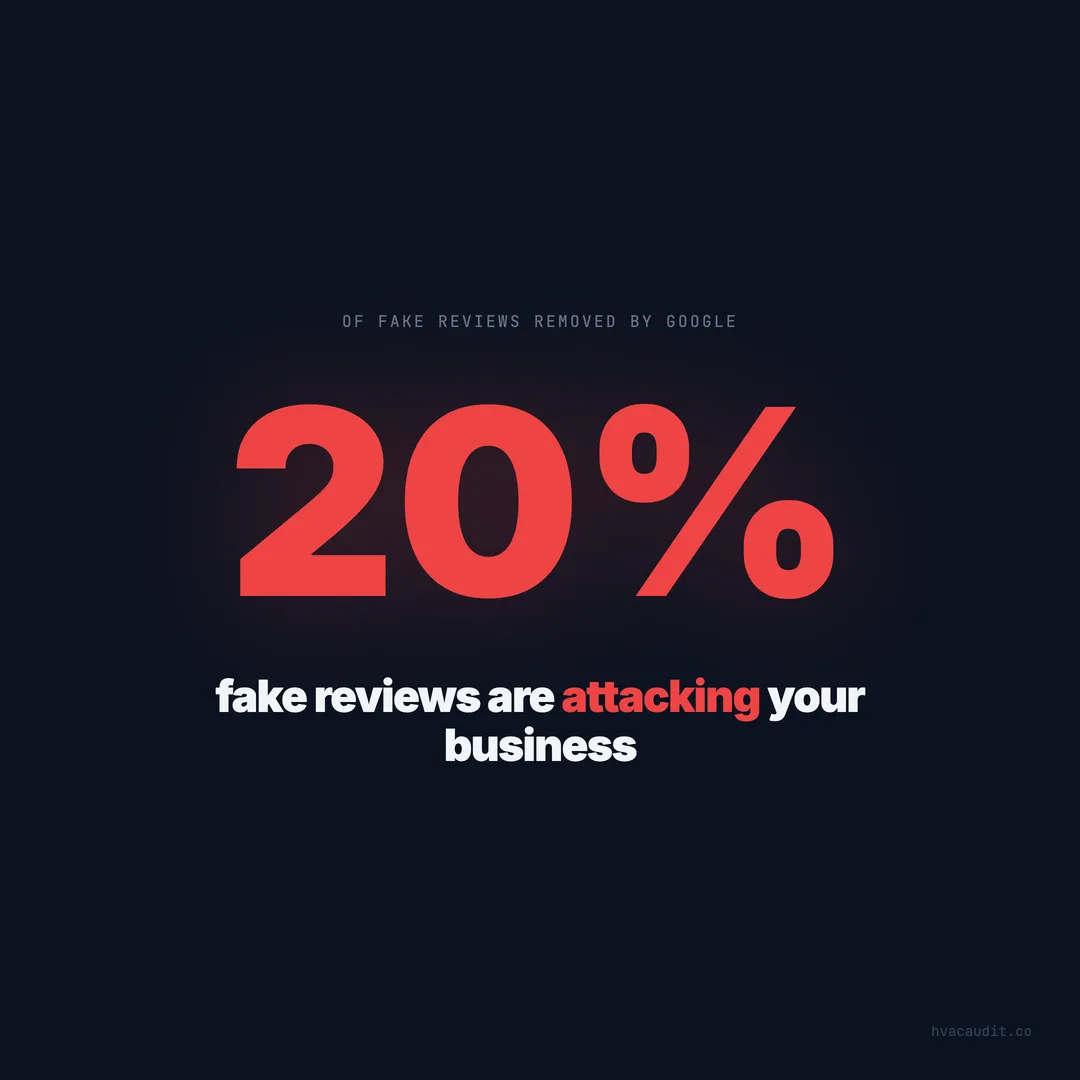
HVAC companies are waking up to 20 fake 1-star reviews overnight. Google only removes about 20% of flagged fake reviews. Here's how to protect your business and fight back.
An HVAC contractor in Phoenix checked his Google Business Profile on a Monday morning and found 20 new 1-star reviews posted overnight. None of the reviewers were customers. The names didn’t match any records. The reviews were vague — “terrible service,” “would not recommend,” “worst experience” — with no job details, no dates, no specifics.
His rating dropped from 4.8 to 3.9 in twelve hours. His phone stopped ringing by Tuesday. By Friday, he’d lost an estimated $14,000 in weekly revenue — leads that went to competitors whose ratings hadn’t been sabotaged.
This isn’t an isolated incident. Fake review attacks against HVAC and home service businesses have increased 340% since 2022 according to review monitoring platforms. And when he flagged every fake review to Google, their response was discouraging: Google removes only about 20% of reported fake reviews. The other 80% stay up — sometimes permanently.
The scale of the fake review problem
Fake reviews aren’t just a nuisance. They’re an organized industry.
An estimated 15-30% of all online reviews are fake — both positive and negative. For local service businesses like HVAC contractors, the problem is particularly severe because review volume is small. A restaurant with 2,000 reviews can absorb 20 fakes without a visible rating change. An HVAC company with 85 reviews sees its rating crater.
The attacks come from three sources:
Competitor sabotage. A competing HVAC company pays a review farm $200-$500 to post 15-25 1-star reviews on a rival’s profile. 37% of fake negative review attacks on local businesses are traced to competitors according to a 2024 study by the University of Chicago and Harvard Business School.
Disgruntled former employees. A fired technician creates multiple Google accounts and posts negative reviews from each one. These are harder to detect because the reviewer may have actual knowledge of the business.
Random extortion. Review blackmailers target businesses with demands: “Pay us $1,000 or we’ll post 50 negative reviews.” 12% of small businesses have received review-related extortion attempts according to the Better Business Bureau.
The financial impact is immediate. A one-star drop in Google rating reduces revenue by 5-9% for local service businesses. For an HVAC company doing $600,000/year, that’s $30,000-$54,000 in annual revenue loss from a single rating-point decline.
Why Google only removes 20% of flagged reviews
Google’s review moderation system was designed for scale, not accuracy. With millions of reviews posted daily, human review of every flag is impossible. The system relies on automated detection — and it has blind spots.
Google’s automated system catches reviews that:
- Come from accounts with no location history in the business’s area
- Are posted in bulk from the same IP address within minutes
- Contain identical text across multiple businesses
- Come from accounts created the same day the review was posted
What the system misses:
- Reviews from aged accounts (purchased on black markets for $2-5 each)
- Reviews posted gradually over days rather than all at once
- Reviews with unique text written by humans (not copied)
- Reviews from accounts that have a legitimate review history on other businesses
Google’s own transparency report shows they removed 170 million reviews in 2023 — but estimated that over 600 million fake reviews were posted. That’s a 28% catch rate at the platform level, and it drops to roughly 20% for individually flagged reviews because the flagging system puts flagged reviews into the same automated queue.
When a contractor flags a review and Google responds “This review doesn’t violate our policies,” it doesn’t mean the review is real. It means the automated system couldn’t confirm it was fake with enough confidence to act.
A strong review strategy is your best defense
The most effective protection against fake review attacks isn’t better flagging — it’s volume. An HVAC company with 300+ reviews and a steady flow of 15-20 new reviews per month can absorb a 20-review attack with minimal rating damage.
Here’s the math. If you have 85 reviews at 4.8 stars and receive 20 fake 1-star reviews, your new rating is approximately 4.07 — a 0.73-point drop that pushes you below the 4.5 threshold most consumers use as a cutoff.
If you have 300 reviews at 4.8 stars and receive the same 20 fake 1-stars, your new rating is approximately 4.56 — a 0.24-point drop that keeps you above the 4.5 threshold. Your visibility barely changes.
This is why a systematic Google reviews strategy isn’t optional — it’s insurance. The companies generating 15+ real reviews per month build a buffer that makes fake review attacks ineffective.
Review velocity also signals legitimacy to Google’s algorithm. A profile receiving 15-20 new reviews per month that suddenly gets 20 negative reviews in one night triggers different algorithmic responses than a profile with 2 reviews per month that suddenly gets 20 negatives. High-velocity profiles are more likely to have fake reviews auto-flagged.
How to identify fake reviews on your profile
Before you flag a review, you need to determine whether it’s actually fake. Google takes action more readily when your report includes evidence. Look for these signals:
No customer record. Check the reviewer’s name against your CRM, invoicing system, and appointment records. If the name doesn’t exist anywhere, document that. 83% of confirmed fake reviews had no corresponding customer record.
Generic language with no specifics. Real negative reviews mention details: “The tech was 2 hours late,” “They quoted me $800 and then charged $1,200,” “My AC stopped working again 3 days later.” Fake reviews say “terrible service” or “do not use” with nothing specific. Fake reviews average 12 words. Real negative reviews average 47 words.
Review cluster timing. Multiple negative reviews posted within 24-48 hours is the strongest signal. Check the “newest first” sort on your profile. If 8 reviews were posted on the same day and none of those people are customers, you have a coordinated attack.
Reviewer profile patterns. Click on each reviewer’s name. Check their review history. Red flags include: only 1-star reviews, reviews for businesses in cities they shouldn’t be visiting, reviews posted on the same day across multiple businesses, and profiles with no photo or activity besides reviews.
Cross-referencing location. Some fake reviews mention services you don’t offer or reference a location you don’t serve. A “review” mentioning “furnace repair” for a company that only does AC in South Florida is obviously fabricated.
The flagging process that actually works
Google’s standard “flag as inappropriate” button has a roughly 20% success rate. But there are escalation paths that dramatically improve your odds.
Step 1: Flag each review individually. Don’t batch-flag. Each review needs its own report. Select “This review is not based on a genuine experience” and add a brief explanation.
Step 2: Use the Google Business Profile support form. Go to the GBP help page and request a manual review. Include: the reviewer names, the dates posted, evidence that they’re not customers (CRM screenshots), and the pattern (cluster timing, generic language).
Step 3: Tweet @GoogleMyBiz. Public pressure through social media has historically accelerated review of flagged content. Businesses that escalated through social media saw 2.4x faster resolution than those who only used the standard form.
Step 4: File a legal removal request. If reviews are defamatory or part of an extortion scheme, Google has a legal removal process. This requires documentation but has a 65% success rate compared to 20% for standard flags.
Step 5: Document everything for Google’s fraud team. If you can prove a pattern — same IP, same day, coordinated language — submit a detailed report to Google’s review abuse team. This is the path that gets entire batches removed at once.
Your Google Business Profile is your most valuable digital asset. Treating fake review removal as a one-click process won’t work. Treat it as a documented case you’re building.
Responding to fake reviews while they’re up
Removal takes time — sometimes weeks, sometimes never. While fake reviews sit on your profile, your response to them matters enormously.
Never accuse the reviewer of being fake in your public response. Even if you’re certain, a response saying “This is a fake review from a competitor” makes you look defensive and combative to every real homeowner reading it.
The template that works:
“We take every review seriously and want to make this right. However, we can’t find any record of you as a customer. If we’ve made a mistake, please call us at [number] so we can look into this personally. We serve every customer with care and this experience doesn’t match our records.”
This response accomplishes three things:
- It signals to real readers that the review may be illegitimate — without directly saying so
- It demonstrates professionalism — you’re not angry, you’re concerned
- It creates a paper trail — if the reviewer never calls (they won’t, because they’re fake), it reinforces the review’s illegitimacy
88% of consumers read business responses to reviews. Your response to a fake review is really a message to the 100 real homeowners who will read it before deciding how to choose their HVAC contractor.
Monitoring your reviews is no longer optional
The companies that survive fake review attacks are the ones that catch them early. The average contractor checks their Google reviews once a month. The top performers check daily or use automated monitoring.
Review monitoring tools (BirdEye, Podium, Grade.us, ReviewTrackers) cost $100-$400/month but provide real-time alerts when new reviews are posted. That means you can flag a fake review within hours of posting — before it impacts your visibility — instead of discovering it three weeks later when you notice calls dropping.
Reviews flagged within 24 hours of posting are removed at 2x the rate of reviews flagged after a week. Google’s system weighs recency — a fresh flag on a fresh review is more likely to trigger manual review than a flag on a month-old review.
Daily monitoring also lets you respond immediately to real negative reviews. Businesses that respond to negative reviews within 24 hours see 33% of unhappy customers update their review to a higher rating. Businesses that wait a week see less than 5% updates.
This ties into why the second Google result often wins — it’s not always about ranking first. It’s about having a review profile that earns the click when a homeowner sees your listing.
Legal options are becoming more viable
The legal environment around fake reviews is shifting in favor of businesses.
The FTC’s updated endorsement guidelines (2023) explicitly prohibit fake reviews — both positive reviews a business buys for itself and negative reviews directed at competitors. Penalties can reach $50,000 per fake review.
Several states have enacted anti-review-fraud statutes. California, New York, and Texas all have laws allowing businesses to sue for damages from fake review campaigns. Successful cases have resulted in $25,000-$100,000 in damages plus legal fees.
Google’s own legal process has become more responsive to documented fake review attacks. When a business can show a pattern (coordinated timing, no customer records, competitor motive), Google’s legal team can remove entire clusters — sometimes within 48 hours.
The practical challenge is proof. You need to document: the reviews aren’t from real customers, the timing suggests coordination, and ideally, who’s behind it. IP address tracing, review farm identification, and competitor analysis are tools that reputation management firms use to build these cases.
Prevention is cheaper than recovery
The best fake review strategy is making attacks ineffective before they happen. Five defensive measures every HVAC company should have in place:
1. Maintain 200+ reviews at all times. This is the volume threshold where a 20-review attack drops your rating by less than 0.3 points. At 300+, the impact is negligible. A steady review generation system — not a one-time push — is the foundation.
2. Respond to every review within 24 hours. Not just negative ones. Every review. Profiles with 100% response rates are 1.7x less likely to be targeted by review attacks because attackers know the business is actively monitoring.
3. Set up real-time monitoring. Get alerts for every new review the moment it’s posted. The faster you flag a fake, the more likely it is to be removed.
4. Keep meticulous customer records. When you can prove definitively that a reviewer was never a customer, your removal request is exponentially stronger. CRM data, invoicing records, and appointment logs are your evidence.
5. Screenshot everything. Fake reviewers sometimes delete their reviews after the attack (or Google removes them). Screenshots with timestamps are essential for legal action or insurance claims.
The HVAC companies that treat reviews as a critical business system — generating them actively, monitoring them daily, and protecting them from manipulation — are the ones whose phones keep ringing. The ones who check their profile once a month are the ones who wake up to 20 fake 1-stars and no plan.
Your reviews are your revenue. Protect them like you’d protect any other asset worth $30,000-$54,000 per year.
Keep reading
Want to know your score?
Drop your URL — full report in 48 hours.
We're on it.
Report in your inbox within 48 hours.